Meta Lead Ads: How to Get Quality Leads from Facebook and Instagram
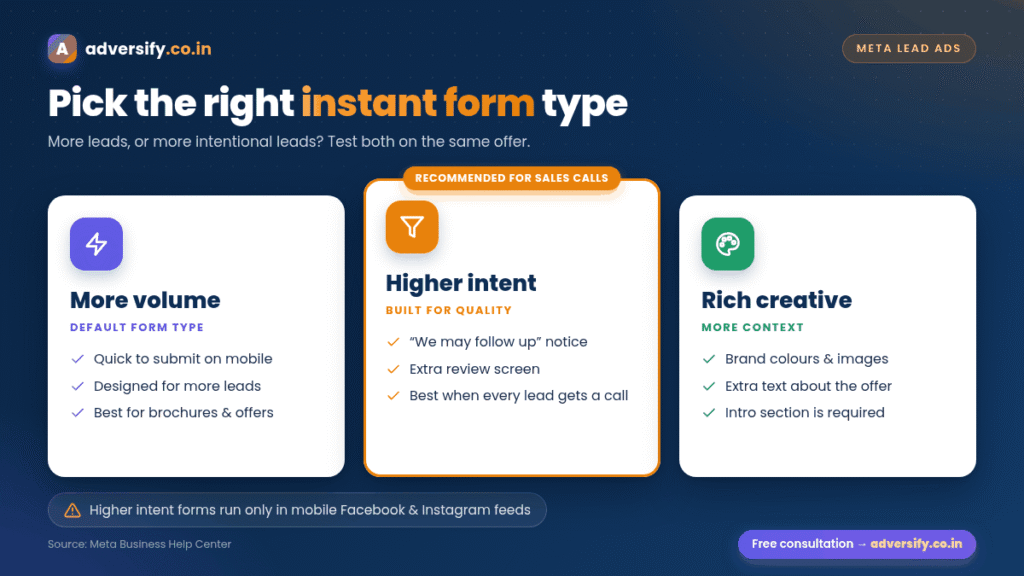
How to run Meta lead ads that bring quality leads: the Leads objective, more volume vs higher intent instant forms, qualifying questions, CRM sync and fast follow-up, the Conversions API and qualified leads goal, creative and audience basics, common mistakes and a launch checklist.
Google Ads Conversion Tracking: How to Set It Up Correctly (Step-by-Step)
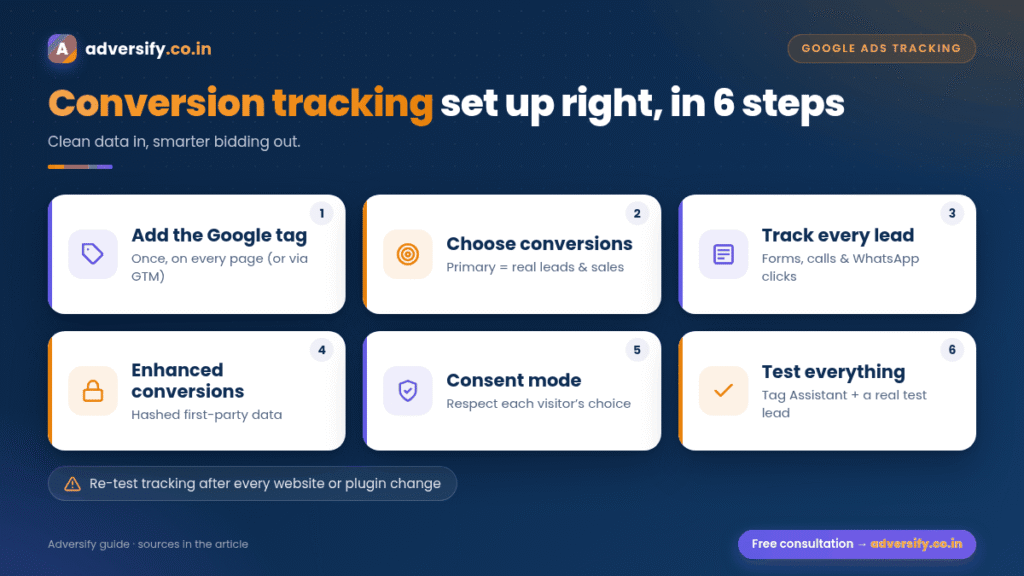
Every smart bidding decision Google Ads makes depends on one thing: the conversions you tell it about. If your tracking counts page views as leads, misses phone calls, or records the same form submission twice, the system will happily optimise towards the wrong outcome. That is why Google Ads conversion tracking is the first thing we check when we audit any account, and why a clean setup often matters more than any bid or keyword change. This step-by-step guide explains how conversion tracking works, how to choose between native Google Ads conversions and GA4 imports, how to track forms, calls and WhatsApp leads, and how enhanced conversions, offline imports and consent mode fit in. It finishes with a testing routine and the most common mistakes we see in Indian lead-generation and e-commerce accounts. We link to the official Google documentation throughout, because Google updates these features regularly. Key takeaways Conversion tracking tells Google Ads which clicks turned into valuable actions. Smart bidding can only be as good as this data. Install the Google tag on every page, then create conversion actions either natively in Google Ads or by importing GA4 key events. Avoid counting the same action from both sources as primary. Track the actions that matter to the business: purchases, qualified form leads, calls and WhatsApp enquiries. Keep micro-actions as secondary goals. Enhanced conversions and offline (CRM) imports improve accuracy and let you optimise for real sales, not just form fills. Test every conversion with Tag Assistant and a real test lead before trusting the numbers. The six-step setup we follow for Google Ads conversion tracking. What is Google Ads conversion tracking? A conversion is an action you value that happens after someone interacts with your ad: a purchase, a submitted enquiry form, a phone call, a sign-up or an app install. Google’s conversion measurement overview describes conversion tracking as the way to see how ad clicks and other interactions lead to these valuable customer actions. On a website, the mechanism is straightforward. The Google tag stores information about the ad click, and when the visitor completes the action, a conversion event fires and Google Ads matches it back to the click. Google’s page on how Google Ads tracks website conversions explains this flow in more detail. Why it matters so much Smart bidding needs it. Strategies such as Maximise conversions, Target CPA and Target ROAS optimise towards the conversions you mark as primary. Wrong data means wrong optimisation. You can judge keywords, ads and campaigns. Without conversions, you can only compare clicks and click-through rates, which say little about leads or sales. Before you start: decide what counts as a conversion The most important decision is not technical. Write down the actions that actually make the business money, and separate them from “nice to know” signals. Business type Primary conversions (optimise for these) Secondary conversions (observe only) Lead generation (services, B2B, education, real estate) Submitted enquiry form, qualified call, WhatsApp click, offline “qualified lead” or “sale” import Brochure download, service page views, scroll depth, chat widget opened E-commerce Purchase with order value Add to cart, begin checkout, newsletter sign-up Local business (clinic, showroom, restaurant) Calls from ads, appointment booked, direction requests where relevant Contact page views, menu or service page views SaaS or app Trial or account sign-up, demo booked, paid subscription import Feature page views, video plays Keep the primary list short. If everything is primary, a brochure download counts the same as a sales enquiry. Step 1: Install the Google tag on every page The Google tag (gtag.js) is a single tag that can send data to Google Ads and Google Analytics. Google’s About the Google tag page explains how it works, and Add a Google tag to your website covers installation options. You have three common ways to install it: Google Tag Manager (GTM): the most flexible option for most business websites. You add the GTM container once and manage all tags, triggers and consent settings inside GTM. A CMS or platform integration: WordPress plugins such as Google’s Site Kit, or built-in integrations on Shopify and similar platforms, can place the tag for you. Direct code: paste the tag into the header template; later changes need a developer. Whichever route you choose, make sure the tag loads on every page, including thank-you pages, and that it is installed only once. Duplicate tags are a frequent cause of double counting. If you use Google Tag Manager Google’s Tag Assistant troubleshooting guide notes that when you keep Google Ads conversion tags in GTM, you also need the Conversion Linker tag alongside the Google tag and your conversion tags. The Conversion Linker helps store ad click information so conversions can be attributed correctly. Step 2: Native Google Ads conversions or GA4 import? You can create conversion actions directly in Google Ads, or create them from Google Analytics 4 key events and import them. Google’s help page on creating conversions from Google Analytics events notes you can use any combination of the two, and compares them. Factor Native Google Ads conversion GA4 key event imported into Google Ads Best for Optimising Google Ads campaigns as precisely as possible Teams that want GA4 as the single source of truth across all channels Traffic covered Conversions from Google Ads interactions GA4 measures all traffic; Google Ads uses what it can attribute to ads Setup effort Moderate (tag event or GTM trigger per action) Lower if GA4 key events already exist Our practical rule: for the one or two actions you bid on, a native Google Ads conversion is usually the more precise choice. Import GA4 key events too if you like, but set them as secondary so the same lead is not counted twice in the Conversions column. Whatever you choose, keep event names consistent and documented. GA4’s own key events documentation explains how to mark an event as a key event. Step 3: Track form, call and WhatsApp leads Most Indian service businesses get leads through forms, phone calls
PPC Management Services in India: Scope, Fee Models, Reporting and How to Choose
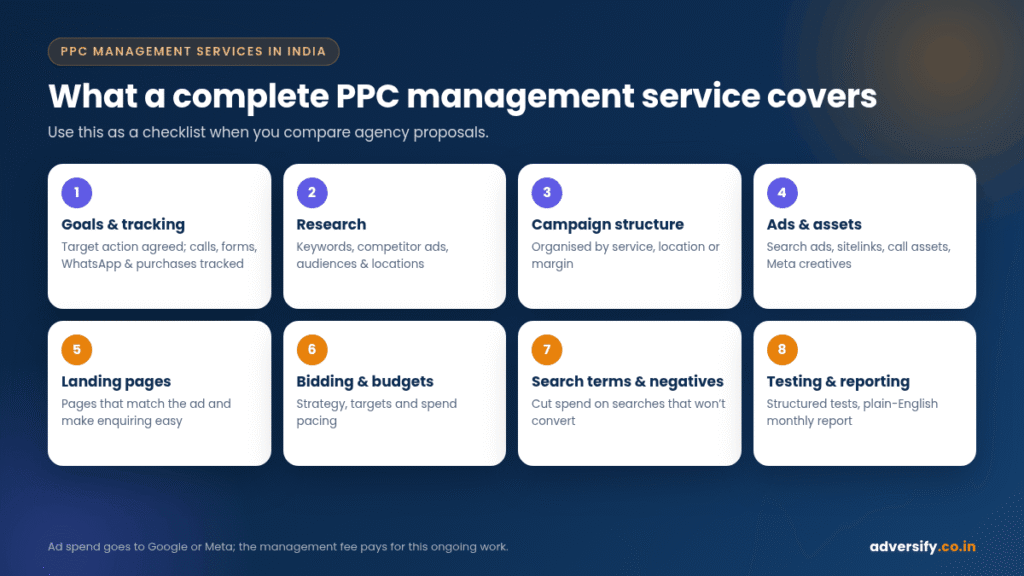
Running Google Ads or Meta Ads yourself works for a while. Then the account grows, the cost per lead creeps up, the search terms get messy, and nobody has time to check what is actually producing enquiries. That is usually the point when a business starts looking at PPC management services in India. The problem is that two proposals for “PPC management” can describe completely different amounts of work. One agency sets up a campaign and sends a screenshot every month. Another rebuilds your tracking, writes new ads every few weeks, tests landing pages and explains every rupee in a report. Both may call it the same service. This guide explains what PPC management should include, how management fees are usually structured, how to evaluate an agency before you sign, and what a useful monthly report looks like. Key takeaways PPC management is the ongoing work of planning, building, measuring and improving paid campaigns. Your ad spend goes to Google or Meta; the management fee pays for the people doing that work. A complete service covers goals and tracking, keyword and audience research, campaign structure, ad copy, landing page feedback, bidding, negative keywords, testing and plain-English reporting. Fees are usually charged as a percentage of ad spend, a flat monthly retainer, a hybrid of the two, or, less often, a performance-linked model. Each suits a different stage of business. You should own your Google Ads and Meta ad accounts, your tracking and your data. Give an agency access; don’t let them hold the account. Judge PPC on cost per qualified lead, sales or return on ad spend, not just clicks or impressions. The eight areas a complete PPC management service should cover. Use it to compare agency proposals. What is PPC management, exactly? Pay-per-click (PPC) advertising means you pay when someone clicks your ad. In India, most pay per click advertising runs on Google Ads (Search, Performance Max, Display, YouTube and Shopping) and Meta Ads (Facebook and Instagram), with Microsoft Advertising and LinkedIn used in some B2B accounts. Setting up a campaign takes a few hours. Managing it well is a continuous job. Google decides where and whether your ad appears in an auction that runs for every search. According to Google, Ad Rank depends on your bid, the quality of your ads and landing page, Ad Rank thresholds, the competitiveness of the auction, the context of the search and the expected impact of your ad assets (Google Ads Help: About Ad Rank). Google also notes that higher-quality ads can often lead to lower costs per click. In other words, the people managing your account influence both how often you appear and how much you pay. A PPC service India businesses hire should therefore be judged on that ongoing work, not on the launch alone. What PPC management services in India should include The exact scope varies by budget and platform, but a complete monthly service usually covers the areas below. Use this as a checklist when you compare proposals. Area What the work involves Why it matters Goals and tracking Agree the target action (call, form, WhatsApp, purchase), set up conversion tracking and check it fires correctly Without reliable conversions, bidding and reporting are guesswork Research Keyword research, competitor ad review, audience and location planning Decides who sees your ads and what you pay for Campaign structure Campaigns and ad groups organised by service, location or margin Lets budget flow to what earns most and keeps ads relevant Ads and assets Responsive search ads, sitelinks, callouts, call assets, images and video for Meta Affects click-through rate, ad quality and lead volume Landing pages Recommendations or builds for pages that match the ad and make enquiring easy Clicks only turn into leads on the page Bidding and budgets Choosing manual or automated bidding, setting targets, pacing spend through the month Controls cost per lead and avoids wasted days Search terms and negatives Reviewing the actual searches that triggered ads and excluding irrelevant ones Stops spend leaking to searches that will never convert Testing Structured tests of ads, offers, audiences and landing pages Improvement comes from tests, not from leaving the account alone Reporting and calls Monthly report in plain language plus a review call You should always know what your money bought Tracking comes first In Google Ads, you choose which actions count as valuable, such as a purchase, sign-up or phone call, and conversion measurement then shows which keywords, ads and campaigns drive them (Google Ads Help: About conversion measurement). For lead-generation businesses, that means tracking form submissions, calls from ads, calls from the website and WhatsApp clicks separately. A good PPC team will also ask you how many of those leads became customers, because an account that produces cheap but unqualified enquiries is not a success. Search terms and negative keywords The search terms report shows the actual searches that triggered your ads and how those searches performed (Google Ads Help: About the search terms report). Reviewing it regularly and adding negative keywords is one of the most practical ways to cut waste. Ask any agency how often they do this. “Weekly in the first month, then at least fortnightly” is a reasonable answer for most small and mid-sized accounts. Bidding strategy Automated strategies such as Target CPA aim to get as many conversions as possible at or below a target cost per action you set (Google Ads Help: About Target CPA bidding). Google requires conversion tracking before you can use Target CPA and recommends judging performance over periods with at least 30 conversions, so accurate tracking matters even more once bidding is automated. A good manager explains why a strategy was chosen and when it will be reviewed, rather than switching strategies every week. For a deeper look at strategy choices, see our guide to PPC marketing strategies for Indian businesses. How PPC management fees are typically structured Before looking at fee models, separate the two costs involved: Ad spend: the money you pay Google or
Meta Ads Cost in India: CPM, CPC, Cost per Lead and Budgets (2026)
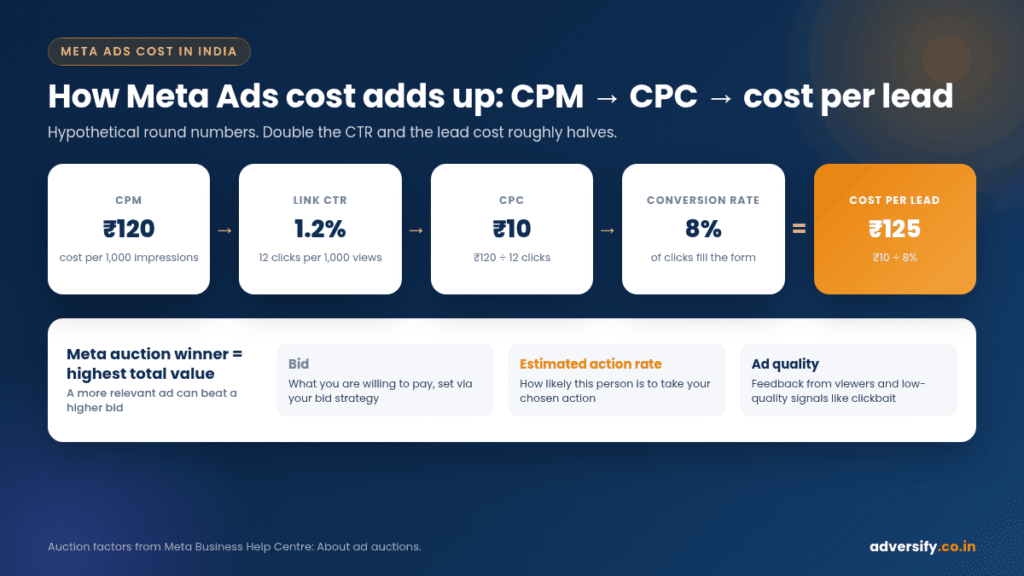
“How much do Facebook and Instagram ads cost?” has a frustrating official answer: as much as you decide to spend. Meta doesn’t publish a rate card. You set a budget, your ads enter an auction, and the price of each impression, click or lead depends on who else is bidding for the same people and how well your ads perform. That is true, but it doesn’t help you plan. So this guide explains what actually drives Meta Ads cost in India, how CPM, CPC and cost per lead relate to each other, what indicative ranges look like by objective and industry, and how to set a budget that gives your campaigns a fair chance. Where we quote Meta’s rules, we link to Meta’s own help pages. Where we give price ranges, we label them clearly as indicative. Key takeaways There is no fixed price for Meta ads. You choose a budget and Meta’s auction decides what each result costs. Meta says that, unless you choose otherwise, you are usually charged for impressions. Meta’s auction picks the ad with the highest total value, which combines your bid, the estimated action rate and ad quality, so a better ad can beat a bigger bid. Your cost per lead is the result of three numbers: CPM (cost per 1,000 impressions), click-through rate and conversion rate. Improve any one of them and the lead gets cheaper. The ranges in this article are indicative planning figures, not Meta data or a survey. Replace them with your own numbers after the first two to four weeks. Plan budget around the learning phase: Meta says ad sets usually exit learning after about 50 results in a week. Small budgets work better with fewer ad sets and easier optimisation events. Daily budgets are an average, not a hard cap. Meta may spend more on some days, but not more than seven times your daily budget in a calendar week. How CPM, click-through rate and conversion rate combine into cost per lead (hypothetical numbers), and what decides Meta’s ad auction. The short answer: what Meta Ads cost in India You can start Meta ads with a small daily budget, and Meta sets minimum budgets that vary by country and objective (Meta Business Help Centre: Best practices for minimum budgets). What you actually pay per result is set by the auction. Two businesses spending the same ₹20,000 in a month can end up with very different results: one gets 40 leads, the other gets 200, because their audience, offer, creative and landing experience are different. That is why the useful question isn’t “what does a Meta ad cost?” but “what will a lead or sale cost me, and how much do I need to spend to find out?” The rest of this guide answers both. How Meta charges you When you advertise on Facebook, Instagram, Messenger, WhatsApp or the Audience Network, you set a budget and Meta spends it through an auction. Meta’s help centre says that usually you are charged based on the number of impressions your ad receives, unless you choose something different when creating the ad (Meta Business Help Centre: How Meta charges for ads). There are two common payment settings. With automatic billing, your card is charged each time you reach your payment threshold and again on your monthly bill date. With available funds, you add money in advance (for example by UPI or card, where offered) and Meta deducts spend from that balance. Either way, the amount you are charged depends on delivery, not on a fixed price per ad. Taxes on Meta ads in India Meta states that ads for accounts with India as the business country are sold by Meta India, billed in rupees and subject to GST and TDS, and that GST and TDS are added whenever you are charged (Meta Business Help Centre: About India’s GST). If you are GST-registered, Meta lets you add your GSTIN to the ad account. Meta also notes it can’t give tax advice, so check the details with your accountant. How the Meta ad auction sets your price Every time someone could see an ad, Meta runs an auction. The winner is not simply the highest bidder. Meta picks the ad with the highest “total value”, which it describes as a combination of three things (Meta Business Help Centre: About ad auctions): Bid: what you are willing to pay, set directly or through your bid strategy. Estimated action rate: how likely this person is to take the action you are optimising for. Ad quality: how relevant and engaging the ad is, using signals such as feedback from people who see or hide it. The practical lesson is that creative quality and relevance directly affect cost. An ad that people stop for, watch and act on can win auctions at a lower price than a dull ad with a bigger bid. Meta also says engagement bait and clickbait don’t help. The metrics that make up Meta Ads cost Meta costs are easiest to understand as a chain. Each link affects the next. Metric What it means Formula CPM Cost per 1,000 impressions Amount spent ÷ impressions × 1,000 CTR (link) Share of people who click the link after seeing the ad Link clicks ÷ impressions CPC (link) Cost per link click Amount spent ÷ link clicks, or CPM ÷ (CTR × 1,000) Conversion rate Share of clicks that become a lead or sale Results ÷ link clicks CPL or CPA Cost per lead or cost per acquisition Amount spent ÷ results, or CPC ÷ conversion rate ROAS Return on ad spend Revenue from ads ÷ amount spent A worked example with round, hypothetical numbers: if your CPM is ₹120 and 1.2% of people click, your CPC is ₹10. If 8% of those clicks fill in your form, each lead costs ₹125. Double the CTR with better creative, and the lead cost roughly halves without touching the bid. Indicative Meta Ads cost ranges by objective The table
PPC Marketing Strategies: A Practical Playbook for Indian Businesses
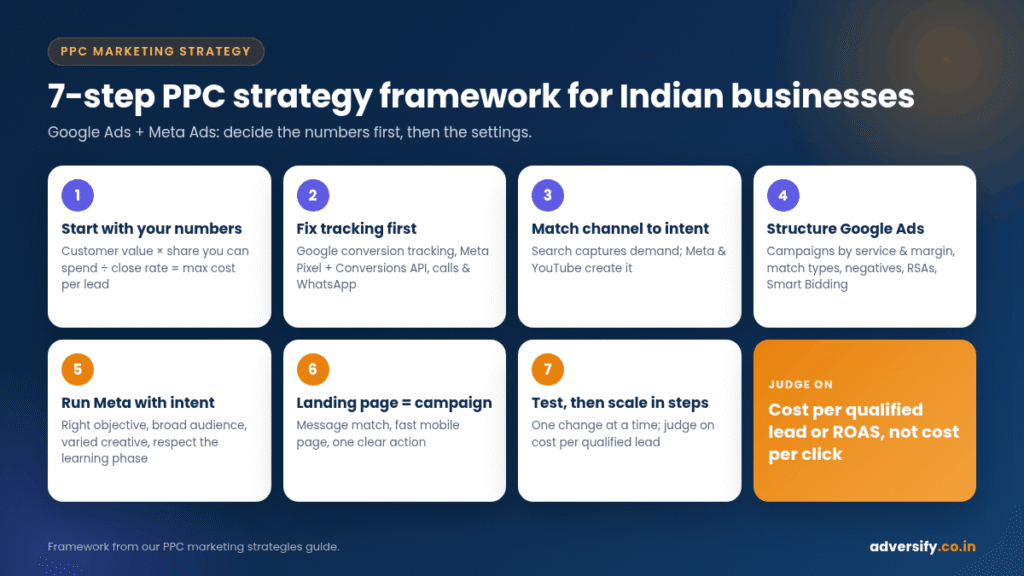
Most PPC accounts we audit don’t fail because of a bad ad or a wrong bid. They fail because nobody decided, before the money went in, what a good customer is worth, which searches deserve budget and what “working” should look like after 30 days. The settings come later. The strategy comes first. This guide walks through the PPC marketing strategies we use when planning paid search and paid social for Indian businesses: how to set targets, choose channels, structure Google Ads and Meta Ads campaigns, pick bidding strategies, test properly and decide where the next rupee should go. Key takeaways A PPC marketing strategy starts with numbers, not ads: work out the most you can afford to pay for a lead or a sale before you set a single bid. Conversion tracking is not optional. Google’s Smart Bidding needs conversion tracking switched on, and Meta’s delivery system learns from the results you feed back to it. Match the channel to intent. Google Search captures people already looking for you; Meta and YouTube create demand among people who are not searching yet. Google recommends pairing broad match keywords with Smart Bidding, but you still need negative keywords, clean ad groups and landing pages that match the search. Give each change enough data before judging it. Meta says goal-based bidding works best with 50 to 100 or more conversions a week, and Google suggests judging Smart Bidding over periods with at least 30 conversions. Scale slowly, one variable at a time, and judge campaigns on cost per qualified lead or return on ad spend, not on cost per click. A seven-step PPC strategy framework for Google Ads and Meta Ads. Judge every step on cost per qualified lead or ROAS. What a PPC marketing strategy actually is Pay-per-click (PPC) advertising means you pay when someone interacts with your ad, usually a click, although some platforms charge mainly for impressions. A PPC marketing strategy is the set of decisions that sit above the day-to-day settings: who you want to reach, how much each result is worth, which platforms and campaign types you will use, how you will measure success and how budget moves as you learn. Tactics are things like adding a negative keyword or writing a new headline. Strategy decides which of those tactics matter for your business this month. A dental clinic in Noida, an online saree store and a B2B software firm in Gurugram can all use Google Ads, but their PPC advertising strategies should look completely different because their margins, buying cycles and customers are different. Step 1: Start with your numbers, not your keywords Before opening Google Ads or Meta Ads Manager, answer three questions on paper: What is a customer worth? Use average order value for e-commerce, or average first-year revenue for services. What share of that value can you spend to win the customer? This depends on your margin and how many customers come back. How many enquiries does it take to win one customer? Ask your sales team for an honest close rate. Those three numbers give you a target cost per lead. Here is a simple, hypothetical example for a home interiors business: Input Example value How it is worked out Average project value ₹2,00,000 From past invoices Gross margin 25% (₹50,000) From your accounts Share of margin you are willing to spend on acquisition 20% (₹10,000) Your decision Close rate from qualified enquiry to project 1 in 8 From your CRM or sales register Maximum cost per qualified lead ₹1,250 ₹10,000 ÷ 8 These numbers are illustrative, not industry benchmarks. The point is the method. Once you know you can afford roughly ₹1,250 per qualified lead, every later decision gets easier: whether a ₹90 click is expensive, whether a lead form is worth its lower quality, and whether a campaign deserves more budget. For a fuller breakdown of click prices and budget maths on Google, see our guide to Google Ads cost in India. Step 2: Fix tracking before you spend Every serious PPC marketing strategy depends on measurement. Without it, you are guessing, and the platforms’ automated bidding is guessing too. Google Ads: set up conversion tracking for form submissions, calls from ads, calls from your website and, where relevant, purchases. Google states plainly that you need conversion tracking enabled to use Smart Bidding (Google Ads Help: About Smart Bidding). Meta Ads: install the Meta Pixel and, ideally, the Conversions API, which sends events from your server rather than relying only on the browser (Meta Business Help Centre: About Conversions API). WhatsApp and calls: many Indian customers would rather call or message than fill in a form. Track WhatsApp button clicks and calls as separate conversions so you can see which campaigns drive them. Lead quality: keep a simple sheet or CRM field that marks each enquiry as qualified or not. A useful rule: if you cannot say how many qualified enquiries a campaign produced last month, you are not ready to increase its budget. Step 3: Match each channel to buyer intent The biggest strategic choice is where to spend. Different PPC channels reach people at different moments. Channel Where the customer is Typical role in the plan Works well for Google Search ads Actively searching for a product or service Capture existing demand Local services, urgent needs, B2B services, high-value purchases Performance Max (Google) Across Search, YouTube, Display, Discover, Gmail and Maps Find extra conversions beyond keyword campaigns E-commerce with a product feed, lead generation with good tracking Meta Ads (Facebook and Instagram) Scrolling feeds, Stories and Reels Create demand and retarget visitors Visual products, offers, events, new categories, local promotions YouTube video ads Watching videos Awareness and consideration Brands with a story to tell or a product that needs explaining Microsoft Advertising (Bing) Searching on Bing and partner sites Optional extra search reach B2B and desktop-heavy audiences, once Google is profitable Don’t try to run everything at once. A common starting point is Google Search for high-intent
Google Ads vs Meta Ads for Small Businesses in India
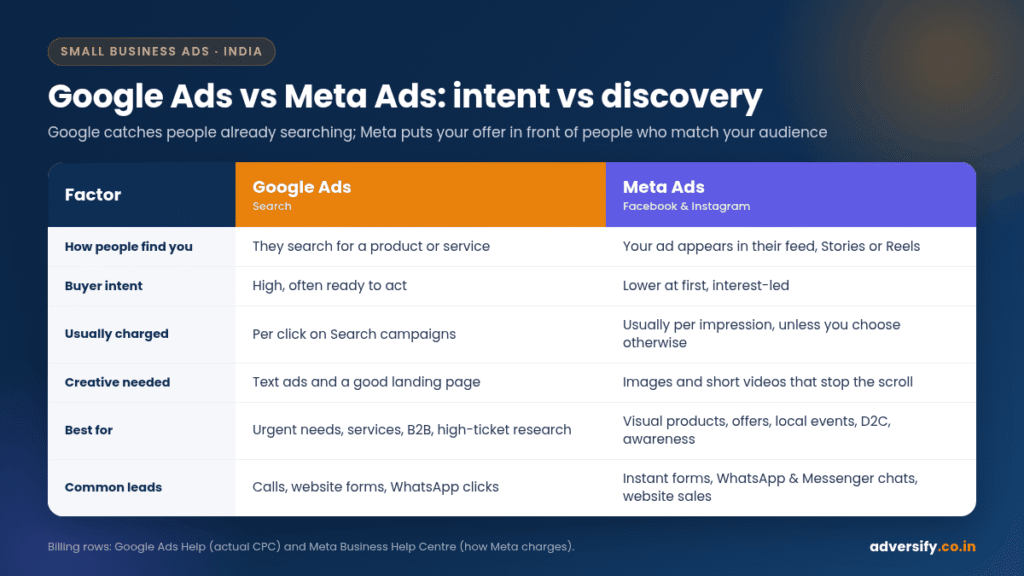
If you run a small business in India and have ₹20,000 or ₹50,000 a month for advertising, the first real decision is where to spend it. Google Ads and Meta Ads (Facebook and Instagram) both work. They just work in different ways, for different kinds of buyers, at different stages of the decision. This guide compares the two platforms honestly: how each one charges, who each one reaches, which businesses tend to do better on which, and how to split a modest budget so you can find out for yourself without burning money. Key takeaways Google Search ads catch people who are already looking for what you sell. Meta ads put your offer in front of people who were not searching but match your audience. On Google Search you usually pay per click. Meta says that, unless specified otherwise, you are usually charged based on impressions. Urgent, high-intent services (repairs, clinics, legal, B2B) usually start better on Google. Visual products, offers, events and new categories often start better on Meta. Meta ad sets usually exit the learning phase after about 50 results in the week after a significant edit, so tiny budgets can keep campaigns stuck in learning. For many small businesses, the best answer is a staged test on both, judged on cost per qualified lead or sale rather than cost per click. Google Ads captures existing demand through search; Meta Ads creates demand in the feed. The core difference: intent vs discovery Think about how a customer reaches you on each platform. On Google, a person in Lajpat Nagar types “AC service near me” because their AC has stopped cooling in May. They have a problem right now and are comparing options. Your ad appears because of what they searched. On Meta, a person scrolling Instagram in the evening sees a reel from a new home bakery in Noida offering customised birthday cakes. They were not looking for a cake, but the ad is relevant to them, and they save it for their daughter’s birthday next month. Your ad appears because of who they are and what they engage with. Google is strongest at capturing existing demand. Meta is strongest at creating demand and building familiarity. Neither is “better” in general; one usually fits your business better at the start. Google Ads vs Meta Ads: side-by-side comparison Factor Google Ads (Search) Meta Ads (Facebook and Instagram) How people find you They search for a product or service Your ad appears in their feed, Stories or Reels Buyer intent High, often ready to act Lower at first, interest-led How you are usually charged Per click on Search campaigns Usually per impression, unless you choose another option Targeting Keywords, location, schedule, audiences Demographics, interests, behaviours, custom and lookalike audiences, broad targeting Creative needed Mainly text ads and a good landing page Images and short videos that stop the scroll Speed to first leads Fast once ads are approved Fast, but needs a learning period to stabilise Best for Urgent needs, services, B2B, high-ticket research Visual products, offers, local events, D2C brands, awareness Common lead types Calls, website forms, WhatsApp clicks Instant forms, WhatsApp and Messenger chats, website sales Sources for the billing rows: Google Ads Help on actual CPC and Meta Business Help Centre: How Meta charges for ads. How each platform decides which ad wins Google: Ad Rank Google runs an auction for each search. Ad Rank decides whether and where your ad shows, using factors including your bid, your competition, the context of the search and your ad quality (Google Ads Help: About Ad Rank). Relevant ads and landing pages help you compete without simply paying more. Meta: total value Meta also runs an auction every time there is a chance to show an ad. It picks the ad with the highest “total value”, which Meta describes as a combination of three things: your bid, the estimated action rate (how likely this person is to take the action you want) and ad quality (Meta Business Help Centre: About ad auctions). Meta states that a more relevant ad can win against ads with higher bids, and that clickbait and engagement bait do not improve performance. The common lesson: on both platforms, relevance lowers your costs. Lazy ads cost more. When Google Ads is usually the better first choice Urgent or problem-solving services Plumbers, pest control, AC repair, locksmiths, emergency dentists, car towing. When someone needs help today, they search. Meta can still work for these, but you are interrupting people who may not need you this week. Clinics and professional services People searching “physiotherapist in Sector 62 Noida” or “GST registration consultant in Delhi” have already decided they need the service. You are competing for the choice of provider, which suits Google well. B2B products and services A procurement manager looking for “industrial packaging supplier in Gurgaon” will usually search. B2B targeting on Meta exists but is less precise for niche job roles and industries. High-ticket purchases with active research Real estate, higher education, cars and home interiors involve weeks of searching and comparing. Google lets you appear at each research step with different keywords. When Meta Ads is usually the better first choice Visual and impulse-friendly products Clothing, jewellery, home décor, cosmetics, food and gifting sell well when people can see them. A good 15-second reel can do what a text ad cannot. New products nobody is searching for yet If you have launched a new kind of product, there may be little or no search volume for it. Meta lets you reach likely buyers before they know the category exists. Local offers and events A café launching a weekend brunch, a gym running a festive membership offer, or a salon promoting a bridal package. Meta’s location and audience options suit time-bound local promotions. Brand building and remarketing Meta is a strong place to stay visible to people who visited your website or engaged with your Instagram profile but did not buy. Repeated, low-cost exposure builds familiarity
How Much Do Google Ads Cost in India?
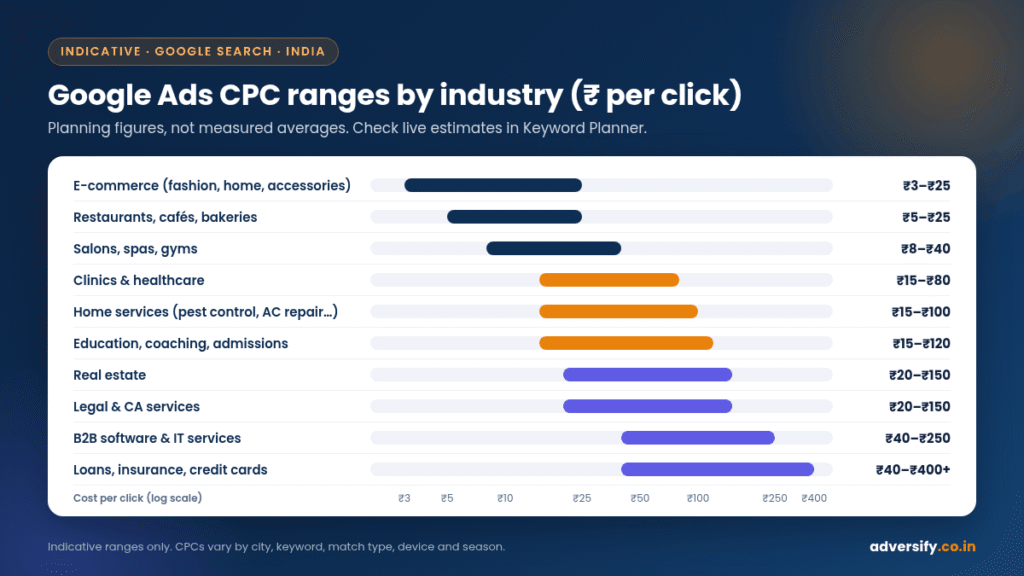
Google Ads has no fixed price list. You can run a campaign in India on ₹300 a day or ₹3 lakh a day, and a click can cost ₹4 or ₹400 depending on what you sell and who you are bidding against. That flexibility is useful, but it also makes budgeting confusing for first-time advertisers. This guide explains how Google Ads pricing actually works, gives indicative cost-per-click (CPC) ranges for common Indian industries, shows how to plan a monthly budget from your lead targets, and covers what agencies charge to manage campaigns. Every Google rule we quote links back to Google’s own help pages so you can check it yourself. Key takeaways Google Ads runs on an auction. You set a maximum bid, but Google says your actual CPC is often lower than that maximum. CPCs in India vary enormously by industry, city, keyword and season. Treat any industry table, including ours, as a planning starting point and check live estimates in Keyword Planner. Your monthly spend per campaign will not exceed 30.4 times your average daily budget, even though Google can spend up to twice the daily budget on a single day. Google charges 18% GST on ad spend billed in India (CGST plus SGST or IGST, depending on your billing state). Management fees are separate from ad spend. Common models are a flat monthly fee, a percentage of spend, or a mix. Indicative Google Search CPC ranges by industry in India. Planning figures only; check live estimates in Keyword Planner. The short answer For most small and medium businesses in India, a realistic starting point for Google Search ads is somewhere around ₹15,000 to ₹60,000 a month in ad spend, plus GST and any management fee. Very local businesses with cheap keywords can test with less. Competitive sectors such as loans, insurance, education admissions and real estate often need more to get enough clicks to learn anything. That range is a planning guide based on how CPCs and conversion rates typically behave, not a published benchmark. The right figure for you depends on your CPC, your conversion rate and how many leads you need, which we will work out step by step below. How Google Ads pricing works The auction and Ad Rank Every time someone searches, Google runs an auction among advertisers bidding on matching keywords. Google uses Ad Rank to decide whether your ad shows and in what position. According to Google, Ad Rank is calculated from several factors including your bid, your competition, the context of the search and your ad quality at that moment (Google Ads Help: About Ad Rank). The practical meaning: the highest bidder does not automatically win. A well-written ad pointing to a relevant, fast landing page can beat a competitor with a bigger bid. Max CPC vs actual CPC Your maximum CPC is the most you are typically willing to pay for a click. Google explains that your actual CPC is often less, because you only pay what is needed to clear the Ad Rank thresholds and beat the advertiser immediately below you (Google Ads Help: Actual cost-per-click). If you set a max CPC of ₹50, you might pay ₹32 on one click and ₹47 on another. Quality Score Quality Score is a 1 to 10 diagnostic at keyword level, based on expected click-through rate, ad relevance and landing page experience (Google Ads Help: About Quality Score). Google is clear that Quality Score itself is not an input in the auction, but the things it measures reflect the ad quality that does affect Ad Rank. Low scores are a useful sign that your ads or landing pages need work, and better ad quality can help you win positions without simply raising bids. What you pay for On Search campaigns you mostly pay when someone clicks. Display and video campaigns can also be charged on impressions or views depending on the bidding option you choose. For most small businesses starting out, Search with cost-per-click bidding is the simplest to understand and control. Indicative CPC ranges by industry in India Google does not publish official CPC averages for India by industry. The ranges below are indicative planning figures for Search campaigns, reflecting the broad spread advertisers commonly see. They are not measured averages. Actual CPCs swing widely with city (Delhi, Mumbai and Bengaluru are usually costlier than smaller cities), keyword wording, match type, device and time of year. Industry Indicative CPC range (INR) Why it sits there E-commerce (fashion, home, accessories) ₹3 to ₹25 Lots of product searches, many competitors, low order values on average Restaurants, cafés, bakeries ₹5 to ₹25 Local searches, low ticket size, heavy competition from delivery apps Salons, spas, gyms ₹8 to ₹40 Local and recurring customers, moderate competition Clinics and healthcare (dental, physio, skin) ₹15 to ₹80 High patient value, strong local competition Home services (pest control, packers and movers, AC repair) ₹15 to ₹100 Urgent intent, many aggregators and lead sellers bidding Education, coaching, admissions ₹15 to ₹120 High course fees and strong seasonal spikes around admissions Real estate ₹20 to ₹150 Very high ticket values, builders and portals competing Legal and CA services ₹20 to ₹150 High client value, specialist terms can be expensive B2B software and IT services ₹40 to ₹250 Long sales cycles, high contract values, global competitors Loans, insurance, credit cards ₹40 to ₹400+ Among the most competitive categories, large banks and fintechs bidding Use this table to get a rough feel, then replace it with real numbers from your own Keyword Planner research (steps below) or, better still, from two to four weeks of live campaign data. What pushes your CPC up or down Location targeting Bidding across all of Delhi NCR costs more than targeting a 5 km radius around your Noida clinic, and the tighter radius usually brings better leads too. Many local businesses waste money showing ads to people who will never travel to them. Keyword choice and match type Broad keywords like “lawyer” attract students, job
PPC Advertising Company Noida
PPC Advertising Company Noida Posted on September 30, 2026 by Adversify Digital Marketing PPC Advertising Company Noida Paid advertising is the fastest route to acquiring high-intent customers, but poorly managed campaigns can rapidly deplete your marketing budget with minimal return. Whether you are scaling an IT firm in Sector 62, managing a real estate venture along the Noida Expressway, or running an online retail store, working with a dedicated PPC advertising company in Noida is essential for lowering Customer Acquisition Cost (CAC) and maximizing Return on Ad Spend (ROAS). Noida has established itself as one of North India’s premier technology and corporate corridors, making it home to some of the country’s sharpest performance marketing specialists. A local agency understands not only regional business dynamics across Delhi NCR but also how to build and scale global campaigns across Google, Meta, and LinkedIn. Why Choose a PPC Advertising Company in Noida? Partnering with an agency situated in Noida provides distinct operational advantages: Strategic Business Alignment: Noida houses an extensive mix of tech startups, industrial manufacturers, real estate developers, and D2C brands. Agencies in this market are accustomed to managing both B2B lead generation and high-volume consumer sales funnels. Cost-Efficient Media Management: Compared to agencies in southern metros or overseas markets, Noida-based firms deliver top-tier campaign strategy, split testing, and bid management at highly competitive retainer pricing. Full-Funnel Capabilities: Modern paid media extends beyond standard Google Search. Top Noida agencies manage multi-touchpoint campaigns across Google Search, Performance Max, Display, Meta Ads (Facebook & Instagram), and YouTube. Top PPC Advertising Companies in Noida To help you find the right performance marketing partner, here is a curated list of top PPC agencies based in and operating out of Noida: Agency Headquarters Core Focus Best Suited For Adversify Digital Marketing Noida / Delhi NCR ROI-focused Google & Meta Ads, landing page CRO, AI search optimization Startups, growing SMBs, local service businesses, & D2C stores Techmagnate Sector 62, Noida Enterprise PPC management, multi-channel performance media, shopping ads Large corporations, aggregators, & enterprise brands EZ Rankings Sector 63, Noida Structured pay-per-click packages, localized lead generation, remarketing Small-to-midsize businesses & budget-conscious brands Sterco Digitex Sector 63, Noida Integrated brand advertising, cross-platform creative campaigns, B2B paid media Mid-market tech brands & established corporate enterprises E2WebServices Sector 62, Noida Google Search Ads, bid management, performance reporting Local businesses & service-oriented companies Spotlight: Adversify Digital Marketing Among the performance agencies serving Noida and the wider NCR market, Adversify Digital Marketing stands out for its high-touch, data-backed execution tailored to growing businesses: Precision Audience Targeting: Rather than wasting ad budget on broad, unqualified keywords, Adversify isolates high-intent commercial terms and applies strict negative keyword filtering to eliminate junk traffic from day one. Integrated Multi-Platform Campaigns: They build cohesive ad funnels across Google Search, Display, YouTube, and Meta Ads (Instagram and Facebook), ensuring prospects are engaged at every stage of the buying cycle. Conversion Rate Optimization (CRO): Driving clicks is only half the job. Adversify pairs paid campaigns with fast-loading, conversion-optimized landing pages to turn incoming ad clicks into booked leads and sales. Transparent Bottom-Line Reporting: Campaigns are tracked against real business metrics—Cost Per Lead (CPL), Cost Per Acquisition (CPA), and conversion values—rather than vanity metrics like impressions. Critical Factors to Consider Before Hiring Before onboarding a PPC agency in Noida, evaluate their approach against these critical standards: 1. Account Ownership & Transparency Ensure that your business retains direct administrative ownership of your Google Ads, Google Analytics 4, and Meta Business Manager accounts. You should never be locked out of your own campaign data. 2. Strategic Bid & Budget Management Ask how the agency handles smart bidding strategies (Target CPA, Target ROAS) versus manual bidding. Top agencies continuously optimize Quality Scores to drive down the actual cost per click (CPC). 3. Landing Page Readiness Even the best ad copy will fail if directed to a generic, slow-loading homepage. Look for an agency that actively audits and builds dedicated landing pages with clear, compelling calls to action. Also read: Best PPC Company in India and PPC Advertising Company India: Grow Your Business with High-Performance PPC Campaigns Key Questions to Ask During Your Agency Pitch What is your process for discovering and updating negative keywords? Continuous negative keyword sculpting protects your budget from irrelevant search queries. How do you set up conversion tracking in GA4? Verify that they track completed form fills, direct calls, and purchases rather than standard pageviews. What is your communication and reporting frequency? A reputable agency provides live dashboard access alongside bi-weekly or monthly strategic reviews. Investing in a verified, performance-driven team ensures your ad spend turns into predictable, scalable revenue for your business.
Best PPC Company in India
Best PPC Company in India Posted on September 29, 2026 by Adversify Digital Marketing Best PPC Company in India Paid advertising can either transform your business into a high-converting revenue engine or quietly drain your marketing budget with zero return. The difference lies in execution. Finding the best PPC company in India is no longer just about hiring a team to set up basic Google Ads campaigns; it is about partnering with performance marketing specialists who understand audience intent, data analytics, conversion rate optimization (CRO), and cross-channel growth. Whether you run an early-stage startup, a mid-market e-commerce brand, or a mature enterprise, selecting the right pay-per-click agency directly impacts your customer acquisition cost (CAC) and overall return on ad spend (ROAS). Why Partner with a Top PPC Agency in India? India has emerged as a global powerhouse for digital talent and performance-driven marketing. Choosing an agency operating in this competitive ecosystem offers distinct advantages: High Cost-Efficiency: Indian PPC agencies offer world-class execution and strategic campaign management at competitive fee structures, ensuring a larger share of your marketing spend goes directly into media buying. Full-Funnel Expertise: Modern PPC is not limited to search queries. Top agencies manage campaigns across Google Search, Performance Max, Meta Ads (Facebook & Instagram), LinkedIn, YouTube, and Amazon Sponsored Ads. Advanced Data & AI Integration: Leading agencies use automated bidding algorithms, programmatic display tools, predictive modeling, and real-time dashboarding to maximize every rupee or dollar spent. What Sets the Best PPC Agencies Apart? When evaluating top-performing pay-per-click management firms, look beyond generic vanity metrics like impressions and total clicks. Focus on these core operational capabilities: 1. Granular Keyword Research & Intent Mapping The best teams prioritize high-intent, bottom-of-funnel keywords over broad search terms. They structure campaigns with rigorous negative keyword lists to eliminate junk traffic from day one. 2. End-to-End Conversion Rate Optimization (CRO) Driving paid clicks is only half the battle. If your landing pages load slowly or lack clear value propositions, your budget is wasted. Top agencies design dedicated, high-converting landing pages, write compelling ad copy, and conduct continuous A/B split tests. 3. Transparent Reporting & Bottom-Line Attribution You should always know where your budget went and what it produced. Elite agencies provide real-time dashboards tracking direct conversions, cost per lead (CPL), and customer lifetime value (LTV)—not vague metric summaries. Top Agencies Leading the PPC Space in India While the ideal agency depends on your niche, industry leaders frequently recognized for strong PPC track records include: Agency Core Strength Best For Tech-Driven Media Agencies Programmatic advertising, multi-channel performance tracking Enterprise & global scaling Boutique Growth Agencies Direct-response search, localized lead generation, hyper-focused CRO B2B service firms & SaaS E-commerce PPC Specialists Google Shopping, Performance Max, Amazon & Marketplace Ads D2C brands & retail stores Also read: PPC Advertising Company India: Grow Your Business with High-Performance PPC Campaigns and PPC Advertising Company Noida Key Questions to Ask Before Hiring Before signing a retainer with a pay-per-click partner, protect your investment by asking these direct questions: Who owns the ad account? Always ensure your business retains complete administrative ownership of your Google Ads and Meta Business Manager accounts. How do you approach campaign scaling? Ensure they use structured budget scaling and negative keyword pruning rather than simply increasing daily spend recklessly. What is your baseline reporting cadence? Look for weekly performance check-ins paired with continuous, on-demand dashboard access. Investing in paid search and social campaigns should deliver measurable, predictable returns. Partnering with a vetted, performance-oriented team ensures your ad spend works relentlessly to scale your business.
PPC Advertising Company India: Grow Your Business with High-Performance PPC Campaigns
PPC Advertising Company India Posted on September 26, 2026 by Adversify Digital Marketing PPC Advertising Company India: Grow Your Business with High-Performance PPC Campaigns In today’s competitive online marketplace, businesses need quick and measurable marketing solutions to stay ahead. One of the most effective ways to generate quality leads and increase sales is through Pay-Per-Click (PPC) advertising. Choosing the right PPC advertising company India can help your business reach the right audience, improve brand visibility, and deliver a higher return on investment (ROI). At Adversify Digital Marketing, we specialize in creating data-driven PPC campaigns that help businesses across India, including Noida and Delhi, achieve sustainable growth. Whether you’re a startup, small business, or enterprise, our expert team ensures every advertising campaign delivers maximum value. What is PPC Advertising? PPC (Pay-Per-Click) is an online advertising model where businesses pay only when someone clicks on their advertisement. These ads can appear on Google Search, YouTube, Facebook, Instagram, and other digital platforms. Unlike traditional marketing, PPC provides immediate visibility and allows businesses to attract potential customers from the very first day of the campaign. With proper planning and optimization, PPC becomes one of the fastest ways to generate qualified leads and increase online sales. Why Choose a PPC Advertising Company in India? Managing PPC campaigns requires technical expertise, keyword research, audience targeting, bid management, and continuous optimization. Hiring a professional PPC advertising company India ensures that your advertising budget is invested wisely while achieving better results. Some major benefits include: Instant traffic to your website Targeted audience reach Better lead generation Higher conversion rates Measurable campaign performance Improved ROI Complete budget control Professional PPC experts continuously monitor campaign performance to reduce unnecessary spending and improve overall campaign effectiveness. Why Adversify Digital Marketing? Adversify Digital Marketing is committed to helping businesses achieve real business growth through performance-driven PPC campaigns. Our experienced professionals develop customized advertising strategies based on your business goals, target audience, and industry competition. Our PPC services include: Google Ads Management Facebook & Instagram Ads Keyword Research Landing Page Optimization Conversion Tracking Campaign Optimization Monthly Performance Reports Every campaign is carefully monitored and optimized to ensure maximum lead generation and improved conversion rates. Industries We Serve Our PPC advertising solutions are suitable for businesses across various industries, including: Healthcare Education Real Estate E-commerce Manufacturing Travel Local Businesses IT & Technology Professional Services No matter your industry, we create customized campaigns designed to attract potential customers and increase sales. Why Businesses Trust Adversify Businesses across India choose Adversify Digital Marketing because we focus on results rather than just clicks. We believe every advertising campaign should contribute to measurable business growth. Our strengths include: Experienced PPC Specialists Transparent Reporting Affordable Pricing Customized Campaign Strategy Continuous Performance Optimization Dedicated Account Support We analyze campaign performance regularly and make data-driven improvements to maximize your advertising investment. Get Started Today If you’re searching for a trusted PPC advertising company India, Adversify Digital Marketing is your ideal partner. We help businesses across Noida, Delhi, and India generate quality leads, increase website traffic, and improve online sales through effective PPC advertising. Visit https://adversify.co.in/ to explore our PPC services and request a free consultation. Let our experts build a high-performing advertising campaign that delivers measurable business growth. Also read: Best PPC Company in India and PPC Advertising Company Noida Final Thoughts Choosing the right PPC advertising company India can transform your digital marketing efforts. With expert strategy, advanced targeting, continuous optimization, and transparent reporting, Adversify Digital Marketing helps businesses achieve higher visibility, better conversions, and long-term success. If you’re ready to grow your business with performance-focused PPC campaigns, Adversify is here to help.