
Most PPC accounts we audit don’t fail because of a bad ad or a wrong bid. They fail because nobody decided, before the money went in, what a good customer is worth, which searches deserve budget and what “working” should look like after 30 days. The settings come later. The strategy comes first.
This guide walks through the PPC marketing strategies we use when planning paid search and paid social for Indian businesses: how to set targets, choose channels, structure Google Ads and Meta Ads campaigns, pick bidding strategies, test properly and decide where the next rupee should go.
Key takeaways
- A PPC marketing strategy starts with numbers, not ads: work out the most you can afford to pay for a lead or a sale before you set a single bid.
- Conversion tracking is not optional. Google’s Smart Bidding needs conversion tracking switched on, and Meta’s delivery system learns from the results you feed back to it.
- Match the channel to intent. Google Search captures people already looking for you; Meta and YouTube create demand among people who are not searching yet.
- Google recommends pairing broad match keywords with Smart Bidding, but you still need negative keywords, clean ad groups and landing pages that match the search.
- Give each change enough data before judging it. Meta says goal-based bidding works best with 50 to 100 or more conversions a week, and Google suggests judging Smart Bidding over periods with at least 30 conversions.
- Scale slowly, one variable at a time, and judge campaigns on cost per qualified lead or return on ad spend, not on cost per click.
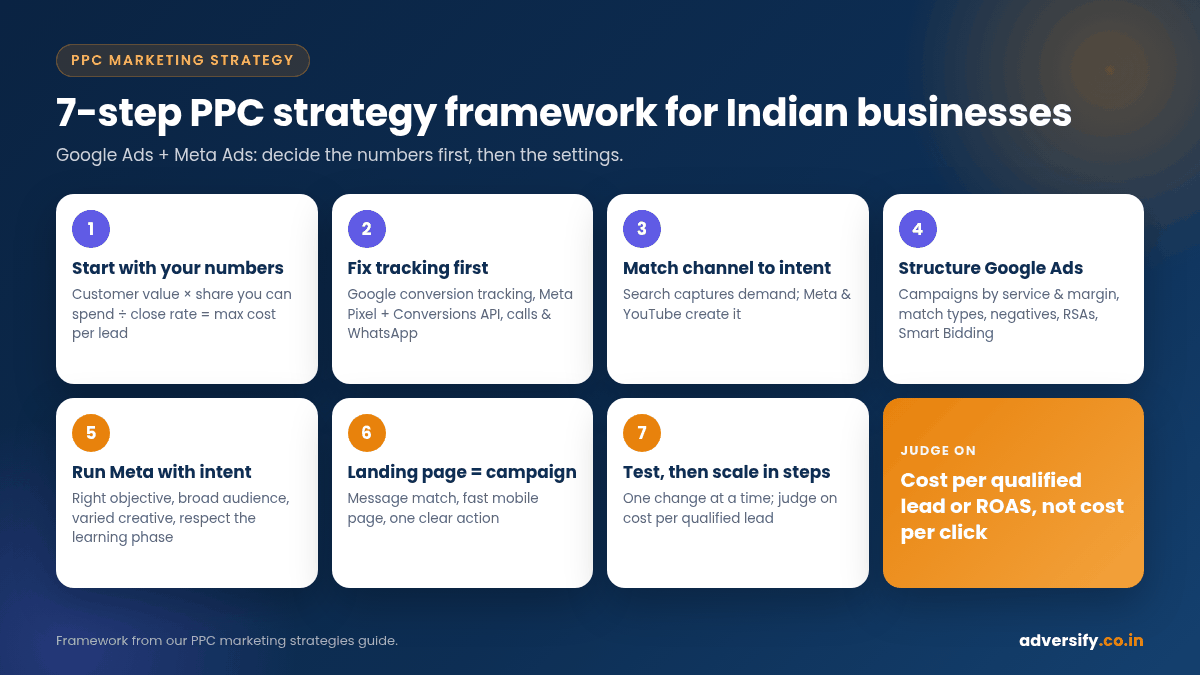
What a PPC marketing strategy actually is
Pay-per-click (PPC) advertising means you pay when someone interacts with your ad, usually a click, although some platforms charge mainly for impressions. A PPC marketing strategy is the set of decisions that sit above the day-to-day settings: who you want to reach, how much each result is worth, which platforms and campaign types you will use, how you will measure success and how budget moves as you learn.
Tactics are things like adding a negative keyword or writing a new headline. Strategy decides which of those tactics matter for your business this month. A dental clinic in Noida, an online saree store and a B2B software firm in Gurugram can all use Google Ads, but their PPC advertising strategies should look completely different because their margins, buying cycles and customers are different.
Step 1: Start with your numbers, not your keywords
Before opening Google Ads or Meta Ads Manager, answer three questions on paper:
- What is a customer worth? Use average order value for e-commerce, or average first-year revenue for services.
- What share of that value can you spend to win the customer? This depends on your margin and how many customers come back.
- How many enquiries does it take to win one customer? Ask your sales team for an honest close rate.
Those three numbers give you a target cost per lead. Here is a simple, hypothetical example for a home interiors business:
| Input | Example value | How it is worked out |
|---|---|---|
| Average project value | ₹2,00,000 | From past invoices |
| Gross margin | 25% (₹50,000) | From your accounts |
| Share of margin you are willing to spend on acquisition | 20% (₹10,000) | Your decision |
| Close rate from qualified enquiry to project | 1 in 8 | From your CRM or sales register |
| Maximum cost per qualified lead | ₹1,250 | ₹10,000 ÷ 8 |
These numbers are illustrative, not industry benchmarks. The point is the method. Once you know you can afford roughly ₹1,250 per qualified lead, every later decision gets easier: whether a ₹90 click is expensive, whether a lead form is worth its lower quality, and whether a campaign deserves more budget. For a fuller breakdown of click prices and budget maths on Google, see our guide to Google Ads cost in India.
Step 2: Fix tracking before you spend
Every serious PPC marketing strategy depends on measurement. Without it, you are guessing, and the platforms’ automated bidding is guessing too.
- Google Ads: set up conversion tracking for form submissions, calls from ads, calls from your website and, where relevant, purchases. Google states plainly that you need conversion tracking enabled to use Smart Bidding (Google Ads Help: About Smart Bidding).
- Meta Ads: install the Meta Pixel and, ideally, the Conversions API, which sends events from your server rather than relying only on the browser (Meta Business Help Centre: About Conversions API).
- WhatsApp and calls: many Indian customers would rather call or message than fill in a form. Track WhatsApp button clicks and calls as separate conversions so you can see which campaigns drive them.
- Lead quality: keep a simple sheet or CRM field that marks each enquiry as qualified or not.
A useful rule: if you cannot say how many qualified enquiries a campaign produced last month, you are not ready to increase its budget.
Step 3: Match each channel to buyer intent
The biggest strategic choice is where to spend. Different PPC channels reach people at different moments.
| Channel | Where the customer is | Typical role in the plan | Works well for |
|---|---|---|---|
| Google Search ads | Actively searching for a product or service | Capture existing demand | Local services, urgent needs, B2B services, high-value purchases |
| Performance Max (Google) | Across Search, YouTube, Display, Discover, Gmail and Maps | Find extra conversions beyond keyword campaigns | E-commerce with a product feed, lead generation with good tracking |
| Meta Ads (Facebook and Instagram) | Scrolling feeds, Stories and Reels | Create demand and retarget visitors | Visual products, offers, events, new categories, local promotions |
| YouTube video ads | Watching videos | Awareness and consideration | Brands with a story to tell or a product that needs explaining |
| Microsoft Advertising (Bing) | Searching on Bing and partner sites | Optional extra search reach | B2B and desktop-heavy audiences, once Google is profitable |
Don’t try to run everything at once. A common starting point is Google Search for high-intent demand, plus one Meta campaign either to build demand or to retarget website visitors. If you are unsure which to start with, our comparison of Google Ads vs Meta Ads for small businesses includes a three-month test plan.
Step 4: Google Ads strategies that hold up in 2026
Build campaigns around services and margins
Group keywords by what you sell and how profitable it is, not by how the keyword looks. A clinic might run one campaign for implants (high value) and another for general check-ups (lower value), each with its own budget.
Use match types deliberately
Google Ads has three keyword match types. Broad match can show your ad on searches related to your keyword; phrase match shows on searches that include the meaning of your keyword; exact match shows on searches with the same meaning or intent. Google notes that broad match is now the default and recommends using it with Smart Bidding, because the bidding system can judge each search individually (Google Ads Help: About keyword matching options).
In practice, broad match works best when you already have reliable conversion data. With a small budget and no tracking history, many accounts start tighter with phrase and exact match, then open up once Smart Bidding has something to learn from.
Keep a living negative keyword list
Negative keywords stop your ads from showing on searches you don’t want. Review the search terms report every week in the first month. Typical negatives for Indian service businesses include “jobs”, “salary”, “course”, “free”, “pdf”, “near me” for businesses that don’t serve walk-ins, and city names you don’t cover.
Write responsive search ads that make sense in any order
Responsive search ads let you enter up to 15 headlines and 4 descriptions. Headlines can be up to 30 characters and descriptions up to 90 characters, and Google tests combinations over time (Google Ads Help: About responsive search ads). Write headlines that work on their own: one with the service and location (“Dental Implants in Noida”), one with genuine proof, one with a next step (“Book a Free Consultation”). Pin sparingly; Google notes that pinning reduces the number of combinations it can test.
Use Quality Score as a diagnostic, not a target
Quality Score is a 1 to 10 rating at keyword level, based on expected click-through rate, ad relevance and landing page experience. Google is clear that it is a diagnostic tool and not an input in the ad auction (Google Ads Help: About Quality Score). If landing page experience is “Below average” across an ad group, the fix is usually a better page, not a new bid.
Choose a bidding strategy that fits your data
Smart Bidding strategies such as Maximize conversions, Target CPA, Maximize conversion value and Target ROAS use Google AI to set bids in each auction. Google suggests evaluating Smart Bidding over periods with at least 30 conversions (50 for Target ROAS), such as a month or longer. A sensible ladder for a new account looks like this:
- Launch with conversion tracking working and a conservative budget.
- Use Maximize conversions once conversions are being recorded.
- Move to Target CPA when you have a steady flow of conversions and know your acceptable cost per lead.
- For e-commerce with reliable revenue tracking, test Maximize conversion value or Target ROAS.
Add Performance Max only when the basics work
Performance Max is a goal-based campaign type that can serve across YouTube, Display, Search, Discover, Gmail and Maps from one campaign (Google Ads Help: About Performance Max campaigns). It relies heavily on your conversion data and creative assets. Google states that a Search campaign is prioritised when the search exactly matches an exact match keyword, so keep your core exact match keywords in Search, add brand exclusions if you don’t want Performance Max taking credit for brand searches, and judge it on qualified leads, not on form fills alone.
Step 5: Meta Ads strategies for Indian businesses
Pick the objective that matches the business result
Meta Ads Manager offers six objectives: Awareness, Traffic, Engagement, Leads, App promotion and Sales (Meta Business Help Centre: How to choose the right ad objective). Choose the objective closest to what you actually want. If you want enquiries, use Leads or Sales with a conversion event, not Traffic. Traffic campaigns are good at finding people who click; they are not built to find people who buy.
Let creative do more of the targeting
Meta’s delivery system decides who sees your ad partly based on how people respond to it. In practice this means the creative itself (the hook in the first second of a reel, the product shown, the words on the image) does a lot of the targeting. Rather than building ten narrow interest audiences, try a broader audience with three to five clearly different creatives: a short reel, a carousel, a testimonial and a simple offer image.
Respect the learning phase
Meta says ad sets usually exit the learning phase after about 50 results in the week after the last significant edit, and that performance is less stable during learning (Meta Business Help Centre: About the learning phase). Two practical consequences: avoid splitting a small budget across many ad sets, and avoid editing ad sets every day.
Choose a bid strategy that fits your goal
Meta groups its bid strategies into spend-based bidding (Highest volume, Highest value), goal-based bidding (Cost per result goal, ROAS goal) and manual bidding (Bid cap). Meta recommends 50 to 100 or more weekly conversions for goal-based bidding and notes that hitting your cost or ROAS goal is not guaranteed (Meta Business Help Centre: About bid strategies). Most new accounts should start with Highest volume and add a cost goal later, once they know what a lead really costs.
Retarget the people Google sends you
One of the most reliable PPC advertising strategies is to let Google Search bring people in and let Meta bring back the ones who left. Build audiences of website visitors, Instagram profile engagers and video viewers, then show them proof (reviews, results, before-and-after photos where allowed) and a clear next step.
Step 6: Treat the landing page as part of the campaign
Your ads can only promise; the landing page has to deliver. Three things matter most:
- Message match. If the ad says “AC repair in Sector 62, same-day visit”, the page should say the same thing above the fold.
- Speed and mobile layout. Check the device report in your account; for many Indian businesses, phones bring the majority of clicks. A slow, cramped mobile page wastes the click you just paid for.
- One clear action. A call button, a WhatsApp button and a short form are usually enough. Long forms reduce enquiries; very short forms can increase junk leads. Test both.
If your current site makes this hard, a focused landing page is often a better investment than a higher bid. Our web design team builds campaign landing pages on WordPress for exactly this reason.
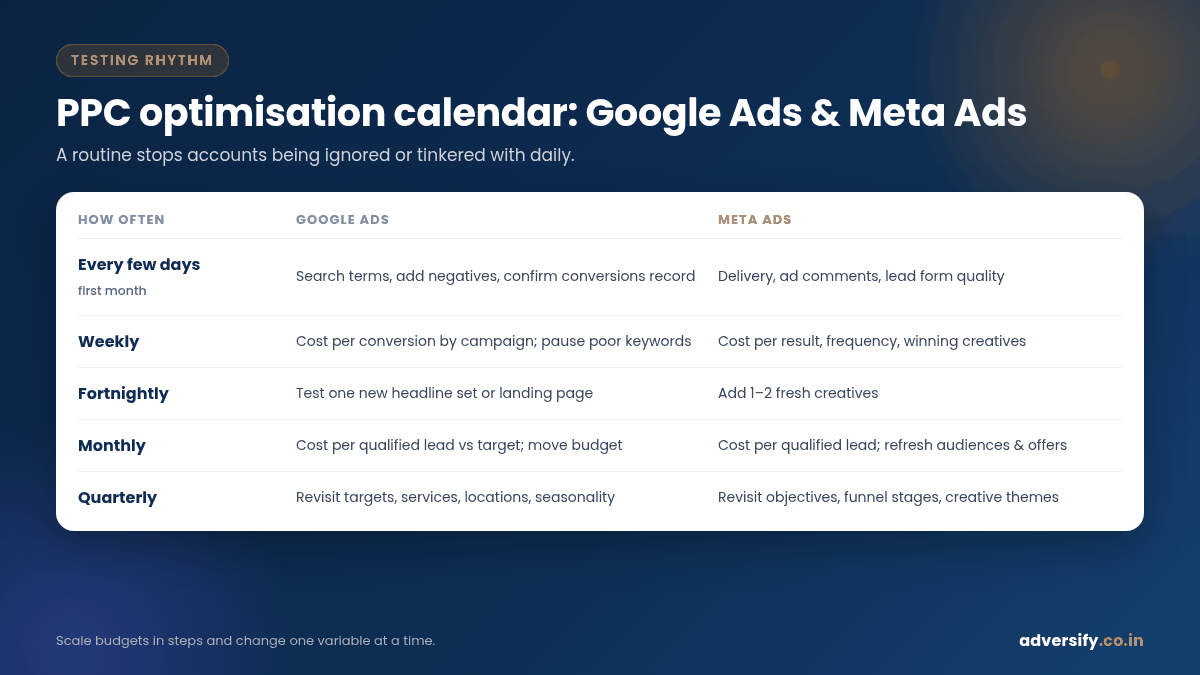
Step 7: Set a testing rhythm and scale in steps
Good PPC marketing strategies have a calendar. Without one, accounts either get ignored or get tinkered with every day.
| How often | Google Ads | Meta Ads |
|---|---|---|
| Every few days (first month) | Check search terms, add negatives, confirm conversions are recording | Check delivery, comments on ads and lead form quality |
| Weekly | Review cost per conversion by campaign, pause clearly poor keywords | Review cost per result, frequency and which creatives are winning |
| Fortnightly | Test one new headline set or landing page variation | Add one or two new creatives to replace tired ones |
| Monthly | Compare cost per qualified lead against your target, move budget between campaigns | Compare cost per qualified lead, refresh audiences and offers |
| Quarterly | Revisit targets, services, locations and seasonality | Revisit objectives, funnel stages and creative themes |
When a campaign is hitting its target, increase budget in steps rather than doubling it overnight, and change one thing at a time so you know what caused the result.
PPC strategy examples by business type
| Business | Starting strategy | Key metric | Watch out for |
|---|---|---|---|
| Local service (clinic, salon, repair, coaching) | Google Search on core services with tight location targeting, call and WhatsApp tracking; Meta retargeting | Cost per qualified call or booking | Ads showing outside your service area; job seekers clicking |
| E-commerce store | Shopping or Performance Max with a clean product feed, Meta Sales campaigns with catalogue and video creative | Return on ad spend after returns | Cash-on-delivery cancellations distorting results |
| B2B services or software | Google Search on problem and solution keywords, LinkedIn or Meta for content and retargeting | Cost per sales-qualified lead | Long sales cycles; judge over months, not weeks |
| Real estate or education | Google Search for project or course names, Meta lead forms with qualifying questions | Cost per site visit or counselling session | Low-quality form leads; ad policies for special categories |
How to measure whether your PPC strategy is working
Cost per click is the number everyone watches and the one that matters least. Use these, in this order:
- Cost per qualified lead or cost per sale: the number you set in Step 1.
- Return on ad spend (ROAS): revenue from ads divided by ad spend, for e-commerce and businesses that can track revenue.
- Conversion rate: conversions divided by clicks. A falling rate usually points to the landing page or offer.
- Click-through rate (CTR): a signal of how relevant your ads are to the searches or audiences you reach.
Common PPC mistakes we see in Indian accounts
- Optimising for clicks instead of customers. Cheap traffic that never calls is not cheap.
- Too many campaigns for the budget. Ten campaigns on ₹20,000 a month means none of them gets enough data.
- Ignoring the search terms report. This is where most wasted spend hides.
- Using the “Boost post” button as a strategy. Boosting is quick, but Ads Manager gives you proper objectives, audiences and reporting.
Frequently asked questions
What is the best PPC marketing strategy for a small business?
For most small businesses, start with Google Search ads on your two or three most profitable services, with proper conversion tracking and a tight location setting. Add Meta retargeting once you have website traffic. Expand only when you are hitting your target cost per lead.
How much budget do I need to start PPC in India?
It depends on your click prices and how many leads you want. Work backwards from your target cost per lead and the number of leads you need each month. Our Google Ads cost guide shows the calculation step by step.
Should I use broad match keywords?
Google recommends broad match with Smart Bidding, and it can work well once you have reliable conversion data. With a small budget and no conversion history, start with phrase and exact match, add negatives, and test broad match later.
How long before a PPC campaign shows results?
Ads can bring clicks on day one, but campaigns usually need a few weeks of data before bidding and targeting settle down. Plan to judge a new campaign after at least a month, or after enough conversions to be meaningful.
Want a second opinion on your PPC strategy?
If you are already running ads and not sure whether the money is working, or you are about to start and want a plan built on your numbers, we can help. Our team in Noida and Hauz Khas, New Delhi manages Google Ads and Meta Ads campaigns on month-to-month contracts. Book a free consultation and we will review your account or plan, and tell you plainly what we would change first.