
Running Google Ads or Meta Ads yourself works for a while. Then the account grows, the cost per lead creeps up, the search terms get messy, and nobody has time to check what is actually producing enquiries. That is usually the point when a business starts looking at PPC management services in India.
The problem is that two proposals for “PPC management” can describe completely different amounts of work. One agency sets up a campaign and sends a screenshot every month. Another rebuilds your tracking, writes new ads every few weeks, tests landing pages and explains every rupee in a report. Both may call it the same service. This guide explains what PPC management should include, how management fees are usually structured, how to evaluate an agency before you sign, and what a useful monthly report looks like.
Key takeaways
- PPC management is the ongoing work of planning, building, measuring and improving paid campaigns. Your ad spend goes to Google or Meta; the management fee pays for the people doing that work.
- A complete service covers goals and tracking, keyword and audience research, campaign structure, ad copy, landing page feedback, bidding, negative keywords, testing and plain-English reporting.
- Fees are usually charged as a percentage of ad spend, a flat monthly retainer, a hybrid of the two, or, less often, a performance-linked model. Each suits a different stage of business.
- You should own your Google Ads and Meta ad accounts, your tracking and your data. Give an agency access; don’t let them hold the account.
- Judge PPC on cost per qualified lead, sales or return on ad spend, not just clicks or impressions.
What is PPC management, exactly?
Pay-per-click (PPC) advertising means you pay when someone clicks your ad. In India, most pay per click advertising runs on Google Ads (Search, Performance Max, Display, YouTube and Shopping) and Meta Ads (Facebook and Instagram), with Microsoft Advertising and LinkedIn used in some B2B accounts.
Setting up a campaign takes a few hours. Managing it well is a continuous job. Google decides where and whether your ad appears in an auction that runs for every search. According to Google, Ad Rank depends on your bid, the quality of your ads and landing page, Ad Rank thresholds, the competitiveness of the auction, the context of the search and the expected impact of your ad assets (Google Ads Help: About Ad Rank). Google also notes that higher-quality ads can often lead to lower costs per click. In other words, the people managing your account influence both how often you appear and how much you pay.
A PPC service India businesses hire should therefore be judged on that ongoing work, not on the launch alone.
What PPC management services in India should include
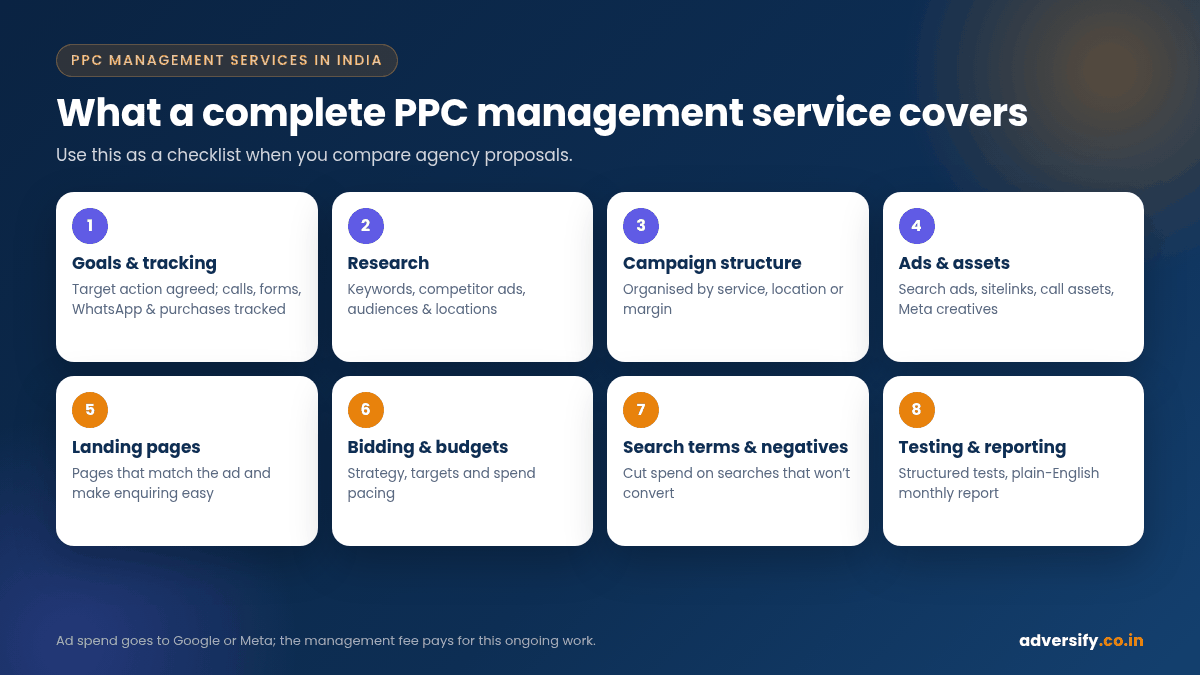
The exact scope varies by budget and platform, but a complete monthly service usually covers the areas below. Use this as a checklist when you compare proposals.
| Area | What the work involves | Why it matters |
|---|---|---|
| Goals and tracking | Agree the target action (call, form, WhatsApp, purchase), set up conversion tracking and check it fires correctly | Without reliable conversions, bidding and reporting are guesswork |
| Research | Keyword research, competitor ad review, audience and location planning | Decides who sees your ads and what you pay for |
| Campaign structure | Campaigns and ad groups organised by service, location or margin | Lets budget flow to what earns most and keeps ads relevant |
| Ads and assets | Responsive search ads, sitelinks, callouts, call assets, images and video for Meta | Affects click-through rate, ad quality and lead volume |
| Landing pages | Recommendations or builds for pages that match the ad and make enquiring easy | Clicks only turn into leads on the page |
| Bidding and budgets | Choosing manual or automated bidding, setting targets, pacing spend through the month | Controls cost per lead and avoids wasted days |
| Search terms and negatives | Reviewing the actual searches that triggered ads and excluding irrelevant ones | Stops spend leaking to searches that will never convert |
| Testing | Structured tests of ads, offers, audiences and landing pages | Improvement comes from tests, not from leaving the account alone |
| Reporting and calls | Monthly report in plain language plus a review call | You should always know what your money bought |
Tracking comes first
In Google Ads, you choose which actions count as valuable, such as a purchase, sign-up or phone call, and conversion measurement then shows which keywords, ads and campaigns drive them (Google Ads Help: About conversion measurement). For lead-generation businesses, that means tracking form submissions, calls from ads, calls from the website and WhatsApp clicks separately. A good PPC team will also ask you how many of those leads became customers, because an account that produces cheap but unqualified enquiries is not a success.
Search terms and negative keywords
The search terms report shows the actual searches that triggered your ads and how those searches performed (Google Ads Help: About the search terms report). Reviewing it regularly and adding negative keywords is one of the most practical ways to cut waste. Ask any agency how often they do this. “Weekly in the first month, then at least fortnightly” is a reasonable answer for most small and mid-sized accounts.
Bidding strategy
Automated strategies such as Target CPA aim to get as many conversions as possible at or below a target cost per action you set (Google Ads Help: About Target CPA bidding). Google requires conversion tracking before you can use Target CPA and recommends judging performance over periods with at least 30 conversions, so accurate tracking matters even more once bidding is automated. A good manager explains why a strategy was chosen and when it will be reviewed, rather than switching strategies every week.
For a deeper look at strategy choices, see our guide to PPC marketing strategies for Indian businesses.
How PPC management fees are typically structured
Before looking at fee models, separate the two costs involved:
- Ad spend: the money you pay Google or Meta for clicks and impressions. It should be billed to your own payment method in your own account.
- Management fee: what you pay the agency or freelancer for the work. This is the part that differs between providers.
If you want to understand the ad spend side, our guides on Google Ads cost in India and Meta Ads cost in India explain how CPCs and budgets work. The management fee is usually charged in one of the following ways.
1. Percentage of ad spend
The agency charges a share of your monthly media spend, often with a minimum monthly fee. It scales naturally as the account grows. The downside is that it can appear to reward spending more rather than spending better, so ask how the agency decides when to recommend a budget increase.
2. Flat monthly retainer
A fixed fee for an agreed scope: platforms, number of campaigns, landing pages, creatives and reporting. It is predictable and doesn’t change when you raise or lower spend. The risk is scope creep in either direction, so get the deliverables written down.
3. Hybrid (base fee plus percentage)
A fixed base covers core management, plus a percentage above a spend threshold. This is common for growing accounts because it covers the agency’s fixed work while scaling with the account.
4. Performance-linked fees
Some providers tie part of the fee to leads or sales. This sounds attractive but only works when both sides agree, in writing, on what counts as a qualified lead and how it is measured. Without that, you may pay for volume rather than quality.
5. One-time setup or audit fee
Many agencies charge separately for the initial audit, tracking setup and account build, then a monthly fee afterwards. That is reasonable when the setup work is substantial, such as rebuilding a messy account.
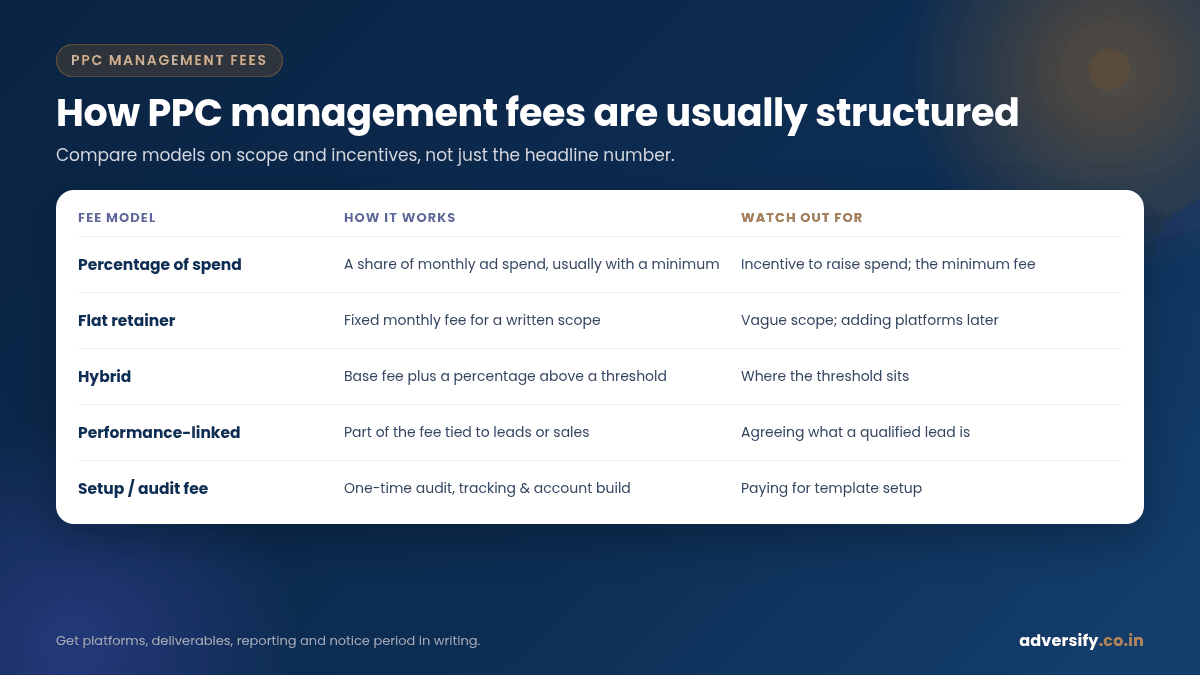
| Fee model | How it works | Often suits | Watch out for |
|---|---|---|---|
| Percentage of spend | A share of monthly ad spend, usually with a minimum | Accounts with growing or seasonal budgets | Incentive to raise spend; check the minimum fee |
| Flat retainer | Fixed monthly fee for a written scope | Stable budgets and clear deliverables | Vague scope; what happens when you add a platform |
| Hybrid | Base fee plus a percentage above a threshold | Mid-sized and scaling accounts | Where the threshold sits and how it is calculated |
| Performance-linked | Part of the fee tied to leads or sales | Businesses with clean lead tracking and CRM data | Disputes over what counts as a qualified lead |
| Setup / audit fee | One-time charge for audit, tracking and build | New or badly structured accounts | Paying for setup that is mostly templates |
An illustrative example
The numbers below are purely illustrative, to show how the models compare. They are not a price list or market data. Suppose a business spends ₹1,00,000 a month on Google Ads.
- A percentage model at 15% would mean a ₹15,000 management fee. If spend rises to ₹2,00,000, the fee becomes ₹30,000, even if the work involved has not doubled.
- A flat retainer of ₹20,000 stays at ₹20,000 whether spend is ₹80,000 or ₹1,50,000, as long as the scope stays the same.
- A hybrid of ₹12,000 plus 8% of spend above ₹1,00,000 stays at ₹12,000 at this budget and grows slowly as spend increases.
Whichever model you choose, ask for a written proposal listing platforms, deliverables, reporting frequency, contract length and notice period. Your final quote will confirm any applicable taxes.
What usually drives the fee up or down
- Number of platforms (Google only, or Google plus Meta, LinkedIn and others)
- Number of campaigns, locations and languages, including Hindi or Hinglish ad copy
- Whether landing pages, ad creatives and videos are included or billed separately
- State of tracking and the account at the start
- Reporting depth, such as CRM or offline conversion integration
How to evaluate a PPC agency: step by step
We have a separate guide on choosing a PPC company in India. Here is a practical step-by-step process focused on management quality.
Step 1: Decide what success means before you talk to anyone
Write down your target action, the rough value of a customer and the maximum you can afford to pay for a lead. If one customer is worth ₹25,000 in profit and one in five leads becomes a customer, you can afford far less than ₹5,000 per lead once you account for other costs. That number gives every conversation a clear yardstick.
Step 2: Ask for an audit of your current account
If you already run ads, ask for a short audit before signing. Give read-only access. Google Ads offers several access levels, including Email-only, Billing, Read-only, Standard and Admin, and Read-only lets someone view campaigns and reports without editing anything (Google Ads Help: About access levels). A useful audit names specific issues, such as broken tracking, wasted search terms or poor ad relevance, rather than generic advice.
Step 3: Check account ownership terms
Your Google Ads account, Meta Business portfolio, ad accounts, pixels, conversion actions and Google Analytics property should be in your name, with the agency given access. If an agency insists on running ads from its own account, you may lose your data and history when you leave.
Step 4: Understand who will actually manage the account
Ask who will log in each week, how many accounts that person manages and who covers when they are on leave. A senior person on the sales call and an overloaded junior on the account is a common mismatch.
Step 5: Ask about certifications, but don’t stop there
Google Partner status has requirements around performance, spend and certification across the agency’s managed accounts. For example, Google lists a minimum optimisation score of 70% and a 90-day ad spend requirement across managed accounts (Google Ads Help: How to become a Google Partner). It is a useful signal of experience, but it doesn’t tell you how well a specific person will run your account. Ask to see examples of reports and how they solved a problem similar to yours.
Step 6: Agree the testing plan and the first 90 days
A good agency can tell you what happens in month one (tracking, structure, launch), month two (search-term clean-up, ad tests, landing page fixes) and month three (bidding refinements, scaling what works). Vague answers here usually mean vague work later.
Step 7: Read the contract carefully
Check the minimum term, notice period, what happens to creatives and landing pages if you leave, and whether there are any charges for handing over access.
Red flags when choosing PPC management services
- Guaranteed leads or “guaranteed page one ads”. Ad position depends on a live auction. Nobody can promise fixed results without knowing your market.
- Ads run from the agency’s account. You should own the account and the data.
- Reports that only show clicks and impressions. These are activity metrics, not results.
- No questions about lead quality. An agency that never asks how many leads became customers is optimising for the wrong thing.
- Hidden ad spend mark-ups. If the agency pays Google and invoices you, ask to see the actual platform invoices.
- Long lock-in contracts with no exit clause. Reasonable notice periods are normal; being unable to leave is not.
What PPC reporting should you expect?
A monthly report should answer three questions in plain language: what did we spend, what did we get, and what are we changing next? Dashboards are helpful, but they don’t replace a short written summary.
| Report section | What it should show |
|---|---|
| Summary | Spend, conversions, cost per conversion and the change from last month, in two or three sentences |
| Lead quality | How many leads were qualified or became customers, using your feedback or CRM data |
| Campaign breakdown | Results by campaign, service or location, so you can see where budget works best |
| Search terms and negatives | Main wasted terms found and excluded |
| Tests | What was tested, what won and what will be tested next |
| Quality signals | Quality Score components and landing page issues, used as diagnostics |
| Next month’s plan | Specific actions, budget recommendations and anything needed from you |
On Quality Score, Google is explicit that it is a diagnostic tool, measured from 1 to 10 at keyword level, based on expected click-through rate, ad relevance and landing page experience, and that it is not an input in the ad auction or a key performance indicator (Google Ads Help: About Quality Score). Treat it as a pointer to what to fix, not as the goal.
Google Ads, Meta Ads or both?
Google Search captures people who are already looking for what you sell. Meta Ads reach people based on interests and behaviour before they search. Many Indian businesses start with Google Search for high-intent leads and add Meta for awareness, remarketing and offers. Our comparison of Google Ads vs Meta Ads covers this in more detail. A good PPC management service will recommend a channel mix based on your goals and budget, not sell you every platform at once.
When should you outsource PPC management?
- You spend more than a few hours a week inside the ad accounts, or you don’t check them at all.
- Cost per lead has risen and you can’t explain why.
- You are adding new platforms, cities or services and need a structure that scales.
- Your tracking is incomplete and you are not sure which campaigns produce customers.
If your budget is very small and your offer is simple, managing one Google Search campaign yourself for a few months can be a good way to learn. Bring in help once the account starts to matter to your revenue. If you are comparing agencies in our area, our guide to working with a PPC advertising company in India explains what to expect from the relationship.
Frequently asked questions
Is the management fee included in my ad budget?
Usually not. Ad spend goes to Google or Meta, and the management fee is paid separately to the agency. Always confirm this in writing, because some proposals quote a single combined figure.
How long before PPC management shows results?
Ads can bring traffic as soon as they are approved, but a newly managed account typically needs a few weeks of data to clean up search terms, test ads and stabilise bidding. Judge the first full month on learning and tracking quality, and later months on cost per qualified lead.
What is a reasonable minimum ad budget?
It depends on your cost per click and how many clicks you need to get a meaningful number of leads. If a click costs ₹40 and your site converts 1 in 20 visitors, you need about ₹800 of spend per lead. Work backwards from the number of leads you want each month.
Should I give my agency Admin access?
Give the lowest access level that lets them do the job. Standard access allows editing campaigns, while Admin access also allows managing users and links. Keep at least one Admin user from your own business.
Do you manage both Google Ads and Meta Ads?
Yes. We offer Google Ads management and Meta Ads management, and we often run both together so search and social reporting sit in one place.
Want a second opinion on your ad account?
If you are unsure whether your current campaigns are wasting money, start with an honest review. Our team in Noida and Hauz Khas, New Delhi will look at your tracking, search terms, structure and landing pages and tell you what we would change first, with no obligation to sign up. Book a free PPC consultation and bring your last three months of numbers.