
“How much do Facebook and Instagram ads cost?” has a frustrating official answer: as much as you decide to spend. Meta doesn’t publish a rate card. You set a budget, your ads enter an auction, and the price of each impression, click or lead depends on who else is bidding for the same people and how well your ads perform.
That is true, but it doesn’t help you plan. So this guide explains what actually drives Meta Ads cost in India, how CPM, CPC and cost per lead relate to each other, what indicative ranges look like by objective and industry, and how to set a budget that gives your campaigns a fair chance. Where we quote Meta’s rules, we link to Meta’s own help pages. Where we give price ranges, we label them clearly as indicative.
Key takeaways
- There is no fixed price for Meta ads. You choose a budget and Meta’s auction decides what each result costs. Meta says that, unless you choose otherwise, you are usually charged for impressions.
- Meta’s auction picks the ad with the highest total value, which combines your bid, the estimated action rate and ad quality, so a better ad can beat a bigger bid.
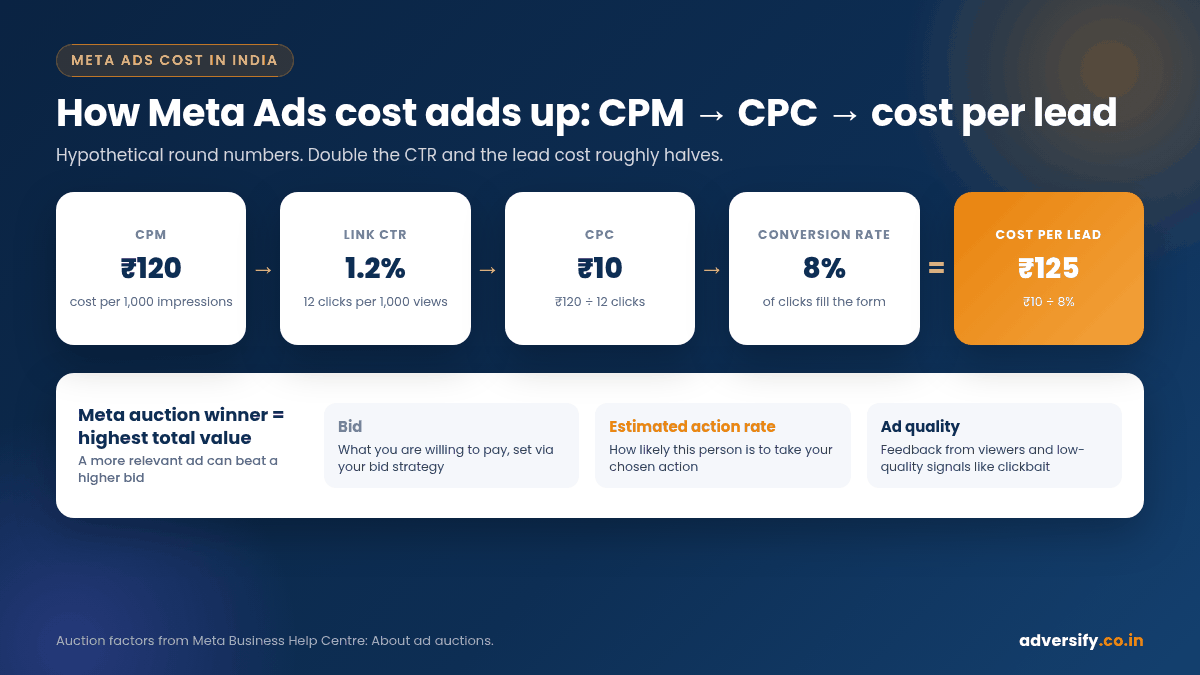
- Your cost per lead is the result of three numbers: CPM (cost per 1,000 impressions), click-through rate and conversion rate. Improve any one of them and the lead gets cheaper.
- The ranges in this article are indicative planning figures, not Meta data or a survey. Replace them with your own numbers after the first two to four weeks.
- Plan budget around the learning phase: Meta says ad sets usually exit learning after about 50 results in a week. Small budgets work better with fewer ad sets and easier optimisation events.
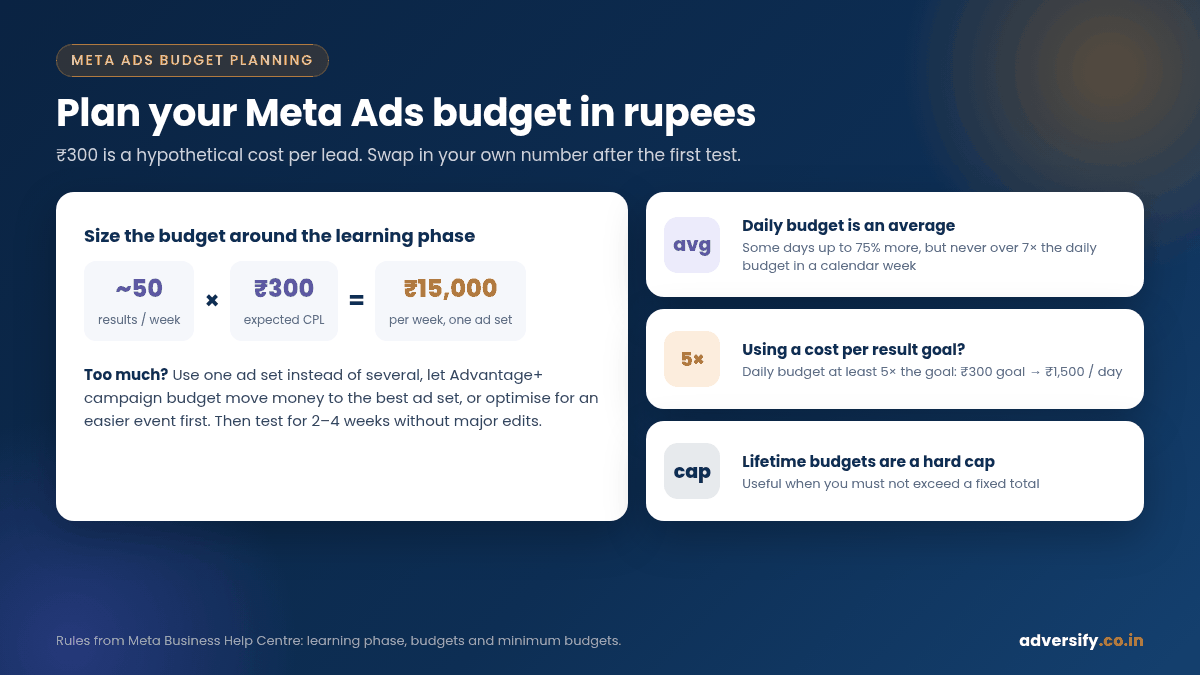
- Daily budgets are an average, not a hard cap. Meta may spend more on some days, but not more than seven times your daily budget in a calendar week.
The short answer: what Meta Ads cost in India
You can start Meta ads with a small daily budget, and Meta sets minimum budgets that vary by country and objective (Meta Business Help Centre: Best practices for minimum budgets). What you actually pay per result is set by the auction. Two businesses spending the same ₹20,000 in a month can end up with very different results: one gets 40 leads, the other gets 200, because their audience, offer, creative and landing experience are different.
That is why the useful question isn’t “what does a Meta ad cost?” but “what will a lead or sale cost me, and how much do I need to spend to find out?” The rest of this guide answers both.
How Meta charges you
When you advertise on Facebook, Instagram, Messenger, WhatsApp or the Audience Network, you set a budget and Meta spends it through an auction. Meta’s help centre says that usually you are charged based on the number of impressions your ad receives, unless you choose something different when creating the ad (Meta Business Help Centre: How Meta charges for ads).
There are two common payment settings. With automatic billing, your card is charged each time you reach your payment threshold and again on your monthly bill date. With available funds, you add money in advance (for example by UPI or card, where offered) and Meta deducts spend from that balance. Either way, the amount you are charged depends on delivery, not on a fixed price per ad.
Taxes on Meta ads in India
Meta states that ads for accounts with India as the business country are sold by Meta India, billed in rupees and subject to GST and TDS, and that GST and TDS are added whenever you are charged (Meta Business Help Centre: About India’s GST). If you are GST-registered, Meta lets you add your GSTIN to the ad account. Meta also notes it can’t give tax advice, so check the details with your accountant.
How the Meta ad auction sets your price
Every time someone could see an ad, Meta runs an auction. The winner is not simply the highest bidder. Meta picks the ad with the highest “total value”, which it describes as a combination of three things (Meta Business Help Centre: About ad auctions):
- Bid: what you are willing to pay, set directly or through your bid strategy.
- Estimated action rate: how likely this person is to take the action you are optimising for.
- Ad quality: how relevant and engaging the ad is, using signals such as feedback from people who see or hide it.
The practical lesson is that creative quality and relevance directly affect cost. An ad that people stop for, watch and act on can win auctions at a lower price than a dull ad with a bigger bid. Meta also says engagement bait and clickbait don’t help.
The metrics that make up Meta Ads cost
Meta costs are easiest to understand as a chain. Each link affects the next.
| Metric | What it means | Formula |
|---|---|---|
| CPM | Cost per 1,000 impressions | Amount spent ÷ impressions × 1,000 |
| CTR (link) | Share of people who click the link after seeing the ad | Link clicks ÷ impressions |
| CPC (link) | Cost per link click | Amount spent ÷ link clicks, or CPM ÷ (CTR × 1,000) |
| Conversion rate | Share of clicks that become a lead or sale | Results ÷ link clicks |
| CPL or CPA | Cost per lead or cost per acquisition | Amount spent ÷ results, or CPC ÷ conversion rate |
| ROAS | Return on ad spend | Revenue from ads ÷ amount spent |
A worked example with round, hypothetical numbers: if your CPM is ₹120 and 1.2% of people click, your CPC is ₹10. If 8% of those clicks fill in your form, each lead costs ₹125. Double the CTR with better creative, and the lead cost roughly halves without touching the bid.
Indicative Meta Ads cost ranges by objective
The table below gives indicative planning ranges for Indian campaigns. They are not Meta figures and not from a published survey; real costs vary widely with city, audience, season, offer and creative. Use them to sanity-check your first test, then replace them with your own data.
| Objective (Ads Manager) | What you usually optimise for | Indicative cost metric | Indicative range (INR) |
|---|---|---|---|
| Awareness | Reach, ad recall, video views | CPM | ₹30 to ₹150 per 1,000 impressions |
| Traffic | Link clicks or landing page views | CPC (link) | ₹2 to ₹20 per click |
| Engagement | Messages on WhatsApp, Messenger or Instagram | Cost per conversation started | ₹15 to ₹150 |
| Leads (instant form) | Form submissions inside Facebook or Instagram | CPL | ₹50 to ₹500 |
| Leads (website form) | Form submissions on your site | CPL | ₹100 to ₹1,000 |
| Sales | Purchases on your website | Cost per purchase | ₹150 to ₹2,000+, depending largely on price point |
Meta offers six objectives in Ads Manager: Awareness, Traffic, Engagement, Leads, App promotion and Sales (Meta Business Help Centre: How to choose the right ad objective). Cheaper metrics higher up the funnel don’t mean cheaper customers. A ₹3 click from a Traffic campaign that never converts costs more in the end than a ₹400 lead that becomes a client.
Indicative cost per lead by industry
Again, these are indicative planning figures for lead-generation campaigns in Indian metros such as Delhi NCR, not measured averages:
| Industry | Indicative CPL (INR) | Why it sits there |
|---|---|---|
| Salons, gyms, cafés, local retail | ₹50 to ₹300 | Visual, offer-friendly, broad local audiences |
| Clinics and wellness | ₹100 to ₹500 | Higher intent needed; health ad policies limit some claims and targeting |
| Education and coaching | ₹100 to ₹600 | Heavy competition around admission seasons |
| Home services and interiors | ₹150 to ₹800 | Higher ticket, smaller qualified audience |
| Real estate | ₹200 to ₹1,500+ | Many advertisers chasing the same high-value buyers; leads need careful qualifying |
| B2B services and software | ₹300 to ₹2,000+ | Niche job roles are harder to reach precisely on Meta |
Pay more attention to cost per qualified lead than to raw CPL. Instant forms are often cheaper per lead than website forms, but quality can be lower. Adding one or two qualifying questions usually raises CPL and improves the leads your sales team actually wants.
What makes Meta ads more expensive (or cheaper)
1. Audience competition
You pay more when many advertisers want the same people. Large metros, high-income audiences and popular categories cost more to reach than smaller towns or broad audiences.
2. Season and festivals
Competition often rises around Diwali and the wider festive season, big sale events and, for education, admission months. Plan higher costs and earlier launches for those periods.
3. Your optimisation event
Meta notes that some optimisation events need more budget than others; optimising for purchases may need more budget than optimising for landing page views (Meta: minimum budgets). Harder events cost more per result but bring better results.
4. Creative quality and fatigue
Since ad quality and estimated action rate feed into the auction, weak creative raises costs. Even good creative wears out: when the same people see an ad repeatedly, results usually drop. Watch frequency and refresh creatives regularly.
5. The learning phase
Meta says ad sets usually exit the learning phase after about 50 results in the week after the last significant edit, and that cost per result is usually higher during learning (Meta Business Help Centre: About the learning phase). Frequent edits and many small ad sets keep campaigns there longer.
6. Landing experience
A slow or confusing landing page lowers conversion rate, which raises cost per lead even when CPM and CPC look healthy.
How to plan your Meta Ads budget in five steps
- Set your target cost per lead or sale. Work backwards from what a customer is worth and your close rate.
- Estimate a starting CPL. Use the indicative table above, or better, your own past results.
- Size the budget around learning. For one ad set to reach about 50 results a week, weekly budget ≈ 50 × expected cost per result. At ₹300 per lead that is about ₹15,000 a week.
- If that is too much, simplify. Use one ad set instead of five, use Advantage+ campaign budget so Meta can move money to the best ad set, or optimise for an earlier, cheaper event until volume builds.
- Commit to a test period. Give the campaign two to four weeks without major edits, then judge it on cost per qualified lead.
How Meta spends a daily budget
Meta treats daily budgets as an average over the week, not a hard daily cap. Meta says it is gradually introducing more flexibility so that on good days it may spend up to 75% over your daily budget and less on others, but it won’t spend more than seven times your daily budget in a calendar week (Sunday to Saturday). Lifetime budgets, by contrast, are a hard cap (Meta Business Help Centre: About budgets). So a ₹1,000 daily budget can mean ₹1,500 on Tuesday and ₹600 on Thursday, while the week stays at or under ₹7,000.
If you use a cost goal
Meta’s bid strategies include Highest volume, Highest value, Cost per result goal, ROAS goal and Bid cap (Meta Business Help Centre: About bid strategies). If you set a cost per result goal, Meta recommends a daily budget of at least five times that goal. A ₹300 cost goal therefore needs at least ₹1,500 a day. Meta also notes that hitting a cost or ROAS goal is not guaranteed, and that goal-based bidding works best with 50 to 100 or more conversions a week.
Example monthly plans (illustrative)
| Monthly ad spend | Suggested set-up | What it can realistically do |
|---|---|---|
| ₹10,000 to ₹20,000 | One campaign, one or two ad sets, three to four creatives; retargeting or a simple local offer | Test an offer and creative, retarget website visitors, gather first data |
| ₹20,000 to ₹60,000 | Prospecting campaign plus retargeting; Advantage+ campaign budget | Steady lead flow for many local businesses; enough data to compare creatives |
| ₹60,000 and above | Separate campaigns by service or product line, regular creative testing | Scale proven offers, test new audiences and placements |
These are illustrative, not minimums. Meta’s actual minimum budget depends on your currency, objective and settings, and Ads Manager will warn you if you are below it.
Meta Ads cost vs Google Ads cost
We have compared the two platforms in detail in Google Ads vs Meta Ads for small businesses, and covered search click prices and budgeting in Google Ads cost in India, so we won’t repeat that here. The short version: Meta clicks and impressions often look cheaper because you are reaching people who weren’t searching, while Google clicks cost more because the person is already looking. Judge both on cost per qualified lead.
Ad spend vs management fees
Your total cost of running Meta ads has two parts:
- Ad spend, paid directly to Meta from your ad account.
- Management and creative, paid to whoever plans, builds and optimises the campaigns, whether that is your own team, a freelancer or an agency.
At Adversify, our Meta Ads management plans run from Bronze (up to 2 campaigns) to Platinum (up to 10 campaigns), on month-to-month contracts. Each plan includes audience research, campaign setup, ad copywriting, Meta Pixel and conversion tracking, A/B tests and reporting, and your ad budget is planned separately based on your goals. Your quote will confirm the exact fee and any applicable taxes.
Seven ways to lower your Meta Ads cost
- Fix tracking first. Install the Meta Pixel and the Conversions API so Meta learns from real results (Meta: About Conversions API).
- Consolidate. Fewer ad sets with more budget each exit learning sooner.
- Test creative, not just audiences. Try clearly different hooks, formats and offers.
- Use vertical video. Reels and Stories placements suit short, vertical, sound-optional video.
- Retarget warm audiences. Website visitors and profile engagers usually convert at a lower cost than cold audiences.
- Qualify leads. A slightly higher CPL with better leads is a lower cost per customer.
- Stop editing daily. Significant edits can restart learning.
Frequently asked questions
Is ₹500 a day enough for Meta ads in India?
It can be enough to test an offer or run retargeting for a local business, roughly ₹15,000 a month. It is usually not enough to get one ad set to around 50 leads a week unless your cost per lead is very low, so keep the structure simple.
Are Instagram ads more expensive than Facebook ads?
There is no fixed rule. Both run through the same auction in Meta Ads Manager, and costs depend on audience, placement and creative. Most advertisers let Meta choose placements and then check the breakdown by platform.
Is boosting a post cheaper than running ads from Ads Manager?
Boosting uses the same auction, so it isn’t cheaper per impression. Ads Manager gives you more control over objectives, optimisation events, audiences and reporting, which usually means better value.
Why did my Meta Ads cost suddenly go up?
Common reasons are festive-season competition, creative fatigue, a significant edit that restarted learning, a narrower audience, or a tracking issue that stopped results from being recorded.
Does Meta charge per click or per impression?
Meta says you are usually charged for impressions unless you choose otherwise when creating the ad. Your cost per click or lead is then worked out from what you spent.
How long should I test before judging cost?
Two to four weeks without major edits is a reasonable minimum for most small accounts. Judge on cost per qualified lead or sale, not on the first few days.
Plan your Meta budget with us
If you want a realistic Meta Ads budget for your business, or a second opinion on why your current cost per lead is high, talk to us. Our team in Noida and Hauz Khas, New Delhi will look at your offer, creative, tracking and numbers and suggest a test plan. Book a free ads review and consultation and we will reply within one business day.