
Most startups know they “should do SEO”, but few have the time, people or marketing budget to do everything an agency checklist recommends. The founders are building the product, selling to the first customers and raising money, all at once. In that situation, SEO for startups is less about doing more and more about doing the right few things in the right order, so that every hour you put in keeps paying back.
This guide is written for Indian startups with a small budget: SaaS products, D2C brands, marketplaces, fintech and edtech apps, and service startups that sell in one city first. It explains where search fits in your growth plan, what to do before and after launch, how to choose keywords you can actually win, and how to run a lean 90-day plan without wasting money on tactics that Google itself warns against. Wherever we refer to how Google works, we link to Google’s own documentation so you can check it.
Key takeaways
- SEO for startups works best as a long-term, compounding channel that runs alongside faster channels such as referrals, sales outreach and paid ads, not as a replacement for them.
- Get the foundations right first: a crawlable, fast, mobile-friendly website, Google Search Console, analytics with conversion tracking, and a clean site structure.
- Small budgets win by focusing: pick a narrow set of high-intent, low-competition keywords tied to what you sell, and build one excellent page for each.
- Content that shows real product knowledge, founder experience and original data beats generic articles. Earn links through genuinely useful assets and PR, not paid link packages.
- Measure sign-ups, demo requests, leads and sales from organic search, not just rankings. No one can guarantee a #1 ranking on Google.
Why SEO matters for startups (and where it fits)
Search is where people go when they already have a problem and are looking for a solution. If your product solves that problem, appearing for the right searches brings visitors who are ready to act. Unlike paid ads, those visits do not stop the day you pause spending, and a good page can keep bringing in sign-ups for years.
The trade-off is time. Google needs to discover, crawl and understand your pages, and new websites usually have little authority. Our guide on how long SEO takes explains why results often build over several months rather than weeks. That is why most startups should treat search as one of two or three growth channels:
- Fast channels (founder-led sales, referrals, partnerships, communities, paid search and social ads) bring the first customers and teach you what they search for and how they describe the problem.
- Compounding channels (SEO and content) start slowly but lower your cost of acquiring customers over time and make you less dependent on ad platforms.
Running both is usually the best approach. What you learn from sales calls and ad search-term reports feeds directly into your keyword and content plan.
Is SEO worth it for every startup?
Not equally. SEO tends to be a strong channel when people actively search for your category or the problem you solve, for example “GST billing software for shops” or “organic baby food online”. It is a weaker first channel when you are creating a completely new category that nobody searches for yet. In that case, focus on problem-based searches, comparisons and educational content, and build brand demand through other channels first.
| Startup type | How people search | Where SEO usually helps first |
|---|---|---|
| B2B SaaS | Problem, category, “software for X”, alternatives, integrations | Use-case pages, comparison pages, integration pages, helpful guides |
| D2C / e-commerce brand | Product type, ingredient, benefit, “buy X online” | Category and product pages, buying guides, structured data |
| Local service startup | Service plus city or “near me” | Google Business Profile, city and service pages, reviews |
| Marketplace or platform | Category plus location, listings | Category and location pages with real, unique inventory |
| Fintech / edtech app | How-to questions, calculators, eligibility, exam or course names | Expert guides, tools, clear and trustworthy product pages |
The startup SEO foundations: get these right once
Many startups launch on a quickly built site and later find that pages are not being indexed, tracking is broken, or the structure has to be rebuilt. Fixing the foundations early is the cheapest SEO work you will ever do. Google’s SEO Starter Guide is a good free reference for the basics.
1. A website Google can crawl and understand
- Make sure important pages are reachable through normal HTML links and are not blocked by robots.txt or a “noindex” tag left over from staging.
- If your product site is a JavaScript app, check that key marketing pages render their main content in a way Google can see. Many startups keep marketing pages on a CMS such as WordPress and the app on a subdomain.
- Submit an XML sitemap. Google explains what sitemaps do and how to build them in its sitemaps overview.
2. Mobile-friendly and fast
Google uses mobile-first indexing, which means it mainly uses the mobile version of your content for indexing and ranking. A large share of Indian users browse on phones, so test every key page on a mid-range Android device. Google’s Core Web Vitals guidance suggests aiming for Largest Contentful Paint within 2.5 seconds, Interaction to Next Paint under 200 milliseconds and Cumulative Layout Shift under 0.1.
3. Search Console and analytics from day one
- Verify your domain in Google Search Console. It is free and shows which searches bring impressions and clicks, which pages are indexed and any problems Google finds.
- Set up Google Analytics 4 (Google’s setup guide) and mark your real goals as key events: sign-ups, demo requests, trial starts, purchases, WhatsApp clicks or form submissions.
- Without tracking, you will not know whether SEO is producing customers or just visits.
4. A simple, scalable site structure
Plan the main sections before you write content: home, product or service pages, use-case or industry pages, comparison pages, resources or blog, and about/contact. Link related pages to each other with descriptive anchor text. If you are on WordPress, our internal linking guide for WordPress shows how to structure this.
5. Brand and trust basics
- A clear about page with the founders, the team and the company’s real details.
- Contact information, privacy policy and terms that match how you actually operate.
- Consistent company name, logo and social profiles so Google and users can connect the dots.
- Structured data such as Organization, Product or FAQ where it genuinely fits. Google’s introduction to structured data explains how it works, and our guide on adding schema covers the practical side.
Keyword strategy for startups: pick battles you can win
Big, generic keywords such as “accounting software” or “skincare” are dominated by established brands, marketplaces and publishers. A new site rarely wins them early. A small-budget plan focuses instead on searches that are specific, close to a purchase decision and directly tied to what you sell.
The four keyword buckets that matter most
| Bucket | Examples (illustrative) | Page to build | Priority |
|---|---|---|---|
| Problem and use case | “track field staff attendance”, “invoice reminders on WhatsApp” | Use-case or solution page | High |
| Category plus qualifier | “HR software for small business”, “sugar-free protein bar” | Product or category page | High |
| Comparison and alternatives | “X vs Y”, “alternatives to X” | Honest comparison page | Medium to high |
| Questions and how-to | “how to file GST return”, “how to start a cloud kitchen” | Helpful guide that links to product | Medium (builds authority) |
How to find these keywords on a small budget
- Talk to customers. Write down the exact words they use to describe the problem in sales calls, support chats and reviews.
- Use free tools. Google autocomplete, “People also ask”, related searches and Search Console’s performance report (once you have some impressions) are free and very useful.
- Mine paid search data. If you run Google Ads, the search terms report shows real queries that led to clicks and conversions.
- Check who ranks. Search each keyword. If the first page is full of huge brands and government sites, look for a more specific variation. If it shows forums, small blogs or thin pages, you have a chance.
- Consider language. Many Indian users search in Hindi, Hinglish or regional languages. Our guide to Hindi and Hinglish keyword research explains how to find and map those searches.
Start with a short list, perhaps 15 to 30 keywords grouped into 8 to 12 page topics. That is enough work for the first quarter, and it keeps the team focused.
Content that works for startups
Google’s guidance on creating helpful, reliable, people-first content asks whether content shows first-hand experience and expertise, and whether it would satisfy someone who arrived from search. Startups actually have an advantage here: founders and product teams know their problem space deeply. Use that.
Content types worth the effort
- Use-case and industry pages that explain how the product solves a specific problem, with screenshots, steps and real limitations.
- Honest comparison pages that state where your product is and is not the right choice. Readers trust balance.
- Founder-led guides that share lessons from building in your space, written or reviewed by someone who knows it.
- Original data and tools: small surveys, anonymised usage insights, calculators, templates or checklists. These earn links naturally.
- Help-centre and documentation pages, which often rank for long-tail “how to” searches and support existing customers.
What to avoid
- Publishing large volumes of generic or AI-spun articles that add nothing new. Google’s spam policies describe scaled content abuse, where many pages are produced mainly to manipulate rankings.
- Creating near-identical city or keyword pages with only the place name swapped.
- Writing about topics unrelated to your product just because they have search volume.
Link building for startups without buying links
Links from relevant, trusted websites still help Google discover and assess your pages. But buying links or joining link exchanges is listed under link spam in Google’s spam policies and can hurt more than it helps. Startups have plenty of legitimate options:
- Launch and funding news. Product launches, funding rounds, partnerships and milestones can earn coverage in startup and industry media.
- Founder visibility. Podcasts, guest articles, conference talks and expert quotes for journalists often include a link.
- Ecosystem listings. Accelerator, incubator, investor portfolio and partner or integration pages. If you are recognised under the government’s Startup India programme, keep your profile accurate and complete.
- Linkable assets. Free tools, templates, research and guides that others want to cite.
- Customers and communities. Case studies with customers, useful answers in relevant communities and open-source contributions.
Quality matters far more than quantity. A handful of links from respected, relevant sites is worth more than hundreds of low-quality directory links. If you want help planning outreach, see our link building services.
Local SEO for startups that sell in a city
If your startup serves customers in specific cities, such as a home-services app in Noida or a clinic chain in Delhi NCR, local search can be your fastest SEO win.
- Create and verify a Google Business Profile that follows Google’s guidelines for representing your business.
- Choose accurate categories, add real photos, opening hours and services, and keep your name, address and phone number consistent everywhere.
- Ask happy customers for honest reviews and reply to them. Never buy or incentivise fake reviews.
- Build one useful page per city or service you genuinely serve, with local details rather than copied text.
Our local SEO services page explains how we approach this for multi-location businesses.
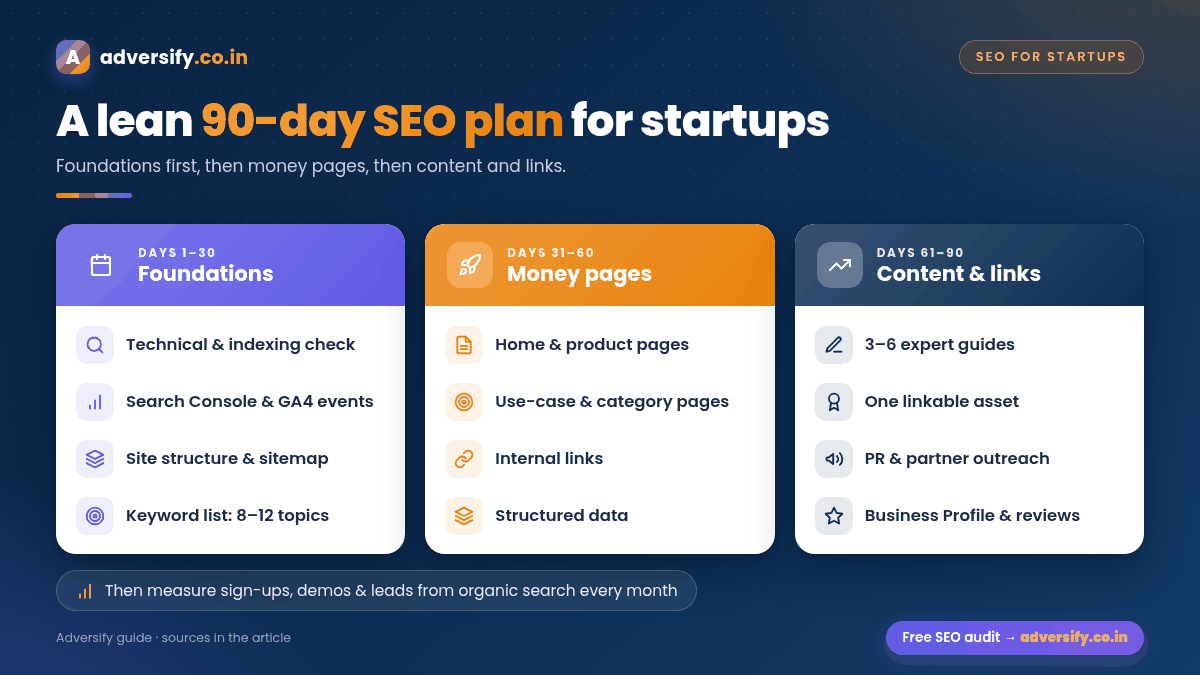
A lean 90-day SEO plan for startups
Here is a practical sequence that a small team, or a founder with a few hours a week plus some outside help, can follow. Adjust the pace to your resources.
| Phase | Focus | Key tasks | Output |
|---|---|---|---|
| Days 1-30 | Foundations and tracking | Technical check, Search Console, GA4 key events, sitemap, site structure, keyword list | Indexable site, working tracking, 8-12 page topics |
| Days 31-60 | Money pages | Improve home and product pages, build use-case, category or city pages, add internal links and structured data | Core pages that match buyer searches |
| Days 61-90 | Content and authority | Publish 3-6 expert guides or comparisons, one linkable asset, PR and partner outreach, Business Profile and reviews | First content cluster and early links |
| Ongoing | Measure and iterate | Monthly review of Search Console and conversions, refresh pages that get impressions but few clicks | Clear priorities for the next quarter |
Step-by-step for the first month
- List your top three customer problems and the product pages that solve them.
- Check that those pages are indexed (use the URL Inspection tool in Search Console).
- Fix obvious technical issues: broken links, missing titles, duplicate pages, slow images.
- Write a unique title tag and meta description for every key page.
- Set up conversion tracking and confirm a test sign-up or form submission is recorded.
- Build your keyword list and map each keyword group to one page.
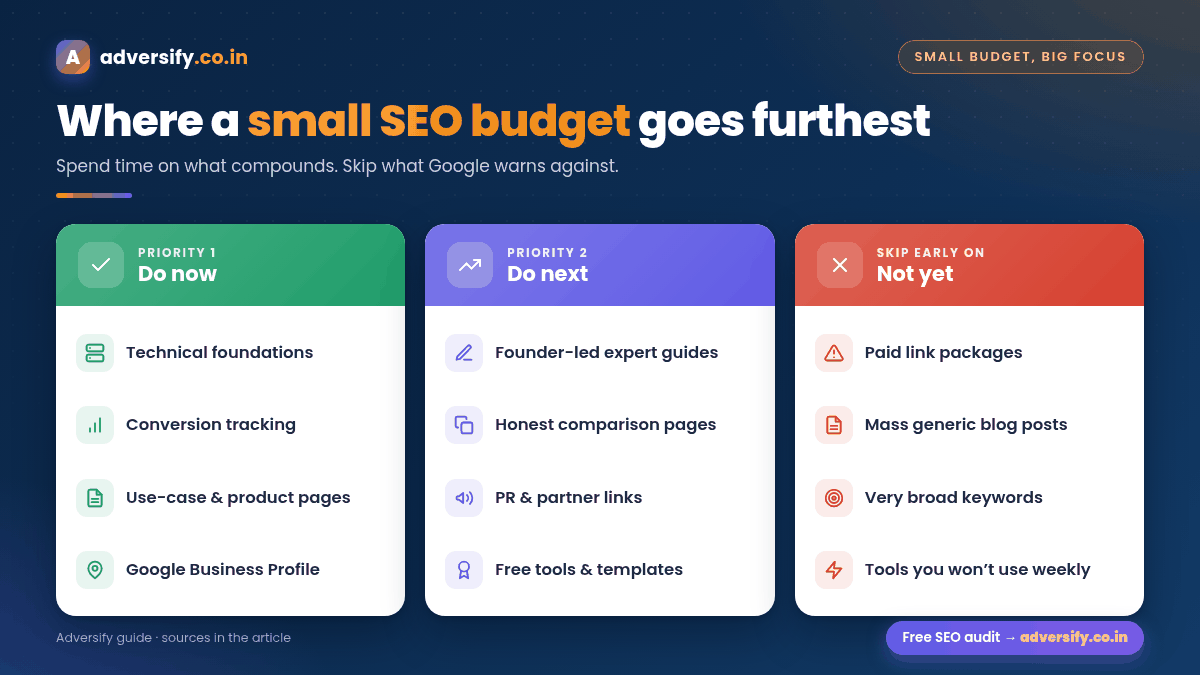
How to stretch a small SEO budget
A small budget is mostly a question of where to spend time and money. These choices make the biggest difference:
| Do in-house | Consider outside help for | Usually skip early on |
|---|---|---|
| Customer research and keyword ideas | Technical audit and fixes | Paid link packages |
| Founder insights for content | Site structure and page templates | Hundreds of generic blog posts |
| Reviews and customer stories | Editing and on-page optimisation | Chasing very broad keywords |
| PR and community activity | Strategy, reporting and prioritisation | Expensive tools you will not use weekly |
Small businesses face many of the same trade-offs; our guide to SEO services for small businesses covers what a typical engagement includes.
What to measure
Rankings are useful for diagnosis, but they are not the goal. Track metrics that connect search to growth:
- Organic conversions: sign-ups, demo requests, trials, leads or orders from organic search (GA4).
- Non-brand clicks and impressions: searches that do not include your brand name show whether you are reaching new people (Search Console).
- Pages indexed and their performance: which pages earn impressions and which do not.
- Click-through rate: pages with many impressions but few clicks often need better titles and descriptions.
- Referring domains: the number of relevant sites linking to you over time.
A short monthly report covering these is enough for most startups. Our article on what a monthly SEO report should include lists the sections that matter.
Common SEO mistakes startups make
- Launching with “noindex” still enabled from staging, or blocking the site in robots.txt.
- Changing domains or URL structures after launch without 301 redirects. Google’s guide to site moves with URL changes explains how to do it safely.
- Building the whole marketing site as a single page with no room for product, use-case and content pages.
- Writing only for brand searches and ignoring the problems customers search for.
- Expecting results in a few weeks, then stopping before the work compounds.
- Trusting anyone who guarantees rankings. Google’s own page on hiring an SEO states that no one can guarantee a #1 ranking on Google.
When to bring in an SEO partner
Many founders handle the basics themselves. Outside help tends to make sense when organic search becomes an important channel but nobody in the team has time to own it, when you are planning a migration or redesign, or when you need a clear plan to turn traffic into sign-ups. Look for a partner who starts with an audit of your site and data, explains the plan in plain language, keeps your accounts in your name and reports on conversions.
As one real example of what focused work can achieve, our client ERA Global gained 1,200+ visits and 32 page-one keywords within four months. Results depend on your market, competition, website and how consistently the plan is executed, so treat this as an example rather than a promise. You can read more on our case study page.
Frequently asked questions
What is SEO for startups?
It is the process of making a startup’s website easy for search engines to find, understand and rank for searches that its potential customers make, with a focus on doing the highest-impact work first because time and budget are limited.
When should a startup start SEO?
Ideally before or at launch, at least for the foundations: an indexable site, Search Console, analytics and a sensible structure. Content and link building can then grow as you learn what customers search for.
How long does SEO take for a new startup website?
It varies with competition, site quality and consistency. New sites often take several months to see meaningful organic traffic, which is why SEO usually runs alongside faster channels at first.
Can a startup do SEO without an agency?
Yes. Many of the most valuable tasks, such as customer research, founder-led content, reviews and PR, are best done in-house. Outside help is most useful for technical work, strategy and editing.
Is SEO better than paid ads for startups?
They do different jobs. Paid ads can bring traffic quickly and help you test messages; SEO builds lasting visibility. Most startups benefit from both, using ad data to inform the SEO plan.
Get a startup-friendly SEO plan
Adversify works with startups and growing businesses across India from our offices in Noida and New Delhi. We can review your website, tracking and keyword opportunities and give you a prioritised plan that fits your stage and resources, whether you want us to handle SEO end to end or just guide your team. We don’t guarantee rankings; we focus on clear work and honest reporting. Request a free SEO audit or contact our team to talk about your startup.