
For a small business, SEO can feel like a black box. One agency quotes a monthly retainer with a long list of deliverables, a freelancer offers “complete SEO” for a fraction of that, and a friend tells you to just post on Instagram. Meanwhile, you still don’t know what SEO services for small business are supposed to include, which parts matter most when the budget is limited, or how to tell whether any of it is working.
This guide answers those questions. It breaks small business SEO into its core services, shows how to prioritise them on a small budget, lays out a practical 90-day plan, compares doing it yourself with hiring a small business SEO agency, and explains what to measure each month. It is written for owners of shops, clinics, consultancies, service businesses and small ecommerce stores in India, although most of it applies anywhere.
Key takeaways
- SEO services for a small business should cover five areas: technical foundations, on-page optimisation, useful content, local visibility and measurement. Link building comes later and should be earned, not bought.
- On a small budget, fix what stops Google from finding and understanding your site first, then improve the few pages that bring enquiries, then add content.
- A 90-day plan should end with a healthy site, optimised money pages, a working Business Profile, a handful of useful articles and a clear baseline to measure against.
- Google says small local businesses can probably do much of the work themselves. An agency earns its fee when it saves time, fixes what you can’t and works consistently every month.
- Measure SEO by enquiries, calls and sales first, then by clicks and impressions in Search Console. Rankings are a signal, not the goal.
What SEO actually means for a small business
Search engine optimisation is the work of helping search engines find, understand and show your website to people searching for what you offer. For a small business, it is less about competing with national brands and more about being the obvious, trustworthy choice for a specific set of searches: your services, in your area, for your kind of customer.
Google’s own SEO Starter Guide is a good place to start, and it is refreshingly practical. It also sets realistic expectations: Google says changes you make can take anywhere from a few hours to several months to be reflected, and that you will likely want to wait a few weeks to assess whether your work had a beneficial effect. That patience is part of the job.
One more point that surprises many owners: Google states that it never accepts money to include or rank sites in its organic results, and that advertising with Google has no effect on them (Google Search Central: Do you need an SEO?). SEO is earned visibility. You pay for the work, not for the position.
The core SEO services a small business needs
Whether you do the work yourself or hire someone, these are the building blocks. A good proposal from a small business SEO agency should explain which of them it covers and in what depth.
| Service | What it covers | Why it matters for a small business |
|---|---|---|
| Technical foundations | Indexing, sitemap, HTTPS, mobile layout, page speed, broken pages and redirects | If Google can’t crawl or index a page, nothing else you do on it counts |
| Keyword and page mapping | Finding the searches customers use and matching each one to a single page | Stops your own pages competing with each other and shows where pages are missing |
| On-page optimisation | Titles, meta descriptions, headings, copy, images and internal links | Helps Google and customers understand each page at a glance |
| Content | Service pages and articles that answer real customer questions | Gives you more ways to be found and builds trust before the first call |
| Local SEO | Google Business Profile, consistent business details, reviews, location pages | Most small businesses win or lose on local and “near me” searches |
| Links and mentions | Genuine references from suppliers, associations, local media and partners | Builds prominence over time; bought links create risk |
| Measurement and reporting | Search Console, analytics, call and form tracking, monthly review | Shows what is working so the budget goes where it pays |
Technical foundations
Technical SEO for a small site is rarely complicated, but it has to be right. Check that your important pages are indexed, that there is an XML sitemap submitted in Search Console, that the site loads over HTTPS and works well on a phone. Google’s Core Web Vitals give clear targets for page experience: Largest Contentful Paint within 2.5 seconds, Interaction to Next Paint under 200 milliseconds and Cumulative Layout Shift under 0.1 (Google Search Central: Core Web Vitals). Many small WordPress sites miss these because of heavy themes, oversized images or too many plugins.
On-page optimisation
Each important page should have a clear, specific title, a helpful meta description, one main heading and copy that says plainly what you offer, where and for whom. Link related pages together so visitors and Google can move between your services, location pages and articles.
Content
Small businesses have an advantage here: you answer customer questions every day. Turn the most common ones into pages and articles. Google’s guidance on helpful content asks whether your content shows first-hand expertise and whether someone reading it will leave feeling they learned enough to achieve their goal (Google Search Central: Creating helpful, reliable, people-first content). A plumber explaining what causes low water pressure, in plain language, meets that bar better than a generic 2,000-word article.
Local SEO
If you serve customers in a particular area, your Google Business Profile is often your most important search asset. We covered how to prioritise local work on a tight budget in detail in our guide to affordable local SEO services, so we won’t repeat it here. In short: complete and verify your profile, keep your details consistent and build a steady flow of genuine reviews.
Links and mentions
Links from other websites still help Google understand which businesses are well known. For a small business, the best ones usually come from real relationships: suppliers, trade associations, local news, event sponsorships and partner businesses. Google’s spam policies list buying links and using automated programs to create links as link spam (Google Search Central: Spam policies), so avoid any package that sells links by the hundred.
How to prioritise SEO on a small budget
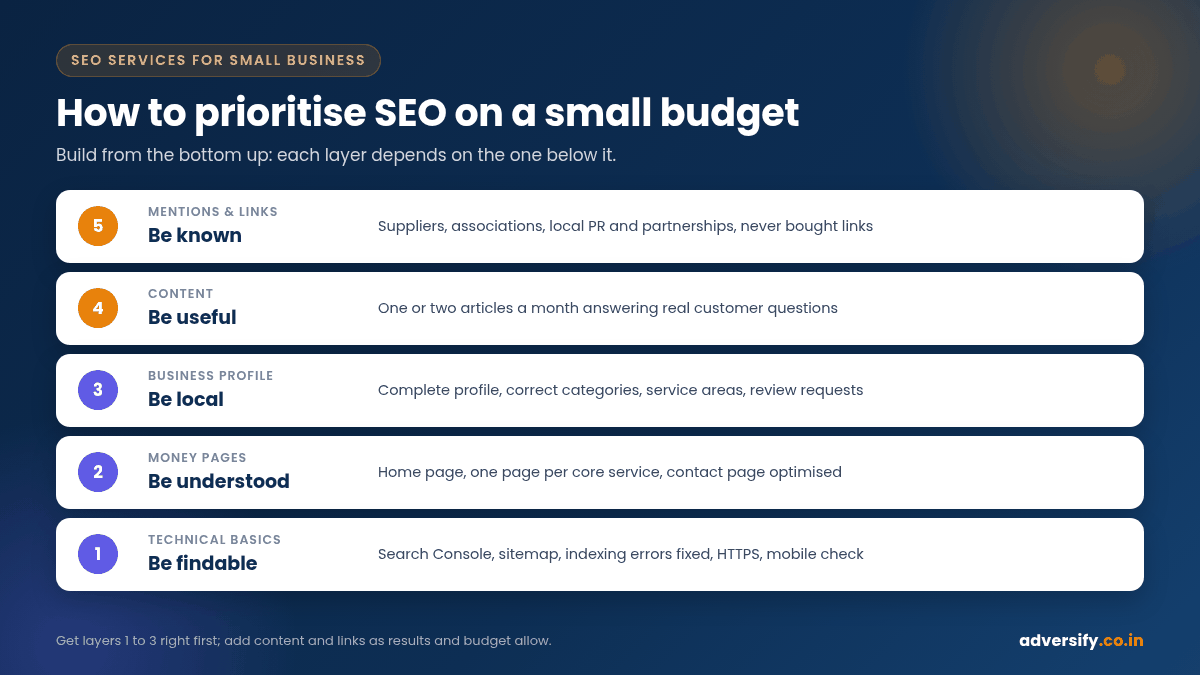
Most small businesses can’t do everything at once, and they don’t need to. The order matters more than the volume. Work from the bottom of the stack upwards: there is no point writing articles for pages Google can’t index, or building links to a service page that doesn’t convert.
| Priority | Focus | Typical tasks |
|---|---|---|
| 1. Be findable | Technical basics | Search Console set up, sitemap submitted, indexing errors fixed, HTTPS, mobile check |
| 2. Be understood | Money pages | Home page, one page per core service, contact page optimised |
| 3. Be local | Business Profile | Complete profile, correct categories, service areas, review requests |
| 4. Be useful | Content | One or two articles a month answering real customer questions |
| 5. Be known | Mentions and links | Supplier and association listings, local PR, partnerships |
If your budget only covers the first three priorities for now, that is fine. Priorities two and three are the pages and profile customers actually contact you from, so get them right before scaling content. Add content and links as results and budget allow. For a sense of how scope changes with budget, our SEO plans run from Bronze, for a smaller set of keywords and pages, up to Platinum for larger sites; your final quote will confirm any applicable taxes.
A 90-day SEO plan for a small business
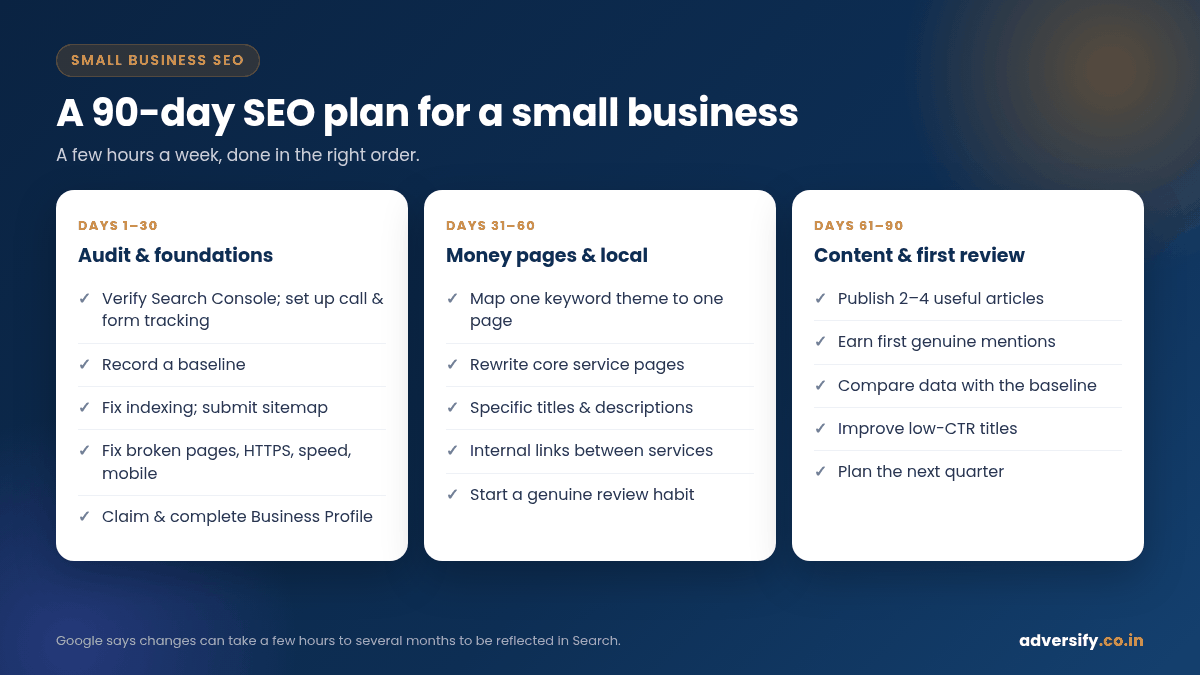
Here is a practical first quarter that works for most small business websites. It assumes a few hours of work a week, either from you or an agency. Adjust the order if your audit shows a bigger problem somewhere specific.
Days 1 to 30: Audit and foundations
- Set up measurement. Verify your site in Google Search Console, which Google describes as a free service to monitor, maintain and troubleshoot your site’s presence in Search. Connect analytics and set up tracking for calls, forms and WhatsApp clicks.
- Record a baseline. Note current clicks, impressions, enquiries per month and your Business Profile activity so you can compare later.
- Fix indexing problems. Check the page indexing report, submit your sitemap and make sure your important pages aren’t accidentally blocked or set to noindex.
- Fix the obvious technical issues. Broken pages, missing HTTPS, slow images, layout problems on mobile.
- Claim and complete your Business Profile. Verify it, fill every relevant field and use your real business name.
Days 31 to 60: Money pages and local signals
- Map keywords to pages. List your core services and the searches customers use for each. Give every important search one clear page.
- Rewrite your service pages. Say what you do, for whom, where, roughly what it costs or what affects the cost, and how to get in touch. Add genuine photos, FAQs and a clear call to action.
- Optimise titles and descriptions. Make each one specific to the page and written for a person, not a list of keywords.
- Add internal links. Link from your home page to each service and between related services.
- Start a review habit. Ask every happy customer for a review using your profile’s review link, and reply to every review.
Days 61 to 90: Content and first review
- Publish two to four useful articles. Pick the questions customers ask most often before they buy.
- Earn your first genuine mentions. Ask suppliers, associations and partners to list or mention you where it makes sense.
- Review the data. Compare Search Console clicks, impressions and queries with your baseline. Look for pages getting impressions but few clicks; their titles may need work.
- Plan the next quarter. Decide which pages to improve, which content to add and whether you need more help.
At the end of 90 days you should have a technically healthy site, stronger service pages, an active Business Profile, a small library of useful content and a clear baseline. That is a solid foundation, even if rankings are still moving. Our guide on how long SEO takes explains what usually happens after the first few months.
DIY vs hiring a small business SEO agency
Google is candid on this point. It says that if you run a small local business, you can probably do much of the work yourself, and that even if you hire someone, being familiar with SEO basics helps you spot techniques that aren’t recommended. So the question isn’t whether you can do SEO yourself, but whether it is the best use of your time.
| Factor | Do it yourself | Hire a small business SEO agency |
|---|---|---|
| Cost | Your time, plus a few low-cost tools if needed | A monthly fee for a defined scope |
| Time | Several hours a week, every week | A short monthly review call and approvals |
| Technical fixes | Fine for basics; harder for speed, redirects or structured data | Handled by people who do it every day |
| Content | You know your customers best, but writing takes time | Written for you, ideally with your input and review |
| Consistency | Often slips when the business gets busy | Scheduled monthly work and reporting |
| Risk | Low if you follow Google’s guidelines | Low with a transparent agency; high with one using shortcuts |
A sensible middle path
Many small businesses get the best value from a mix: an agency handles the audit, technical fixes, page optimisation and reporting, while the owner supplies photos, answers customer questions for content and manages reviews. That keeps costs down without the work stalling.
If you hire, ask the right questions
Ask for examples of previous work, whether the agency follows Google Search Essentials, what results it expects and in what timeframe, and whether it will share every change it makes. Keep your Search Console, Business Profile and website accounts in your own name and give the agency user access. Google adds that no one can guarantee a number one ranking. For a longer checklist on picking a partner, read our guide on which SEO agency is best for small businesses in India.
What to measure: a simple small business SEO scorecard
Reports full of charts are easy to produce and hard to act on. For a small business, a one-page monthly scorecard is usually enough.
- Enquiries from organic search. Calls, form submissions and WhatsApp messages from people who found you through Google. This is the number that matters most.
- Clicks and impressions. From the Search Console performance report. Impressions show you are being seen; clicks show people are choosing you.
- Top queries and pages. Which searches and which pages bring visitors. New queries appearing is often the first sign of progress.
- Business Profile activity. Calls, direction requests, website clicks and messages from your profile.
- Reviews. New reviews in the month and your average rating.
- Indexing and technical health. Any new errors in Search Console, and Core Web Vitals status.
- Rankings for a small set of keywords. Useful as a signal, but don’t judge the whole programme on them.
Ask every new customer how they found you, and note it. That simple habit often tells you more than any tool.
Common small business SEO mistakes
- Targeting national keywords too early. “Best accountant in India” is a long shot; “chartered accountant for GST registration in Laxmi Nagar” may bring real customers this quarter.
- One page for every service. If your home page tries to rank for everything, it usually ranks for nothing. Give each core service its own page.
- Copy-paste location pages. Google’s spam policies describe pages targeted at specific regions or cities that funnel users to one page as doorway abuse. Only create location pages with genuinely useful, specific content.
- Buying links or reviews. Both break Google’s policies and can undo months of work.
- Not tracking enquiries. Without call and form tracking, you can’t tell whether SEO is paying for itself.
- Stopping too soon. SEO builds over months. Changing direction every few weeks means nothing gets a fair test.
A real example
We only share results we can stand behind. For ERA Global Standards Certification, our SEO work grew organic traffic to more than 1,200 monthly visitors, with 32 keywords on Google’s first page, within four months. That reflects one client’s starting point, industry and competition, and it is not a promise for every business, but it shows what consistent, guideline-friendly work can achieve.
Frequently asked questions
What should SEO services for a small business include?
At minimum: a technical check and fixes, keyword research mapped to pages, on-page optimisation of your main pages, local SEO including your Google Business Profile, some useful content and a monthly report tied to enquiries. Link building should focus on genuine mentions.
Is SEO worth it for a very small business?
Usually, yes, if customers search for what you offer. Start with the basics, which you can often do yourself, and invest more as you see enquiries come in.
How is this different from local SEO?
Local SEO is one part of small business SEO, focused on map results and local searches. Small business SEO also covers your website’s technical health, service pages and content, which help you appear in regular organic results.
How much should a small business spend on SEO?
It depends on your competition, the number of services and areas you target and how much work your website needs. Ask for a written scope with monthly deliverables, compare like with like, and expect your final quote to confirm any applicable taxes.
Can a small business SEO agency guarantee results?
No reputable agency can guarantee rankings. Google says no one can guarantee a number one ranking. Look for an agency that commits to clear work and transparent reporting instead.
What should I do myself even if I hire an agency?
Keep ownership of your accounts, ask customers for reviews, share photos and real customer questions for content, and review the monthly report with the agency.
Get a free SEO audit for your small business
Not sure which of these priorities applies to your website first? Our team in Noida and Hauz Khas, New Delhi will review your site, your Google Business Profile and your main service pages, and give you a short, prioritised list of what to fix, whether you hire us or do it yourself. Request a free SEO audit or talk to us about a plan that fits your budget.