
Every business owner who starts SEO asks the same question within the first few weeks: “When will I see results?” It is a fair question. You are paying every month, and unlike ads, there is no switch that turns traffic on.
The honest answer is that most websites start to see meaningful improvement somewhere between three and six months, and stronger, compounding results usually take six to twelve months or more. But “results” can mean very different things, and the timeline depends heavily on where your site starts. This guide walks through what typically happens month by month, what speeds things up, what slows them down, and how to tell slow progress from no progress.
Key takeaways
- Google says some changes take effect in a few hours and others can take several months, and suggests waiting a few weeks before judging whether a change helped.
- Crawling alone can take anywhere from a few days to a few weeks, according to Google’s documentation.
- Most sites see early improvements in months 3 to 6. Competitive keywords and new domains often take longer.
- Local SEO for a business with a well-optimised Google Business Profile can move faster than national SEO, but reviews and prominence still take time to build.
- Nobody can guarantee rankings or exact dates. Judge progress by impressions, rankings for target terms, clicks and enquiries, in that order.
The short answer, with sources
Google’s own SEO Starter Guide says every change takes some time to be reflected on Google’s side: some might take effect in a few hours, others could take several months, and in general you would want to wait a few weeks to assess whether your work had an effect.
Before any of that, Google has to crawl your updated pages. Google’s documentation on asking Google to recrawl notes that crawling can take anywhere from a few days to a few weeks, and that requesting a crawl does not guarantee your page will be included in results quickly, or at all.
Based on that, and on our own work, our guidance to clients is the same one you will find on our SEO services page: most websites start to see improvements within 3 to 6 months, depending on competition, website quality and keyword difficulty.
What “SEO results” actually means
Part of the frustration with SEO timelines comes from expecting sales in month one, when the early wins are much smaller. Results tend to arrive in a predictable order:
- Indexing. Google discovers and stores your new or fixed pages.
- Impressions. Your pages start appearing in searches, often on page two or three at first. You see this in Google Search Console before you see any traffic.
- Ranking movement. Target keywords move from position 40 to 20, then to the bottom of page one.
- Clicks. Once pages reach the first page, organic visits start rising noticeably.
- Enquiries and sales. Traffic on commercial pages turns into calls, forms and WhatsApp messages.
If you are in month two and impressions are rising but enquiries are not, that is normal. If you are in month six and impressions have not moved at all, that is a problem worth investigating.
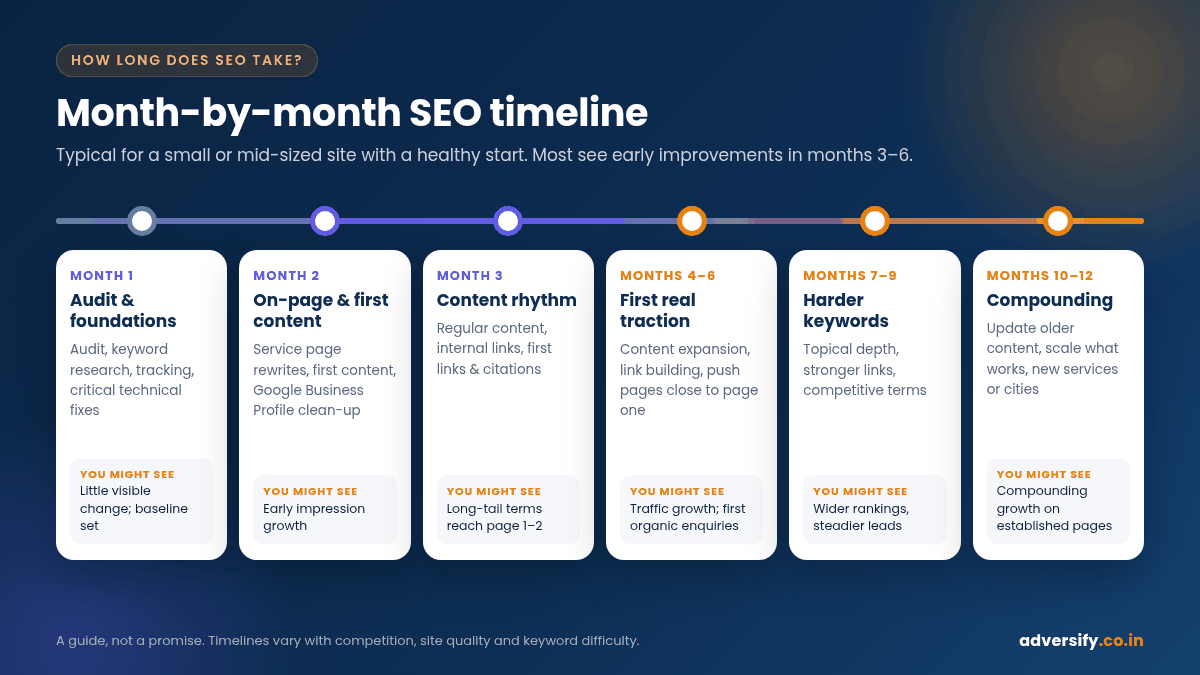
Month-by-month SEO timeline
This is a typical timeline for a small or mid-sized business website with a reasonably healthy starting point. Your own timeline will differ. Treat it as a guide to what should be happening, not a promise of when results arrive.
| Period | Main work | What you might see | What to measure |
|---|---|---|---|
| Month 1 | Audit, keyword research, tracking setup, critical technical fixes | Little visible change; baseline established | Indexed pages, crawl errors fixed, baseline rankings |
| Month 2 | On-page optimisation, service page rewrites, first content, Google Business Profile clean-up | Early impression growth on optimised pages | Impressions, average position in Search Console |
| Month 3 | Regular content, internal linking, first link building and citations | Some long-tail terms move onto page one or two | Keywords in top 20 and top 10, organic clicks |
| Months 4 to 6 | Content expansion, link building, refining pages that are close to page one | Noticeable traffic growth; first organic enquiries for many sites | Organic leads, conversions from organic traffic |
| Months 7 to 9 | Targeting harder keywords, building topical depth, earning stronger links | Wider rankings, steadier lead flow | Leads per month, cost per lead vs paid channels |
| Months 10 to 12 | Updating older content, scaling what works, expanding to new services or cities | Compounding growth on established pages | Revenue from organic, share of total leads |
Month 1: audit and foundations
The first month is mostly diagnosis. A proper audit checks how Google sees your site: which pages are indexed, which are blocked or duplicated, how fast pages load on mobile, whether titles and headings make sense, and where competitors are beating you. Keyword research maps the terms that actually bring buyers, not just traffic.
Critical fixes happen here too, such as broken redirects, pages accidentally set to noindex, missing sitemaps or a staging site that Google has indexed. These are not glamorous, but skipping them slows down everything that follows.
What you should receive: an audit summary, a prioritised fix list, a keyword map and baseline numbers for rankings, traffic and leads.
Month 2: on-page work and the first content
With the foundations in place, the focus moves to the pages that make money: service pages, location pages and key product categories. That means clearer titles and descriptions, better headings, stronger copy that answers what buyers actually ask, internal links between related pages, and schema markup where it helps.
For local businesses, this is also when the Google Business Profile gets a thorough clean-up: correct categories, services, hours, photos and a consistent name, address and phone number everywhere.
What you might see: rising impressions in Search Console for the pages you have worked on. Traffic changes are usually still small.
Month 3: content rhythm and early authority
By month three, there should be a steady content rhythm, for example two to four useful articles or pages a month, built around questions your customers ask. Link building and local citations begin in earnest. Google’s guidance on helpful, people-first content is the best checklist here: content should show real expertise and leave the reader satisfied.
What you might see: long-tail keywords, such as “best physiotherapist for back pain in Sector 50 Noida”, moving onto page one or close to it. Head terms are usually still some way off.
Months 4 to 6: the first real traction
This is where most sites start to feel SEO working. Pages that were sitting on page two often get pushed onto page one by a combination of better content, internal links and a handful of good backlinks. Organic traffic grows and the first steady organic enquiries arrive for many businesses.
As a real example, our SEO work for ERA Global Standards Certification brought the site to more than 1,200 monthly organic visitors and 32 first-page Google rankings within four months. The details are on our case study page. That is one project in its own niche; other sites, especially in crowded markets, take longer.
What to do: identify keywords in positions 8 to 20 and give those pages extra attention. They are usually the quickest wins.
Months 7 to 9: going after harder keywords
With early traction, the strategy can stretch towards more competitive terms. This needs deeper content, such as comparison guides, detailed service explanations and original data or examples, plus stronger links from relevant sites. Quality link building matters more here than in the early months.
What you might see: rankings broadening across more keywords and a more predictable monthly lead count.
Months 10 to 12: compounding
By the end of the first year, the work starts to compound. Older articles collect links and rankings, service pages become more authoritative, and new content tends to rank faster because the site as a whole is more trusted. The job now is updating content that has slipped, doubling down on what converts, and expanding into new services or cities.
How long does local SEO take?
Local SEO can show results sooner than national SEO, mainly because you are competing with a smaller set of businesses in a defined area. Google says local results are mainly based on relevance, distance and prominence, and that prominence draws on information such as links and the number of reviews, with more reviews and positive ratings helping local ranking (Google Business Profile Help).
In practice:
- Relevance improves quickly once your profile has the right categories, services and description. This is often visible within weeks.
- Distance is fixed by where you are. You cannot optimise it, but you can create location pages for the areas you genuinely serve.
- Prominence takes longest, because reviews, links and mentions accumulate over months.
A single-location clinic in Hauz Khas with a well-run profile and a steady flow of genuine reviews may see Google Maps visibility improve within the first two to three months, while a business targeting several cities across NCR will take longer. Our local SEO services are scoped by number of locations for exactly this reason.
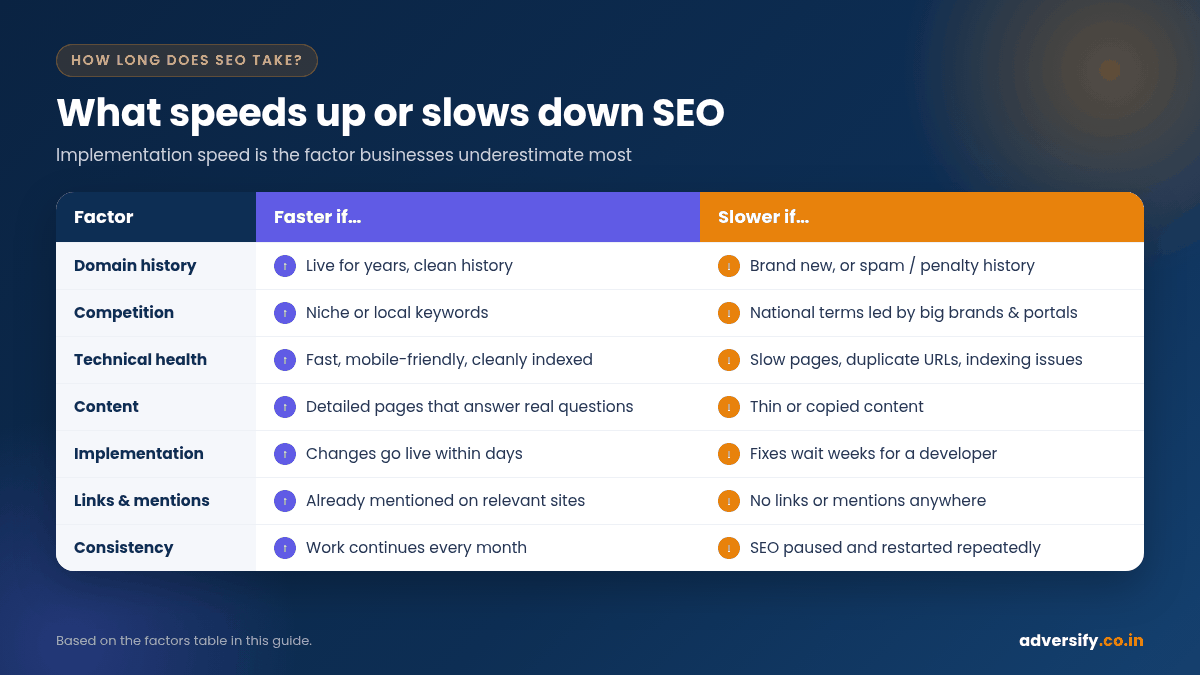
Factors that speed up or slow down SEO
| Factor | Faster if | Slower if |
|---|---|---|
| Domain history | The site has been live for years with clean history | The domain is brand new or has a spam or penalty history |
| Competition | Niche or local keywords with few strong competitors | National terms dominated by big brands and portals |
| Technical health | Fast, mobile-friendly, cleanly indexed site | Slow pages, duplicate URLs, indexing problems |
| Content | Useful, detailed pages that answer real questions | Thin or copied content, few pages per service |
| Implementation speed | Recommended changes go live within days | Fixes wait weeks for a developer |
| Links and mentions | The business is already mentioned on relevant sites | No links or mentions anywhere |
| Consistency | Work continues every month | SEO is paused and restarted repeatedly |
Implementation speed is the factor businesses underestimate most. If an agency recommends twenty fixes in month one and only five go live by month three, the timeline slips accordingly. Having a developer or maintenance plan ready to implement changes quickly makes a real difference.
New website vs established website
New websites
A new site starts with no rankings, no links and no history. Google first has to find and understand it. Expect the early months to be mostly about indexing, building core pages and earning first mentions. For new sites in competitive markets, meaningful organic leads commonly take longer than the 3 to 6 month range, so plan another channel, such as Google Ads, to bring leads in the meantime.
Established websites
An older site with some authority but poor optimisation can move surprisingly quickly once technical issues and on-page problems are fixed, because the trust is already there. These are often the fastest SEO projects.
Redesigned or migrated websites
A redesign or domain change without proper redirects can cause rankings to drop while Google processes the changes. If you are planning a redesign, involve SEO before launch. Google’s own hiring guidance notes that a site redesign or new launch is a great time to bring in an SEO (Google Search Central).
Does AI search change the timeline?
Many buyers now get answers from Google’s AI Overviews, ChatGPT or Perplexity before they click anything. Google says there are no additional requirements to appear in AI Overviews or AI Mode beyond standard SEO best practices (Google Search Central: AI features and your website). In other words, the same foundations that improve rankings also improve your chances of being included in AI answers.
What AI search does change is how you measure progress. Some people will see your brand in an AI answer and then search for you directly, or call without visiting the site. Watch branded search impressions and ask new customers how they heard about you. If AI visibility is a priority, our AI SEO and GEO services focus on that side of search.
How to track SEO progress month by month
A good monthly SEO report should answer five questions. If yours does not, ask for it.
- What work was done this month? Pages optimised, content published, links earned, fixes completed.
- Are impressions growing? From Google Search Console, for the whole site and for priority pages.
- Are target keywords moving? Not just “top 10” but the number of keywords in the top 3, top 10 and top 20 over time.
- Is organic traffic growing on pages that matter? Blog traffic is good; service-page traffic pays the bills.
- Are organic enquiries increasing? Calls, forms and WhatsApp clicks tracked in Google Analytics or your CRM.
Slow progress or no progress? How to tell
It is normal for SEO to feel slow. It is not normal for nothing to happen. These are warning signs worth raising with your agency:
- After three months, you cannot say what work was actually done.
- Impressions in Search Console are flat or falling after four to six months of work, with no explanation.
- Reports show only rankings for keywords no one searches, or only your brand name.
- You have been promised guaranteed rankings or a fixed date for page one. Google says no one can guarantee a number one ranking, and our own FAQ says no ethical agency can guarantee specific rankings.
- Large numbers of cheap backlinks have appeared from unrelated or foreign-language sites.
Should you run ads while SEO builds?
For many businesses, yes. SEO is the slower, cheaper-over-time channel; paid search is the fast one. Running a focused Google Ads campaign in the first months keeps leads coming while organic rankings develop, and the search terms that convert in ads also tell you which keywords to prioritise for SEO. As organic leads grow, you can reduce ad spend on the terms you now rank for.
Frequently asked questions
How long does SEO take for a new website?
Usually longer than for an established site. Expect the first few months to focus on indexing and foundations, with meaningful organic leads often taking six months or more in competitive markets.
Can SEO show results in one month?
Small technical fixes can have an effect quickly, and Google says some changes take effect in hours. But steady ranking and lead growth in one month is rare. Be cautious of anyone promising it.
How long does local SEO take?
Often faster than national SEO. Profile improvements can show within weeks, but building reviews and local prominence takes months.
Why did my rankings drop after improving?
Rankings fluctuate, especially in the first months and during Google updates. Look at the trend over several weeks rather than daily positions.
When should I stop SEO if it is not working?
Give a properly executed campaign at least six months. If impressions, rankings and traffic have not moved by then and the agency cannot explain why, it is time for a serious review.
Do I need to keep doing SEO after I rank?
Yes. Competitors keep working, content ages and search results change. Ongoing SEO protects and extends the rankings you have earned.
Find out where your website stands today
If you want a realistic timeline for your own site, start with a free SEO audit. We will look at your site’s technical health, content, competitors and current visibility, and give you an honest view of what to expect and when. Our team works from Noida and Hauz Khas, New Delhi, with clients across India. Claim your free SEO audit and we will reply within one business day.
4 Responses