
More of your customers now ask a question before they search for a business. They type it into ChatGPT, read the AI Overview at the top of Google, or ask Perplexity to compare three options. If your business is not part of those answers, a competitor is. That shift is why so many Indian businesses are now looking for AI SEO services in India, and why so many agencies have suddenly started selling them.
The trouble is that “AI SEO” means different things to different sellers. Some offer genuine technical and content work; others repackage a monthly blog plan with a new label. This guide explains what AI SEO (also called GEO, generative engine optimisation, or AEO, answer engine optimisation) really involves, what the official documentation from Google, OpenAI and Perplexity actually says, how it differs from classic SEO, what to ask an agency before you sign, and how to measure whether it is working.
Key takeaways
- AI SEO is not a replacement for SEO. Google says the same SEO best practices apply to AI Overviews and AI Mode, and there are no extra technical requirements beyond being indexed and eligible for a snippet.
- Access comes first. ChatGPT search relies on OAI-SearchBot and Perplexity on PerplexityBot; if your robots.txt or firewall blocks them, your pages cannot be surfaced in their search answers.
- You don’t need an “AI text file” or special schema to appear in Google’s AI features. Be wary of any agency whose main deliverable is an llms.txt file.
- Good AI SEO work focuses on clear answers, a well-defined brand (consistent name, address, services and proof across the web), crawlable pages, internal links and structured data that matches visible content.
- Nobody can guarantee a mention in an AI answer. Measure progress with a fixed prompt set, Search Console, analytics referrals from AI tools and, most importantly, enquiries.
What AI SEO services actually are
AI SEO is the work of making your business easy for AI-powered search experiences to find, understand, trust and cite. Those experiences include:
- Google AI Overviews and AI Mode, which sit inside Google Search and show links to supporting pages.
- ChatGPT search, which can browse the web and show sources.
- Perplexity, an answer engine that searches the web and links to the pages it used.
- Gemini, Google’s assistant, which can ground its answers in Google Search results.
You will see three overlapping labels. AEO (answer engine optimisation) focuses on content that answers specific questions clearly. GEO (generative engine optimisation) focuses on being included and cited in AI-generated answers. AI SEO is the umbrella term most agencies use for both, plus the technical SEO that makes everything possible. In practice, a sensible engagement covers all three, because the same pages and signals feed every system.
What the platforms officially say
Before paying anyone, it helps to know what the platforms themselves have published. This is the most useful filter for separating real work from hype.
Google: AI Overviews and AI Mode
Google’s documentation is direct: the best practices for SEO remain relevant for AI features, and there are no additional requirements or special optimisations needed to appear in AI Overviews or AI Mode. To be eligible as a supporting link, a page must be indexed and eligible to be shown in Google Search with a snippet. Google also says you don’t need to create new machine-readable files, AI text files or special schema.org markup to appear in these features (Google Search Central: AI features and your website).
The same page lists the fundamentals worth checking: crawling allowed in robots.txt and by your CDN or hosting, content findable through internal links, a good page experience, important content available as text, supporting images and video, structured data that matches the visible text, and up-to-date Merchant Center and Business Profile information.
Gemini and Google-Extended
Google-Extended is a robots.txt product token that controls whether content Google crawls can be used to train future Gemini models and for grounding in Gemini Apps and Grounding with Google Search on Vertex AI. Google states that it does not affect a site’s inclusion or ranking in Google Search (Google’s common crawlers). If you block Google-Extended, you are opting out of those Gemini uses, so make that decision deliberately rather than by copying someone else’s robots.txt.
ChatGPT: OAI-SearchBot and GPTBot
OpenAI separates its crawlers. OAI-SearchBot is used to surface websites in ChatGPT’s search features, and OpenAI says sites that opt out of it will not be shown in ChatGPT search answers (though they can still appear as navigational links). GPTBot is used for crawling content that may be used to train OpenAI’s models. The two settings are independent, so you can allow OAI-SearchBot while blocking GPTBot (OpenAI: Overview of OpenAI crawlers).
Perplexity: PerplexityBot
Perplexity says PerplexityBot is designed to surface and link websites in its search results and is not used to crawl content for AI foundation models. It recommends allowing PerplexityBot in robots.txt and permitting its published IP ranges, and it includes guidance for firewall rules (Perplexity: Perplexity crawlers).
The practical point: many Indian business sites sit behind a security plugin or CDN firewall that challenges unfamiliar bots. If that firewall blocks OAI-SearchBot or PerplexityBot, no amount of content work will get those pages into their answers. A good AI SEO audit checks this on day one.
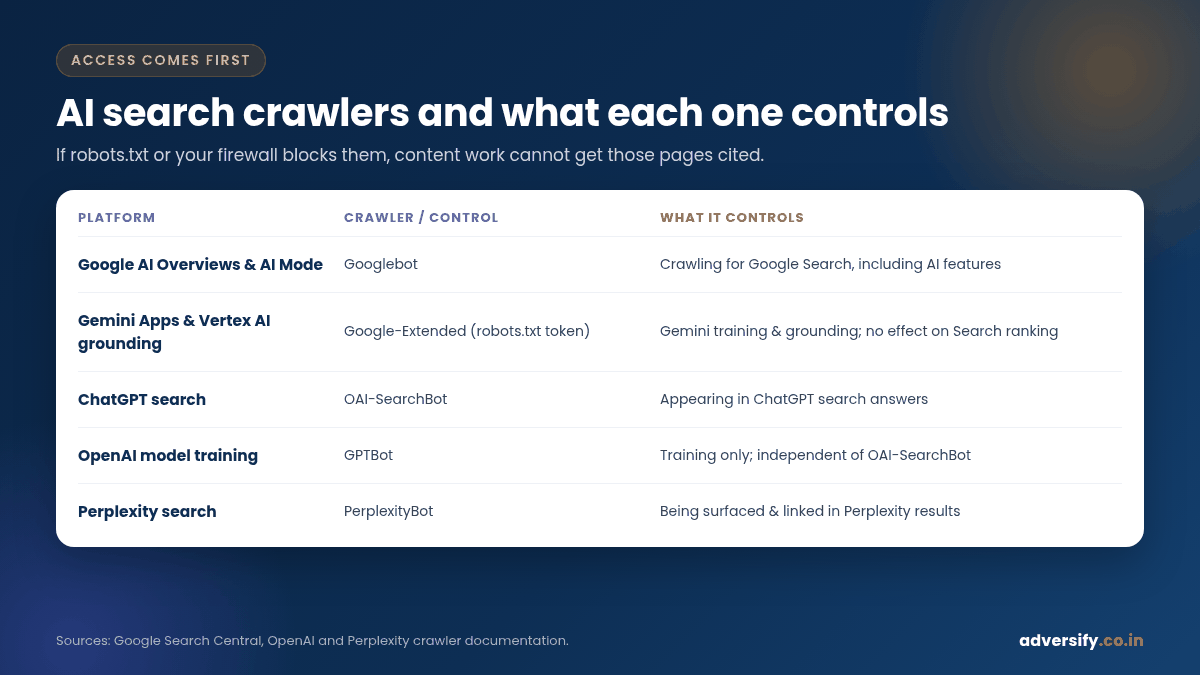
| Platform | Crawler or control | What it controls | What to do |
|---|---|---|---|
| Google AI Overviews and AI Mode | Googlebot | Crawling for Google Search, including AI features | Allow Googlebot; use nosnippet or noindex only where you really want to limit display |
| Gemini Apps and Vertex AI grounding | Google-Extended (robots.txt token) | Use of crawled content for Gemini training and grounding | Decide deliberately; it does not affect Google Search ranking |
| ChatGPT search | OAI-SearchBot | Appearing in ChatGPT search answers | Allow it if you want to be shown in ChatGPT search |
| OpenAI model training | GPTBot | Use of content for training OpenAI models | Independent choice; blocking it does not block OAI-SearchBot |
| Perplexity search | PerplexityBot | Appearing and being linked in Perplexity results | Allow it and check your firewall allows its published IPs |
AI SEO vs classic SEO: what changes and what doesn’t
Most of the foundation is the same. What changes is the shape of the result and the way you judge success.
| Area | Classic SEO | AI SEO / GEO |
|---|---|---|
| Goal | Rank a page in the blue links and earn the click | Be included, cited or recommended inside an AI answer, and still earn the click |
| Unit of content | A page targeting a keyword | Clear passages that answer specific questions, within pages that cover a topic fully |
| Queries | Short keywords such as “seo agency noida” | Longer, conversational prompts such as “which agency in Noida can fix my Google Business Profile and run ads?” |
| Brand signals | Links and on-site relevance | Links plus consistent brand facts across your site, Business Profile, directories, reviews and press |
| Technical access | Googlebot and Bingbot | Googlebot plus OAI-SearchBot, PerplexityBot and any firewall rules affecting them |
| Measurement | Rankings, clicks, conversions | Prompt-based visibility checks, AI referral traffic, Search Console and conversions |
Google notes that AI Overviews and AI Mode may use a “query fan-out” technique, running several related searches across subtopics to build a response. In plain terms, a single prompt can pull in pages that answer different parts of the question. That rewards sites that cover a topic in depth, with each sub-question answered clearly, rather than sites with one thin page per keyword.
What good AI SEO services in India should include
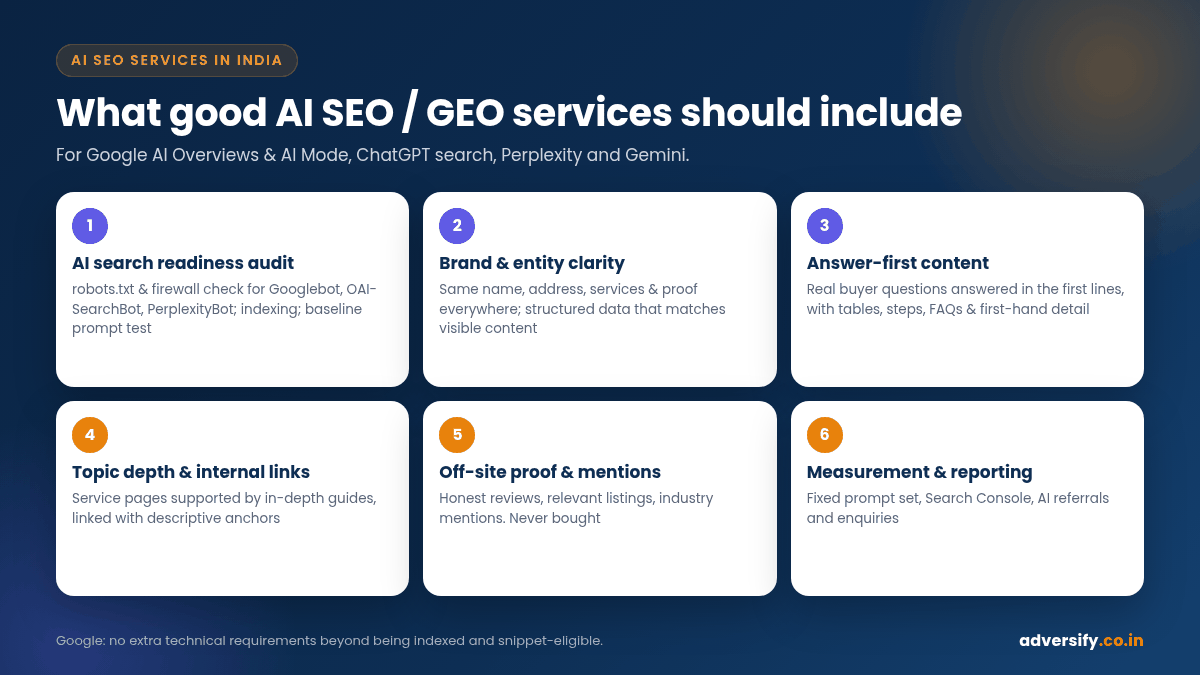
When you get AI SEO services in India from a serious agency, the work should fall into six areas. If a proposal skips most of them, it is probably a blog package with a new name.
1. An AI search readiness audit
- robots.txt rules for Googlebot, Google-Extended, OAI-SearchBot, GPTBot and PerplexityBot, and a check that your CDN or security plugin is not silently blocking them.
- Indexing in Google Search Console, and whether key pages are eligible for snippets (no accidental nosnippet or noindex).
- Whether important content is in HTML text, not only inside images, sliders or scripts.
- A baseline prompt test: how ChatGPT, Perplexity, Gemini and Google’s AI features describe your business and your competitors today.
2. Brand and entity clarity
AI systems summarise what the web says about you. If your business name, address, phone number, services and founding details differ between your website, Google Business Profile, directories and social profiles, the summary will be muddled. This work aligns those facts, builds a clear About page, and adds Organization or LocalBusiness structured data that matches what is visible on the page. Google’s general structured data guidelines are clear that markup must represent the main content of the page and must not describe content that users cannot see (General structured data guidelines).
3. Answer-first content
- Research the real questions your buyers ask, including comparison and “which is better” questions.
- Answer each question directly in the first sentence or two under a clear heading, then add detail, examples and proof.
- Use tables for comparisons, numbered steps for processes and short FAQs for follow-up questions.
- Show first-hand experience: your process, your photos, your pricing logic, your team’s credentials. Google’s guidance on helpful, people-first content asks whether content demonstrates first-hand expertise and depth of knowledge (Creating helpful, reliable, people-first content).
4. Topic depth and internal linking
Because AI answers often draw on several pages, it helps to build clusters: a strong service page supported by guides that answer related questions, all linked together with descriptive anchor text. Google’s AI features documentation lists internal links among the fundamentals worth getting right.
5. Off-site proof and mentions
Reviews on your Business Profile, listings in relevant directories, mentions in industry publications and genuine customer stories all shape how your brand is described. This is earned, not bought: paid or fake reviews break Google’s policies and can lead to restrictions on your profile.
6. Measurement and reporting
Monthly reporting should show what was done, which prompts now mention you, how AI referral traffic and Search Console clicks are trending, and what happened to enquiries. More on this below.
A step-by-step AI SEO plan for the first 90 days
Here is a realistic sequence for a small or mid-sized Indian business. Timelines vary with site size and how much content already exists.
- Weeks 1 to 2: Audit and baseline. Fix crawler access, confirm indexing, and record a fixed list of 20 to 50 prompts your customers might use. Note which AI tools mention you, which competitors appear and which sources they cite.
- Weeks 2 to 4: Brand facts. Align your name, address, phone and services everywhere, update the Google Business Profile, improve the About and Contact pages and add matching structured data.
- Weeks 3 to 8: Upgrade key pages. Rewrite your most important service pages so they answer the main questions clearly near the top, with tables, process steps, FAQs and proof.
- Weeks 5 to 12: Fill topic gaps. Publish in-depth guides for the questions where competitors are cited and you are not, and link them to the relevant service pages.
- Ongoing: Earn mentions. Ask happy customers for honest reviews, get listed where your buyers look, and pitch useful data or opinions to industry sites.
- Monthly: Re-run the prompt set. Compare against the baseline, look at referral traffic and enquiries, and adjust the content plan.
How to measure AI SEO
AI visibility is harder to measure than rankings, so it pays to be disciplined.
- Google Search Console: Google says sites appearing in AI Overviews and AI Mode are included in the overall search traffic in Search Console, within the Performance report’s “Web” search type. There is no separate AI Overviews filter, so watch impressions and clicks for the queries and pages you are improving.
- Analytics referrals: in Google Analytics, check referral traffic from sources such as chatgpt.com, perplexity.ai and gemini.google.com. Volumes are often small, but they are a direct signal.
- A fixed prompt set: run the same prompts each month, ideally logged out and from the same location, and record whether you are mentioned, cited with a link, or absent. AI answers vary between runs, so look at trends across many prompts rather than one screenshot.
- Enquiries: add “How did you hear about us?” to forms and calls, with ChatGPT and Google AI options. This is often the most convincing evidence.
Questions to ask before you hire an AI SEO agency
| Question | A good answer sounds like | Red flag |
|---|---|---|
| What exactly will you do in month one? | Crawler and indexing audit, prompt baseline, brand-fact fixes, page priorities | “We will start publishing AI-optimised blogs” |
| Can you guarantee we appear in ChatGPT or AI Overviews? | No, but here is how we improve the signals and how we will report progress | Any guarantee of placement or rankings |
| How will you measure results? | Fixed prompt set, Search Console, AI referrals, enquiries | Only a “visibility score” from a tool they won’t explain |
| Do we need an llms.txt file or special schema? | Google says no for its AI features; it is optional and not a priority | It is the main deliverable |
| Who writes the content and how is it checked? | Writers who interview you, editors who fact-check, your approval before publishing | Bulk AI-generated posts with no review |
| How do you handle reviews and mentions? | Honest review requests and genuine outreach | Buying reviews, links or placements |
What affects the cost of AI SEO services
We won’t quote a universal price, because the honest answer depends on scope. The main drivers are:
- How many services, locations and pages need work.
- Whether technical fixes (speed, indexing, firewall rules) are needed first.
- How much new content the topic needs, and whether your team can supply expert input.
- How competitive your category is in AI answers today.
- Whether classic SEO, local SEO and AI SEO are bundled together or run separately.
Ask for a written scope with monthly deliverables, and make sure your final quote will confirm any applicable taxes. Our guide to SEO cost in India explains how monthly retainers are usually split.
Common AI SEO myths
- “SEO is dead, now it’s all GEO.” Google says AI features are built on the same foundations as Search. Strong SEO is still the entry ticket.
- “Add FAQ schema and you’ll be in AI answers.” Structured data can help machines understand a page, but Google says there’s no special schema needed for AI features, and markup must match visible content.
- “Blocking GPTBot keeps you out of ChatGPT.” OpenAI treats GPTBot (training) and OAI-SearchBot (search) separately. Check which one you actually mean to block.
- “More AI-written content means more AI visibility.” Thin, repetitive content gives AI systems nothing new to cite. Original detail, data and experience do.
Where proof fits in
AI tools and human buyers both look for evidence. Publish real results with permission. For example, our SEO work for ERA Global helped the site reach 1,200+ monthly visits and 32 page-one keywords within four months; you can read more on our case study page. Results depend on the site, the competition and the starting point, so treat any case study as an example, not a promise.
Frequently asked questions
What are AI SEO services?
AI SEO services improve how easily AI-powered search tools such as Google AI Overviews, ChatGPT search, Perplexity and Gemini can find, understand and cite your business. They combine technical SEO, answer-first content, brand consistency, structured data and measurement.
Is AI SEO different from GEO and AEO?
The terms overlap. AEO focuses on answering questions clearly, GEO focuses on being included in AI-generated answers, and AI SEO is usually the umbrella for both plus technical SEO.
Can an agency guarantee my business will appear in ChatGPT?
No. AI answers change between users, prompts and time, and no agency controls them. A credible agency improves the signals that support visibility and reports progress honestly.
Do I still need regular SEO if I invest in AI SEO?
Yes. Google says pages must be indexed and eligible for a snippet to appear as supporting links in its AI features, and the same SEO best practices apply. AI SEO builds on classic SEO services rather than replacing them.
How long does AI SEO take to show results?
Technical fixes such as unblocking crawlers can take effect within days to weeks, depending on recrawling. Content and brand signals usually take months. Our guide on how long SEO takes explains the typical timeline.
Want to see how AI search describes your business?
If you want to get AI SEO services in India without vague promises, start with the facts. Our team in Noida and Hauz Khas, New Delhi will check your crawler access, run a baseline prompt test across Google AI features, ChatGPT and Perplexity, and show you where you are missing. Learn more about our AI SEO services and GEO services, or request a free SEO audit and we will tell you plainly what we would fix first.
One Response