
India has a huge SEO market. Thousands of agencies, freelancers and “growth hackers” offer search engine optimisation, and almost all of them say they are a professional SEO company in India. Proposals arrive full of the same words: white-hat, ROI-driven, data-led, guaranteed growth. So how do you separate genuinely professional teams from the rest before you commit a year of budget?
This guide gives you an evaluation framework you can actually use. Instead of another list of agency names, you will get a weighted scorecard, a due-diligence checklist, a way to test an agency with a paid audit, the proposal sections to scrutinise, and the reporting standard you should expect once work begins. It works whether you are a startup, an SME or an established brand, and whether you are shortlisting two agencies or ten.
Key takeaways
- Professional SEO is defined by process and transparency, not promises. Judge agencies on how they work, not on what they claim.
- Use a weighted scorecard covering strategy, technical depth, content, ethics, reporting, communication and commercial terms, so every shortlisted agency is judged the same way.
- Google’s own advice is to interview SEOs, check references and ask for examples of previous work. Do all three.
- A small paid audit or discovery phase is the best test of an agency’s thinking before a long retainer.
- No one can guarantee a #1 ranking on Google, according to Google itself. Treat guarantees as a reason to walk away.
- Make sure you own your Google Search Console, analytics, website and content from day one.
What “professional” really means in SEO
SEO has no licence or mandatory certification in India, so anyone can call themselves an SEO company. Professionalism therefore shows up in behaviour. A professional SEO company:
- Starts with your business goals and customers, not with a fixed package.
- Follows Google Search Essentials, the published rules for what makes content eligible to appear in Google Search (Google Search Central).
- Explains every change it makes and why.
- Gives realistic timeframes. Google’s SEO Starter Guide notes that some changes can take effect in a few hours while others could take several months (Google Search Central).
- Reports on business outcomes such as enquiries and sales, not only on rankings.
- Leaves you in control of your accounts and assets.
Google’s page on hiring an SEO describes what a good SEO can help with: reviewing your site’s content or structure, technical advice on development, content development, managing campaigns, keyword research, SEO training and expertise in specific markets and geographies. It also warns that an irresponsible SEO can damage your site and reputation (Google Search Central). The framework below is designed to tell the two apart.
The weighted scorecard for evaluating SEO companies
Score each shortlisted agency from 1 to 5 on every criterion, multiply by the weight, and add up the totals. The weights below are a sensible default; adjust them to your situation. An e-commerce site may weight technical SEO higher, while a local clinic may weight local SEO and content higher.
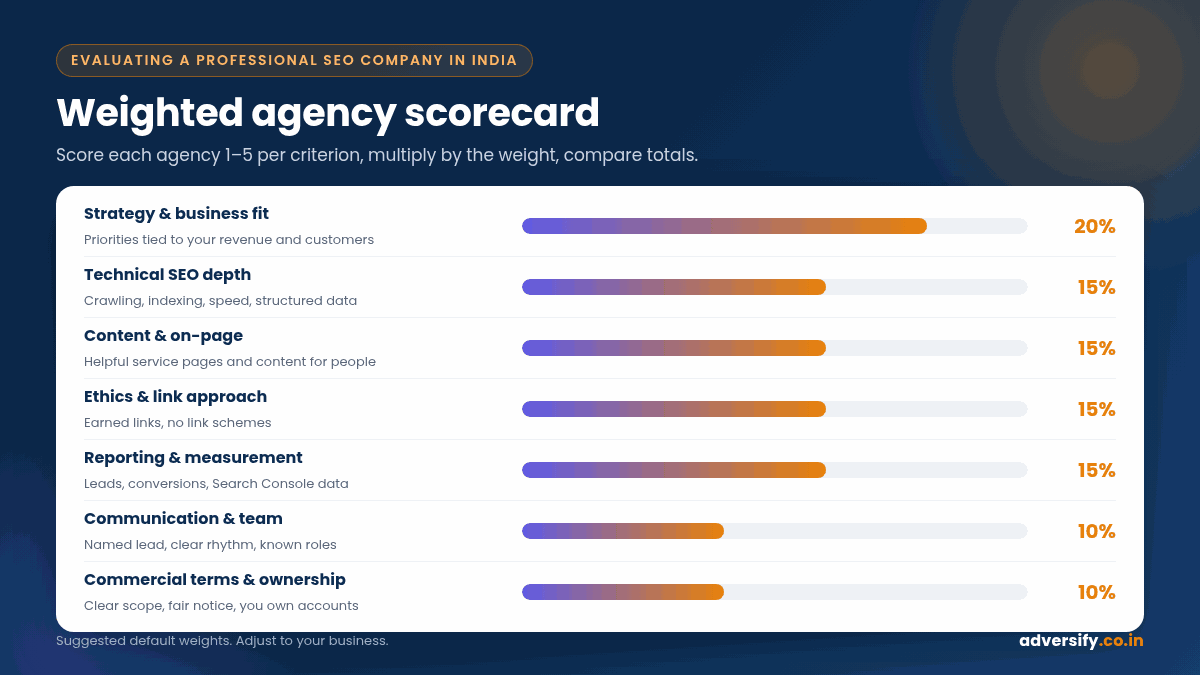
| Criterion | Suggested weight | What a score of 5 looks like | What a score of 1 looks like |
|---|---|---|---|
| Strategy and business fit | 20% | Asks about margins, best services, customers and cities; proposes priorities tied to revenue | Sends a standard package before asking anything |
| Technical SEO depth | 15% | Can explain crawling, indexing, site speed, structured data and migrations in plain language | Only talks about “keywords and backlinks” |
| Content and on-page | 15% | Has a plan for service pages and helpful content written for people | Promises a fixed number of short articles per month |
| Ethics and link approach | 15% | Earns mentions and links through content, PR and relationships; avoids link schemes | Sells bulk backlinks, PBNs or “DA 50+ links” packages |
| Reporting and measurement | 15% | Reports leads, conversions, organic traffic and Search Console data with commentary | Sends a ranking screenshot with no context |
| Communication and team | 10% | Named account lead, clear meeting rhythm, you know who does the work | Changing contacts, slow replies, vague roles |
| Commercial terms and ownership | 10% | Clear scope, fair notice period, you own every account and asset | Long lock-ins, agency-owned accounts, hidden extras |
A scorecard does two things. It stops a charming sales call from outweighing a weak proposal, and it gives you a written reason for your decision that you can share with partners or management.
Step 1: Shortlist with simple public checks
Before booking calls, spend fifteen minutes on each candidate:
- Look at their own website. Is it fast, clear and well structured? An SEO company with a slow, thin site has a credibility problem.
- Read their blog. Is it original and useful, or generic filler? Their content shows how they will write for you.
- Check case studies. Do they name clients, timeframes and specific outcomes, or only show unlabelled graphs?
- Check reviews. Look at reviews on their Google Business Profile and other platforms, and read the detailed ones, not just the stars.
- Look at the people. Can you see who leads strategy and how long the team has worked in SEO?
Keep three to five agencies for the next step. More than that and comparison becomes noise.
Step 2: Run a structured discovery call
Google suggests a set of questions to ask a potential SEO, including asking for examples of previous work and success stories, whether they follow the Google Search Essentials, what results they expect and in what timeframe, how long they have been in business, and how they will communicate with you and share the changes they make (Google Search Central). Build on that with questions that reveal how an agency thinks:
| Question | Strong answer | Weak answer |
|---|---|---|
| What would you look at first on our site? | Specific: indexing, key service pages, intent match, local signals, speed | “We will do a full audit” with no detail |
| Which of our services would you prioritise, and why? | Links priorities to demand, competition and your margins | “All of them, equally” |
| How do you build links? | Content worth citing, digital PR, partnerships, local citations | Monthly quotas of guest posts or directory links |
| What will you need from us? | Access, approvals, subject-matter input, a point of contact | “Nothing, we handle everything” |
| What would make you say this is not working? | Clear leading indicators and a review point | Avoids the question |
| How are you handling AI-driven search? | Talks about helpful content, entity clarity, structured data and being cited | Buzzwords with no method |
Take notes during each call and score the agency on your scorecard the same day while it is fresh.
Step 3: Test them with a paid audit or discovery phase
The most reliable way to judge an SEO company is to see real work on your own site. Many professional agencies offer a short paid audit or a one-month discovery phase before a retainer. Google’s guidance says an SEO audit should give you realistic estimates of improvement and an estimate of the work involved (Google Search Central).
A useful audit or discovery output should include:
- A prioritised list of technical issues, with the business impact of each, not a raw tool export with hundreds of warnings.
- A review of your key service or category pages against search intent.
- Keyword and topic opportunities grouped by page, with realistic difficulty notes.
- Competitor observations: what the sites ranking above you do better.
- A 90-day action plan with owners and dependencies.
If an agency’s audit is a generic PDF that could apply to any website, you have learned what you needed to know at a fraction of the cost of a full year.
Step 4: Read the proposal like an auditor
Proposals from the best SEO service providers in India tend to be specific about scope and honest about uncertainty. Check these sections carefully.
| Proposal section | What to look for |
|---|---|
| Objectives | Business goals such as qualified leads or online sales, plus leading indicators |
| Scope of work | Activities listed by month or quarter: technical fixes, page optimisation, content, local SEO, outreach |
| Deliverables | Tangible outputs such as pages optimised, content published, issues fixed, with quality standards |
| Timeline | Phased plan with realistic expectations, no fixed ranking dates |
| Reporting | Frequency, metrics, data sources and a review meeting |
| Team | Who does strategy, content, technical work and outreach |
| Commercials | Monthly fee, what is excluded, notice period; your final quote will confirm any applicable taxes |
| Ownership | You own the website, content, Search Console, analytics and Business Profile |
If you want to understand what drives fees before comparing numbers, see our guide to SEO cost in India. And for a realistic view of timelines, read how long SEO takes.
Step 5: Check the ethics carefully
Shortcuts can work briefly and then cost you dearly. Google’s spam policies list practices that can lead to lower rankings or removal from results, including link spam, scaled content abuse, cloaking, doorway abuse, hidden text and site reputation abuse (Google Search Central). A professional SEO company will be able to tell you, in plain language, which of these it avoids and how.
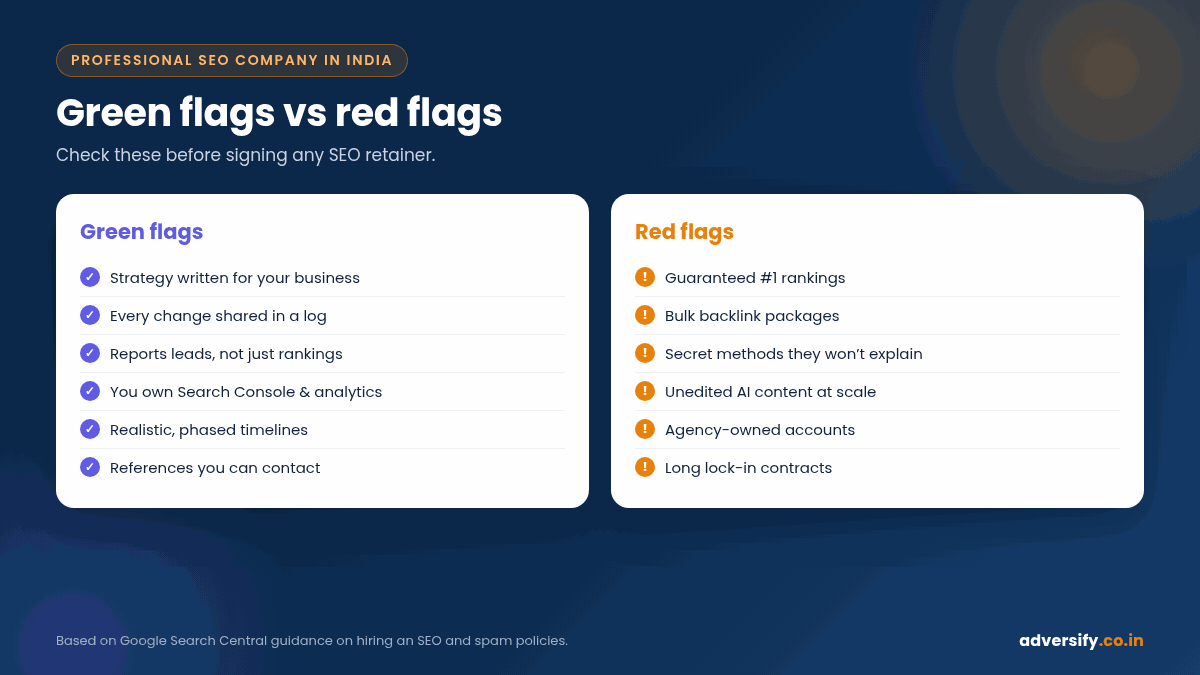
Red flags
- Ranking guarantees. Google says no one can guarantee a #1 ranking on Google and advises caution with SEOs who claim to.
- Unsolicited emails promising to fix your rankings. Google recommends the same scepticism you would apply to any spam email.
- Secret methods they will not explain.
- Bulk link packages sold by quantity or third-party metrics.
- AI content at scale with no editing, expertise or fact-checking. Google’s guidance asks for helpful, reliable, people-first content (Google Search Central).
- Agency-owned accounts for your Search Console, analytics or Business Profile.
Green flags
- A strategy written for your business, not a renamed template.
- Willingness to share every change in a log or tracker.
- Realistic, phased expectations with clear review points.
- References you can actually contact.
- Honest “we don’t know yet” answers where data is missing.
Step 6: Set the reporting standard before you sign
Agree on what a monthly report will contain before work begins. A good report blends data with interpretation and next steps.
| Report element | Source | Why it matters |
|---|---|---|
| Organic clicks, impressions and average position by page | Google Search Console | First-party data from Google on search visibility |
| Organic sessions and engagement | Your analytics tool | Shows whether visitors find what they need |
| Leads, calls, form fills or sales from organic | Analytics conversions, CRM | The metric that pays for SEO |
| Work completed this month | Agency change log | Accountability and transparency |
| Issues and blockers | Agency notes | Surfaces what needs your approval or input |
| Next month’s priorities | Agency plan | Keeps the strategy moving with purpose |
Make sure Search Console and analytics are set up under your own Google account, with the agency added as a user. Google’s help pages explain how property owners can add and manage users in Search Console (Search Console Help).
Step 7: Plan the first 90 days together
Once you choose an agency, a clear onboarding plan sets the tone for the relationship.
- Days 1 to 15: Access to the website, Search Console, analytics and Business Profile; kick-off meeting; agreed goals and KPIs; baseline report.
- Days 15 to 45: Technical fixes with the highest impact, optimisation of priority service pages, tracking of calls and forms.
- Days 45 to 90: Content plan in motion, local SEO and citations if relevant, first outreach, and a 90-day review against the scorecard.
Use the 90-day review to rescore the agency on communication, delivery and reporting. A professional SEO company will welcome that review.
Matching the agency type to your business
| Business type | What to prioritise in an SEO partner |
|---|---|
| Local service business (clinic, salon, coaching) | Local SEO, Google Business Profile, reviews strategy, service-area pages |
| B2B or professional services | Strong service pages, thought-leadership content, lead tracking into CRM |
| E-commerce store | Technical SEO at scale, category pages, product schema, site speed |
| Startup entering a new market | Keyword research, positioning, content velocity with quality control |
| Brand facing AI-driven search | Entity clarity, structured data, being cited by trusted sources; see our AI SEO services |
How Adversify works as an SEO partner
We built our own process around the same framework you have just read. Every engagement with our SEO services starts with an audit and a written strategy tied to your business goals. You own every account. We share a change log, report on leads and conversions as well as visibility, and review progress with you every month. Our plans are tiered from Bronze to Platinum so the scope can match your stage. As a real example, our client ERA Global reached 1,200+ visits and 32 page-one keywords in 4 months; you can read more on our case study page. Results always vary, and we do not guarantee rankings.
Frequently asked questions
How do I know if an SEO company in India is professional?
Look for a custom strategy, clear explanations, realistic timeframes, transparent reporting, client-owned accounts and adherence to Google Search Essentials. Use a weighted scorecard to compare agencies on the same criteria.
What questions should I ask before hiring an SEO company?
Ask for examples of previous work, whether they follow Google’s guidelines, what results they expect and when, how they build links, how they report, who will work on your account and what they need from you.
Is it a good idea to pay for an SEO audit before signing a retainer?
Yes, for most businesses. A short paid audit or discovery phase shows you how the agency thinks and gives you a usable action plan even if you do not continue.
Can any SEO company guarantee first-page rankings?
No. Google states that no one can guarantee a #1 ranking on Google. Rankings depend on many factors outside any agency’s control.
How long should I give an SEO company before judging results?
Judge activity and leading indicators from the first month, such as fixes completed and impressions growing. Meaningful traffic and lead growth usually take several months, depending on competition and your starting point.
Who should own my Search Console and analytics accounts?
You should. Create them under your own business Google account and add the agency as a user, so you keep your data if you ever change agencies.
Want a second opinion on your SEO options?
If you are evaluating professional SEO companies in India and want an honest benchmark, ask us for a free SEO audit. We will show you what we would fix first and why, with no obligation. Request your free SEO audit or contact our team.
One Response