
AI SEO Services in India: What You Get, What to Ask and How to Measure
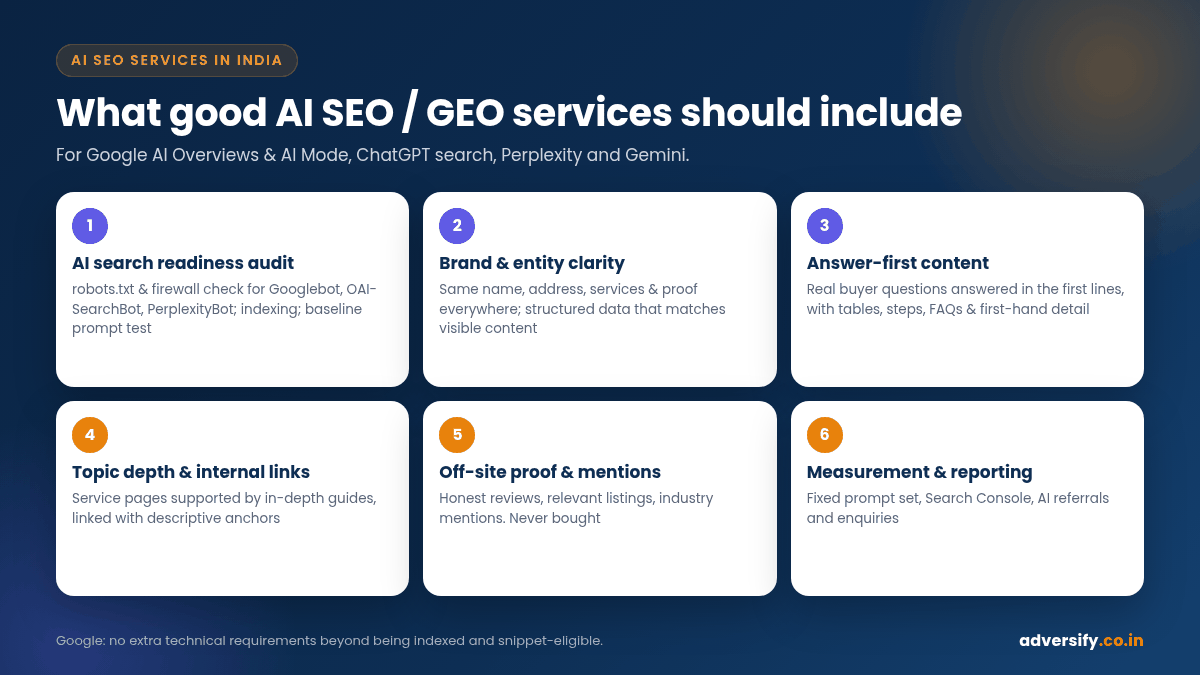
More of your customers now ask a question before they search for a business. They type it into ChatGPT, read the AI Overview at the top of Google, or ask Perplexity to compare three options. If your business is not part of those answers, a competitor is. That shift is why so many Indian businesses are now looking for AI SEO services in India, and why so many agencies have suddenly started selling them. The trouble is that “AI SEO” means different things to different sellers. Some offer genuine technical and content work; others repackage a monthly blog plan with a new label. This guide explains what AI SEO (also called GEO, generative engine optimisation, or AEO, answer engine optimisation) really involves, what the official documentation from Google, OpenAI and Perplexity actually says, how it differs from classic SEO, what to ask an agency before you sign, and how to measure whether it is working. Key takeaways AI SEO is not a replacement for SEO. Google says the same SEO best practices apply to AI Overviews and AI Mode, and there are no extra technical requirements beyond being indexed and eligible for a snippet. Access comes first. ChatGPT search relies on OAI-SearchBot and Perplexity on PerplexityBot; if your robots.txt or firewall blocks them, your pages cannot be surfaced in their search answers. You don’t need an “AI text file” or special schema to appear in Google’s AI features. Be wary of any agency whose main deliverable is an llms.txt file. Good AI SEO work focuses on clear answers, a well-defined brand (consistent name, address, services and proof across the web), crawlable pages, internal links and structured data that matches visible content. Nobody can guarantee a mention in an AI answer. Measure progress with a fixed prompt set, Search Console, analytics referrals from AI tools and, most importantly, enquiries. The six areas a good AI SEO engagement should cover, for Google AI features, ChatGPT search, Perplexity and Gemini. What AI SEO services actually are AI SEO is the work of making your business easy for AI-powered search experiences to find, understand, trust and cite. Those experiences include: Google AI Overviews and AI Mode, which sit inside Google Search and show links to supporting pages. ChatGPT search, which can browse the web and show sources. Perplexity, an answer engine that searches the web and links to the pages it used. Gemini, Google’s assistant, which can ground its answers in Google Search results. You will see three overlapping labels. AEO (answer engine optimisation) focuses on content that answers specific questions clearly. GEO (generative engine optimisation) focuses on being included and cited in AI-generated answers. AI SEO is the umbrella term most agencies use for both, plus the technical SEO that makes everything possible. In practice, a sensible engagement covers all three, because the same pages and signals feed every system. What the platforms officially say Before paying anyone, it helps to know what the platforms themselves have published. This is the most useful filter for separating real work from hype. Google: AI Overviews and AI Mode Google’s documentation is direct: the best practices for SEO remain relevant for AI features, and there are no additional requirements or special optimisations needed to appear in AI Overviews or AI Mode. To be eligible as a supporting link, a page must be indexed and eligible to be shown in Google Search with a snippet. Google also says you don’t need to create new machine-readable files, AI text files or special schema.org markup to appear in these features (Google Search Central: AI features and your website). The same page lists the fundamentals worth checking: crawling allowed in robots.txt and by your CDN or hosting, content findable through internal links, a good page experience, important content available as text, supporting images and video, structured data that matches the visible text, and up-to-date Merchant Center and Business Profile information. Gemini and Google-Extended Google-Extended is a robots.txt product token that controls whether content Google crawls can be used to train future Gemini models and for grounding in Gemini Apps and Grounding with Google Search on Vertex AI. Google states that it does not affect a site’s inclusion or ranking in Google Search (Google’s common crawlers). If you block Google-Extended, you are opting out of those Gemini uses, so make that decision deliberately rather than by copying someone else’s robots.txt. ChatGPT: OAI-SearchBot and GPTBot OpenAI separates its crawlers. OAI-SearchBot is used to surface websites in ChatGPT’s search features, and OpenAI says sites that opt out of it will not be shown in ChatGPT search answers (though they can still appear as navigational links). GPTBot is used for crawling content that may be used to train OpenAI’s models. The two settings are independent, so you can allow OAI-SearchBot while blocking GPTBot (OpenAI: Overview of OpenAI crawlers). Perplexity: PerplexityBot Perplexity says PerplexityBot is designed to surface and link websites in its search results and is not used to crawl content for AI foundation models. It recommends allowing PerplexityBot in robots.txt and permitting its published IP ranges, and it includes guidance for firewall rules (Perplexity: Perplexity crawlers). The practical point: many Indian business sites sit behind a security plugin or CDN firewall that challenges unfamiliar bots. If that firewall blocks OAI-SearchBot or PerplexityBot, no amount of content work will get those pages into their answers. A good AI SEO audit checks this on day one. Platform Crawler or control What it controls What to do Google AI Overviews and AI Mode Googlebot Crawling for Google Search, including AI features Allow Googlebot; use nosnippet or noindex only where you really want to limit display Gemini Apps and Vertex AI grounding Google-Extended (robots.txt token) Use of crawled content for Gemini training and grounding Decide deliberately; it does not affect Google Search ranking ChatGPT search OAI-SearchBot Appearing in ChatGPT search answers Allow it if you want to be shown in ChatGPT search OpenAI model training GPTBot Use of content for training OpenAI models Independent choice; blocking
Local SEO Checklist for Noida Businesses (2026)
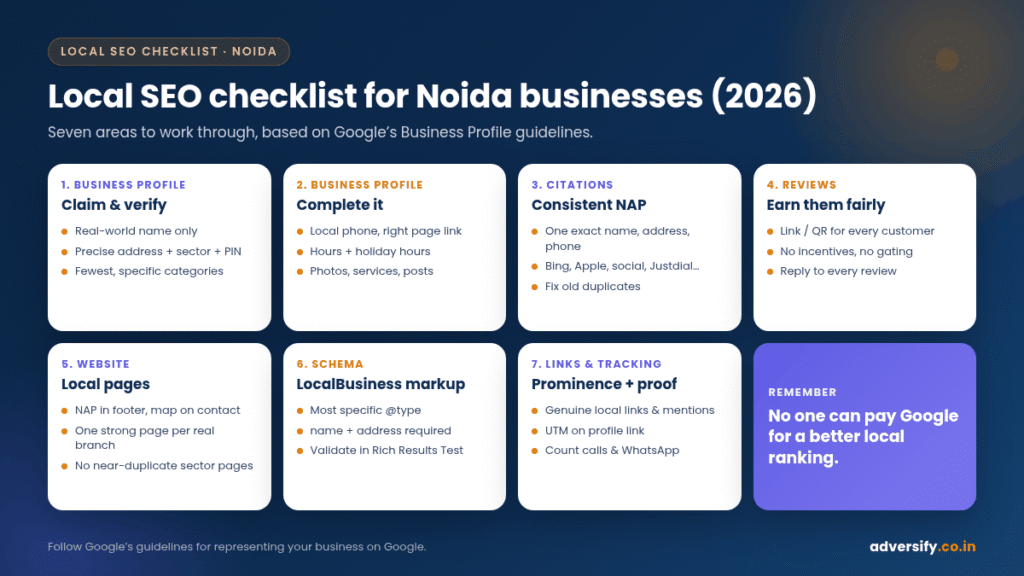
Search “dentist near me” or “CA in Sector 62” from a phone in Noida and you will see a map with three businesses before any regular website. That map is where many customers decide who to call, message or visit. Getting into them is not luck. It comes from doing a long list of small things properly and keeping them up to date. This local SEO checklist is written for Noida and Greater Noida businesses: clinics, coaching centres, restaurants, salons, showrooms, real estate offices, CA firms and service businesses that travel to customers. It follows Google’s own Business Profile guidelines, which we link to throughout, and it reflects the order in which we work through local SEO for a new client. Key takeaways Google says local results are mainly based on relevance, distance and prominence. You can’t change distance, so the checklist focuses on relevance (complete, accurate information) and prominence (reviews, links and mentions). Your Google Business Profile must reflect your real-world business: real name, precise address or service area, local phone number, accurate hours and the fewest categories that describe your core business. Keep your name, address and phone number (NAP) identical on your website, Google, directories and social profiles. Ask every genuine customer for a review, reply to reviews, and never offer incentives or ask only happy customers. Google treats both as policy violations. Build useful local pages and LocalBusiness structured data on your website, but avoid near-duplicate “sector pages” made only to rank. There is no way to pay Google for a better local ranking, and no honest agency can guarantee a top-three map position. The seven parts of our local SEO checklist for Noida businesses, based on Google’s Business Profile guidelines. How Google ranks local businesses Google’s Business Profile help centre says local results are mainly based on three factors (Google Business Profile Help: Tips to improve your local ranking): Relevance: how well your profile matches what someone searched for. Complete, detailed information helps Google understand what you do. Distance: how far your business is from the searcher, or from the location in their search. Prominence: how well-known your business is, including information such as how many websites link to you and how many reviews you have. Google notes that more reviews and positive ratings can help. Google also states that there is no way to request or pay for a better local ranking. Everything in this checklist is about earning it. For Noida, distance has a particular effect. The city is laid out in sectors, and someone searching from Sector 18 will often see different map results from someone in Sector 137 or Noida Extension. That is normal. Your job is to be the most relevant and prominent choice near your real location. Part 1: Google Business Profile checklist Your Business Profile is the core of local SEO. Before you change anything, read Google’s guidelines for representing your business on Google. Profiles that break them can be suspended. 1. Claim and verify the profile Search for your business on Google Maps first. If a profile already exists, claim it rather than creating a second one; Google says there should be only one profile per business. Verification tells Google you are authorised to manage the business and makes it more likely to show in results (Google Business Profile Help: Verify your business). 2. Use your real business name, nothing more Your profile name should match your signage, website and stationery. Google’s guidelines list what must not be added: marketing taglines, service or product keywords, location information, phone numbers, URLs and business hours. “Sharma Dental Clinic” is fine. “Sharma Dental Clinic, Best Dentist in Noida Sector 50” is not. Google warns that adding unnecessary information to the name could get the profile suspended. 3. Get the address exactly right Use a precise, real address. Include the shop or office number, floor, building or tower, block, sector and PIN code, for example “Shop 12, Ground Floor, XYZ Plaza, Block C, Sector 18, Noida, Uttar Pradesh 201301”. Google allows landmarks and cross-streets only where the official address doesn’t pinpoint the location accurately. In some Noida markets and villages this is genuinely needed; elsewhere, keep it out. Drag the map pin to your actual entrance if Google places it wrongly. Virtual offices aren’t eligible. A co-working office qualifies only if it has clear signage, receives customers during business hours and is staffed by your team during those hours. 4. Set a service area if you travel to customers If you are a plumber, pest-control service, home tutor or interior designer who works at customers’ locations and doesn’t receive them at your address, Google says you should hide your address and set a service area instead. Google also says the overall service area shouldn’t extend farther than about two hours’ driving time from where the business is based. A Noida business might list Noida, Greater Noida, Ghaziabad and parts of East Delhi, rather than “all of India”. 5. Choose the fewest, most specific categories Google advises using as few categories as possible to describe your core business, and choosing ones that complete the sentence “This business IS a…”, not “This business HAS a…”. A physiotherapy clinic should pick the closest specific match, such as “Physiotherapist”, as its primary category, not a long list of every treatment. 6. Add a local phone number and the right website link Google prefers a phone number that connects to your individual location, under your direct control, rather than a central call centre. Link to the most relevant page on your website: your home page for a single-location business, or the specific location page for each branch. 7. Keep hours accurate, including holidays Set your regular customer-facing hours and add special hours for Diwali, Holi and other closures. Wrong hours lead to frustrated customers and negative reviews. 8. Write a useful business description Describe what you offer, who you serve and what makes you different. Google’s guidelines don’t allow links in the description, and the
How Long Does SEO Take? A Month-by-Month Timeline
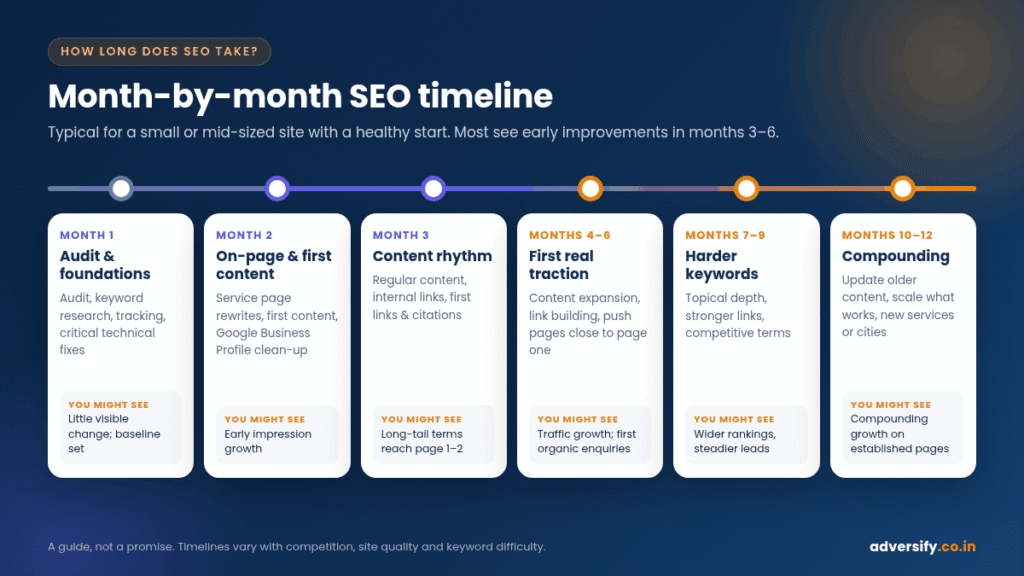
Every business owner who starts SEO asks the same question within the first few weeks: “When will I see results?” It is a fair question. You are paying every month, and unlike ads, there is no switch that turns traffic on. The honest answer is that most websites start to see meaningful improvement somewhere between three and six months, and stronger, compounding results usually take six to twelve months or more. But “results” can mean very different things, and the timeline depends heavily on where your site starts. This guide walks through what typically happens month by month, what speeds things up, what slows them down, and how to tell slow progress from no progress. Key takeaways Google says some changes take effect in a few hours and others can take several months, and suggests waiting a few weeks before judging whether a change helped. Crawling alone can take anywhere from a few days to a few weeks, according to Google’s documentation. Most sites see early improvements in months 3 to 6. Competitive keywords and new domains often take longer. Local SEO for a business with a well-optimised Google Business Profile can move faster than national SEO, but reviews and prominence still take time to build. Nobody can guarantee rankings or exact dates. Judge progress by impressions, rankings for target terms, clicks and enquiries, in that order. A typical SEO timeline for a small or mid-sized website. Most sites see early improvements in months 3 to 6. The short answer, with sources Google’s own SEO Starter Guide says every change takes some time to be reflected on Google’s side: some might take effect in a few hours, others could take several months, and in general you would want to wait a few weeks to assess whether your work had an effect. Before any of that, Google has to crawl your updated pages. Google’s documentation on asking Google to recrawl notes that crawling can take anywhere from a few days to a few weeks, and that requesting a crawl does not guarantee your page will be included in results quickly, or at all. Based on that, and on our own work, our guidance to clients is the same one you will find on our SEO services page: most websites start to see improvements within 3 to 6 months, depending on competition, website quality and keyword difficulty. What “SEO results” actually means Part of the frustration with SEO timelines comes from expecting sales in month one, when the early wins are much smaller. Results tend to arrive in a predictable order: Indexing. Google discovers and stores your new or fixed pages. Impressions. Your pages start appearing in searches, often on page two or three at first. You see this in Google Search Console before you see any traffic. Ranking movement. Target keywords move from position 40 to 20, then to the bottom of page one. Clicks. Once pages reach the first page, organic visits start rising noticeably. Enquiries and sales. Traffic on commercial pages turns into calls, forms and WhatsApp messages. If you are in month two and impressions are rising but enquiries are not, that is normal. If you are in month six and impressions have not moved at all, that is a problem worth investigating. Month-by-month SEO timeline This is a typical timeline for a small or mid-sized business website with a reasonably healthy starting point. Your own timeline will differ. Treat it as a guide to what should be happening, not a promise of when results arrive. Period Main work What you might see What to measure Month 1 Audit, keyword research, tracking setup, critical technical fixes Little visible change; baseline established Indexed pages, crawl errors fixed, baseline rankings Month 2 On-page optimisation, service page rewrites, first content, Google Business Profile clean-up Early impression growth on optimised pages Impressions, average position in Search Console Month 3 Regular content, internal linking, first link building and citations Some long-tail terms move onto page one or two Keywords in top 20 and top 10, organic clicks Months 4 to 6 Content expansion, link building, refining pages that are close to page one Noticeable traffic growth; first organic enquiries for many sites Organic leads, conversions from organic traffic Months 7 to 9 Targeting harder keywords, building topical depth, earning stronger links Wider rankings, steadier lead flow Leads per month, cost per lead vs paid channels Months 10 to 12 Updating older content, scaling what works, expanding to new services or cities Compounding growth on established pages Revenue from organic, share of total leads Month 1: audit and foundations The first month is mostly diagnosis. A proper audit checks how Google sees your site: which pages are indexed, which are blocked or duplicated, how fast pages load on mobile, whether titles and headings make sense, and where competitors are beating you. Keyword research maps the terms that actually bring buyers, not just traffic. Critical fixes happen here too, such as broken redirects, pages accidentally set to noindex, missing sitemaps or a staging site that Google has indexed. These are not glamorous, but skipping them slows down everything that follows. What you should receive: an audit summary, a prioritised fix list, a keyword map and baseline numbers for rankings, traffic and leads. Month 2: on-page work and the first content With the foundations in place, the focus moves to the pages that make money: service pages, location pages and key product categories. That means clearer titles and descriptions, better headings, stronger copy that answers what buyers actually ask, internal links between related pages, and schema markup where it helps. For local businesses, this is also when the Google Business Profile gets a thorough clean-up: correct categories, services, hours, photos and a consistent name, address and phone number everywhere. What you might see: rising impressions in Search Console for the pages you have worked on. Traffic changes are usually still small. Month 3: content rhythm and early authority By month three, there should be a
SEO Cost in India 2026: Monthly Price Breakdown in INR
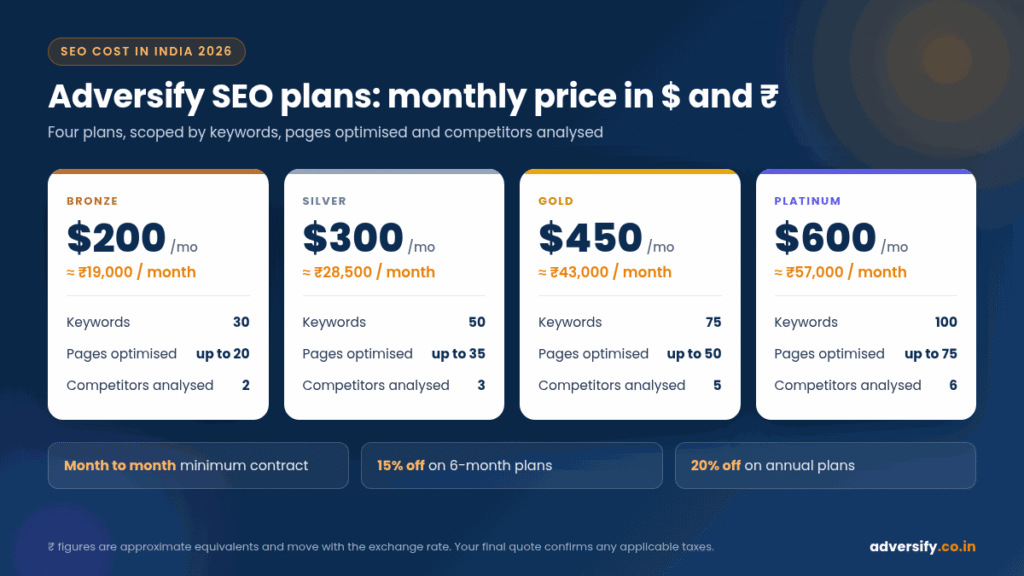
“How much does SEO cost per month?” is usually the first question a business owner asks us, and it is also the one most agencies answer badly. Some quote ₹5,000 a month and promise page one in 30 days. Others send a ₹2 lakh proposal without explaining what the money buys. Neither helps you plan. This guide breaks down what SEO actually costs in India in 2026, what changes the price, where your monthly fee goes, and how to work out a budget that makes sense for your business. We have also put Adversify’s own plan prices on the table, in rupees, so you have at least one fully transparent reference point. Key takeaways There is no fixed SEO rate in India. Commonly quoted retainers run from under ₹10,000 a month (freelancers) to well over ₹1.5 lakh a month (large or enterprise projects). Treat these as typical market ranges, not survey data. Price is driven mainly by competition, the number of keywords and pages in scope, the state of your website, and how much content and link building you need each month. Adversify’s SEO plans start at about ₹19,000 a month (Bronze, 30 keywords) and go up to about ₹57,000 a month (Platinum, 100 keywords). Six-month plans save 15% and annual plans save 20%. Google’s own guidance says no one can guarantee a number one ranking. A cheap package that “guarantees” rankings is a warning sign, not a bargain. Work out your budget backwards from the value of a lead or sale, and plan for at least six months before judging results. Adversify’s four monthly SEO plans in US dollars and approximate rupees. Six-month plans save 15% and annual plans save 20%. The short answer: what SEO costs per month in India in 2026 SEO in India is sold mostly as a monthly retainer. One-off projects exist (an audit, a site migration, a technical clean-up), but ranking work compounds over time, so most businesses pay monthly. The table below shows the ranges you will typically come across when you collect quotes. These figures vary widely between cities, agencies and project sizes, and they are not taken from a formal industry survey. Use them to sense-check a proposal, not as a price list. Who does the work Typical monthly range (INR) What you usually get Best suited to Freelancer or part-time consultant ₹5,000 to ₹20,000 On-page fixes, a few blog posts, basic reports. Depth depends entirely on the individual. Single-location shops, very low-competition niches Small agency ₹15,000 to ₹50,000 Audit, keyword tracking, on-page and technical work, some content and link building, monthly reporting Local businesses, clinics, coaching centres, small B2B firms Mid-size agency ₹50,000 to ₹1,50,000 Larger keyword sets, regular content production, outreach-based links, dedicated account manager Multi-city brands, e-commerce stores, competitive services Large agency or enterprise programme ₹1,50,000 and above Big sites with thousands of URLs, international SEO, digital PR, in-depth analytics National brands, marketplaces, large publishers The ranges overlap a lot. A ₹40,000 retainer at one agency may include four articles and ten quality links; elsewhere the same fee may be mostly reporting. Always look at the scope behind the number. Why SEO prices vary so much When two agencies quote ₹15,000 and ₹60,000 for the “same” job, they are usually pricing different amounts of work. These are the factors that move the number. 1. How competitive your keywords are Ranking a bakery for “eggless cake shop in Sector 18 Noida” is a very different task from ranking a fintech app for “personal loan”. Competitive terms need more content, stronger links and more time, and that means more hours each month. If your competitors have spent years building authority, you are paying to close that gap. 2. Number of keywords and pages in scope Most Indian agencies, including us, price plans partly by the number of keywords tracked and the number of pages optimised. Tracking 30 keywords for a single-service business is a smaller job than tracking 100 keywords across a product catalogue. Ask how many pages will actually be worked on each month, not just how many keywords appear in the report. 3. The current condition of your website A clean WordPress site with fast hosting needs far less technical work than a ten-year-old site with broken redirects, duplicate pages and a mobile layout that falls apart. If your site needs heavy fixes, expect either a higher first few months or a separate one-time technical project. Sometimes the cheapest route to better SEO is a properly maintained website before any ranking work begins. 4. Content requirements Content is often the single biggest cost inside an SEO retainer. A service business may need a handful of strong service pages and two articles a month. An e-commerce store may need category descriptions for hundreds of pages. Well-researched long-form content written by someone who understands your industry costs more than generic 500-word posts, and it is usually worth it. 5. Link building and digital PR Earning links from relevant, trusted Indian websites takes outreach, relationships and content worth linking to. This is slow, manual work. Packages that promise “500 backlinks a month” for a few thousand rupees are almost always using directories, spam comments or private networks, which can do more harm than good. If links are a priority, ask exactly which kinds of sites your links will come from. 6. Geographic scope Local SEO for one location in Hauz Khas costs less than national SEO, which costs less than international SEO. Each extra city or country adds pages, keywords and competitors. 7. Who is doing the work Senior strategists cost more than junior executives. A very low retainer often means a trainee juggling many accounts. Know who is behind the work before you sign. Adversify’s SEO plans and what they cost in rupees Here are our current monthly SEO plans as listed on our SEO services page. Prices are set in US dollars because we work with Indian and overseas clients; the rupee figures are approximate equivalents shown on
Which SEO Best Practices in 2026 Matter Most for Google Rankings?
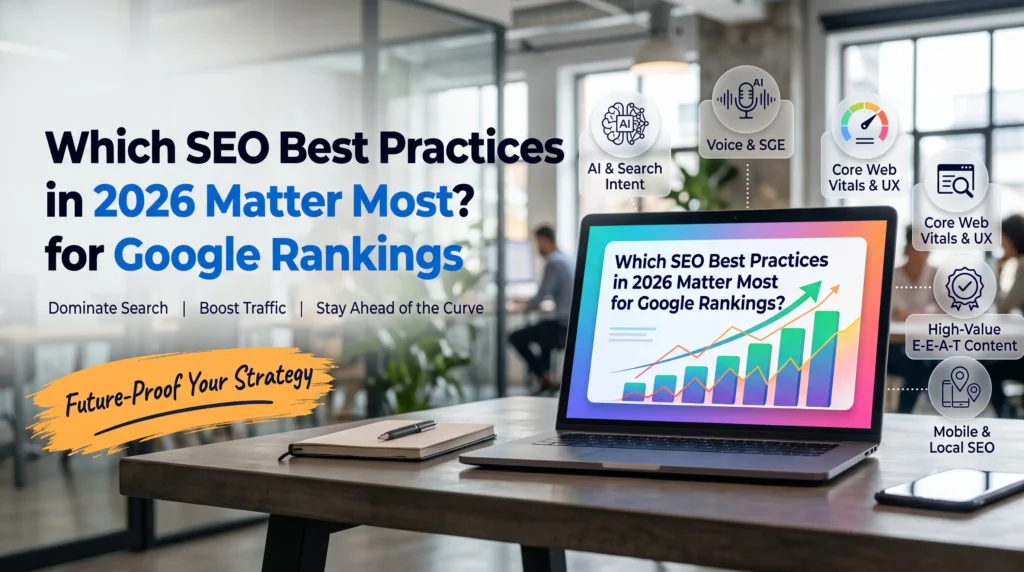
Which SEO Best Practices in 2026 Matter Most for Google Rankings? Posted on October 07, 2026 by Adversify Digital Marketing Which SEO Best Practices in 2026 Matter Most for Google Rankings?. The era of manipulating search engines with repetitive keywords, thin content hubs, and low-grade link networks is over. In 2026, Google evaluates websites through an advanced combination of neural search models, verified brand authority, and direct user satisfaction. Ranking today requires a balanced approach. Search engines reward platforms that run fast, demonstrate real-world credibility, and deliver genuine answers without making users hunt through unnecessary filler. 1. Why Organic Search Outperforms Other Channels in 2026 Organic search remains the highest-ROI acquisition channel for online businesses. While paid digital advertising offers quick bursts of traffic, it functions like a utility bill: the moment you stop spending, your acquisition drops to zero. Sustainable, Compounding Traffic: A well-optimized, authoritative resource continues to pull qualified visitors for months or years without ongoing cost-per-click charges. Implicit Brand Credibility: Searchers naturally trust organic top results more than sponsored ads. Earning position one signals industry leadership, which lifts conversion rates across the entire site. High Purchase Intent: Unlike social feeds where ads interrupt the user’s focus, search engine users are actively hunting for a solution. They arrive ready to evaluate, learn, or buy. Valuable Audience Intelligence: Analyzing organic search queries reveals the exact questions, pain points, and terminology your target market uses, providing a clear blueprint for product development and marketing messaging. 2. Master Matrix: Core SEO Levers for 2026 SEO Pillar Focus Area Why It Influences Google in 2026 Priority Search Intent Matching real-world user needs (Solve, Learn, Buy) Prevents site bounces and signals that queries are fully satisfied Critical E-E-A-T & Provenance Showing first-hand experience, author data, and credentials Separates human expertise from low-value, mass-produced text Critical Core Web Vitals LCP under 2.5s, CLS under 0.1, INP under 200ms Direct ranking factor and baseline metric for user retention High Topical Siloing Linking parent pillar assets to focused sub-pages Proves deep subject authority across entire topic categories High Schema Markup Interconnected JSON-LD (Author, Org, Article, Product) Feeds clear entity data directly to search models and AI summaries High Digital PR & Backlinks Earning tier-one media links through primary data Passes real authority that automated spam filters cannot discount High Content Freshness Updating decaying data, broken links, and old references Keeps high rankings stable and maintains relevance signals Medium-High 3. The 10 Most Critical SEO Best Practices for Modern Rankings 1. Optimize for Multi-Layered Search Intent Google categorizes queries into four main intent types: Informational (learning), Navigational (finding a brand), Commercial (comparing solutions), and Transactional (buying). In 2026, winning content addresses fractal intent—handling the searcher’s immediate question first, then walking them through the natural next steps of their evaluation. Place the core answer directly in the opening 100 words so scanners and search engines find it immediately. Follow the initial answer with actionable steps, comparative data tables, and edge-case solutions. Align the page layout to the intent: informational queries demand clear guides; commercial queries need unbiased pros-and-cons comparisons; transactional queries need clean, friction-free checkout flows. 2. Demonstrate Concrete First-Hand Experience (E-E-A-T) With millions of synthetic pages generated daily, Google actively rewards content containing verifiable human experience. Share proprietary data: Include original split-test results, performance benchmarks, and real client numbers. Use real visual proof: Replace generic stock photography with custom screenshots, interface walkthroughs, or photos of your team actively working with the product. Highlight direct trials: Discuss what went wrong, practical limitations, and unexpected edge cases, rather than giving generic recommendations. 3. Build Unified Topic Clusters and Natural Internal Links Publishing disconnected articles leaves your site with isolated pages that struggle to rank. Instead, organize content into structured topical silos: The Pillar Page: A comprehensive master guide that broadly covers an entire core subject. The Supporting Clusters: Detailed breakout pages targeting specific long-tail questions and narrow sub-problems. Strategic Internal Links: Link the supporting clusters up to the main pillar page and laterally across related topics using clear, descriptive anchor text (e.g., use “audit your internal links” rather than “click here”). 4. Optimize Core Web Vitals: Focus on INP, LCP, and CLS Technical speed is non-negotiable for mobile usability and core indexing: Interaction to Next Paint (INP): Keep UI response latency under 200ms. Remove render-blocking JavaScript and defer non-essential third-party tracking tags. Largest Contentful Paint (LCP): Ensure the primary above-the-fold content renders in under 2.5 seconds. Preload key assets and use next-gen image formats like WebP or AVIF. Cumulative Layout Shift (CLS): Keep score under 0.1. Always set explicit width and height dimensions on images, embeds, and dynamic notification bars to prevent layout shifts. 5. Structure On-Page Metadata for Click-Through Rates Title tags and meta descriptions act as your organic search ad copy: Title Tags: Keep titles between 50 and 60 characters. Place your core topic or primary keyword near the front, and use a compelling differentiator (e.g., a real data point, process framework, or clear outcome). Meta Descriptions: Keep them between 140 and 155 characters. Clearly summarize what the reader will learn or gain, and include an actionable reason to click. Heading Hierarchy: Use a single <h1> for your main page topic, followed by logical <h2> sections and <h3> supporting points to make the document scannable. 6. Implement Interconnected JSON-LD Schema Markup Schema markup translates raw page text into structured data that Google’s Knowledge Graph can parse without guesswork: Mark up authors using Person schema, linking to active LinkedIn profiles and verified portfolios via sameAs. Link business details to verified entity directories (Wikidata, Crunchbase, official social channels) using Organization markup. Apply relevant schemas like Article, Product, FAQPage, or HowTo to earn rich snippets and make your content eligible for inclusion in conversational and AI Overviews. 7. Earn Editorial Links via Primary Data and Digital PR Google’s algorithms easily identify and neutralize link-buying schemes, low-quality guest post directories, and spam networks. Sustainable authority comes from earned media: Publish Proprietary Surveys: Survey industry practitioners, aggregate the findings, and turn
Best Ecommerce SEO Company in India
Best Ecommerce SEO Company in India Posted on September 30, 2026 by Adversify Digital Marketing Best Ecommerce SEO Company in India Paid advertising can jumpstart revenue, but rising Customer Acquisition Costs (CAC) make relying solely on paid media unsustainable. For direct-to-consumer (D2C) brands, multi-brand retailers, and marketplace sellers, organic search provides the compounding, margin-friendly growth needed for long-term profitability. Securing the best ecommerce SEO company in India is not about buying generic backlinks or targeting low-intent blog keywords. It requires an agency with deep technical proficiency in catalog taxonomy, faceted navigation, structured schema data, crawl budget preservation, and conversion-focused architecture. Why Choose an Indian Ecommerce SEO Agency? India has established itself as an international hub for specialized search marketing. Brands worldwide partner with Indian agencies for several key reasons: Platform-Specific Technical Depth: Strong familiarity with Shopify, WooCommerce, Magento (Adobe Commerce), BigCommerce, and custom headless storefronts. Cost Efficiency at Scale: Enterprise-level audits, product taxonomy structuring, and digital PR delivered at competitive retainer rates. Modern Search Engine Readiness: Optimization strategies built for traditional Google SERPs, Google Merchant Listings, and emerging AI search engines like Perplexity, ChatGPT, and Google AI Overviews. Top Ecommerce SEO Companies in India Agency Base / Location Core Specialty Best Suited For Adversify Digital Marketing Noida / Delhi NCR AI-driven search, technical faceted cleanup, and conversion rate optimization (CRO) Fast-scaling D2C brands, emerging stores, and SMBs Techmagnate New Delhi Enterprise-level technical SEO, large catalog architecture, E-E-A-T building High-SKU marketplaces and large corporate retailers PageTraffic New Delhi / Mumbai Structured white-hat link building, multi-region and international SEO Global retail brands selling cross-border Infidigit Mumbai Data-led crawl diagnostics, technical architectural fixes, enterprise analytics Large-scale retail platforms and high-traffic portals EZ Rankings Noida Standardized SEO packages, off-page link acquisition, on-page optimization Small-to-midsize consumer product shops Spotlight: Adversify Digital Marketing For high-growth online retailers and digital-first D2C brands, Adversify Digital Marketing brings an agile, conversion-first approach to e-commerce optimization: Fixing Faceted Navigation & Index Bloat: Product filters (size, color, brand, price) often spawn thousands of duplicate, thin URLs that waste search crawl budgets. Adversify configures strict canonicalization, URL parameters, and robots directives to ensure search bots prioritize revenue-driving collection pages. Commercial Category Architecture: Instead of targeting generic search terms, they build and optimize category and sub-category taxonomies around high-intent transactional search queries. Rich Schema & AI Engine Optimization: They deploy comprehensive JSON-LD schemas (Product, Offer, AggregateRating, InStock) to secure rich snippets—such as pricing, star ratings, and stock status—on Google, while ensuring products are visible across AI-driven discovery platforms. Conversion-Driven Technical Fixes: Rankings mean nothing if visitors bounce. Adversify evaluates site speed, Core Web Vitals, and checkout flows so organic clicks translate into completed purchases. Essential Capabilities to Look for in an Agency When assessing potential partners, focus on competencies that directly impact retail revenue: 1. Catalog Hygiene & Crawl Budget Allocation Large e-commerce websites frequently burn search bot resources on pagination strings, internal search results, and broken URLs. A capable team audits log files, eliminates redirect loops, and keeps priority SKUs indexed. 2. Discontinued & Out-of-Stock Item Protocols Deleting seasonal or sold-out items results in broken 404 links and lost authority. Top agencies implement automated workflows using 301 redirects to parent collections or relevant product alternatives to preserve earned page equity. 3. Bottom-Funnel Keyword Intent High-performing agencies optimize product pages for high-intent queries (e.g., exact model numbers, specifications, and buying triggers) rather than vanity keywords that never convert. Also read: Best Professional SEO Company in India for Startups With Tight Budgets and Which SEO Best Practices in 2026 Matter Most for Google Rankings? Questions to Ask Before Signing an Agreement How do you handle multi-variant and filter URLs on our platform? Ensure their team understands canonical tags and parameter management on your specific CMS. Do your developers implement code changes directly, or only deliver audit PDFs? Implementation speed determines how quickly your store sees results. What metrics do you report monthly? Look for partners that track organic transactions, revenue attribution, and assisted conversions in GA4 rather than just vanity ranking
How to Delete Negative Google Reviews
How to Delete Negative Google Reviews Posted on September 29, 2026 by Adversify Digital Marketing How to Delete Negative Google Reviews: A Complete Guide Negative Google reviews can be a serious concern for businesses. A few bad reviews can influence customer trust, affect your online reputation, and potentially reduce the number of people who choose your products or services. Because of this, many business owners search for how to delete negative Google reviews from their Google Business Profile. However, it is important to understand that businesses cannot simply delete a negative review because they do not like it. Google allows businesses to report reviews, but removal generally happens only when a review violates Google’s content policies. Can You Delete a Negative Google Review? No, a business owner cannot directly delete a customer’s Google review. You can report a review to Google if you believe it violates Google’s policies. Google then evaluates the report and decides whether the review should be removed. A genuine negative review about a real customer experience may remain online, even if the business disagrees with the customer’s opinion. Google specifically advises businesses not to report reviews simply because they are negative or unfavorable. Therefore, the first step in learning how to delete negative Google reviews is determining whether the review actually violates Google’s policies. Which Google Reviews Can Be Removed? Not every negative review qualifies for removal. Reviews may be eligible for removal when they contain prohibited or restricted content. Examples can include: Fake or spam reviews Reviews unrelated to the business Offensive or abusive content Conflicts of interest Personal or confidential information Fake engagement Reviews connected to fraudulent activity Google’s policies focus on the content and circumstances of the review rather than whether the business owner considers it unfair. For example, if a competitor creates a fake review to damage your reputation, reporting the review with the appropriate evidence may be appropriate. How to Report a Negative Google Review If you believe a review violates Google’s policies, you can report it through your Google Business Profile. Follow these steps: Open your Google Business Profile. Go to the reviews section. Find the review you want to report. Select the option to report the review. Choose the reason that best describes the policy violation. Submit your report. Google reviews the submitted report and determines whether the content violates its policies. Review evaluations can take several days. You can also check the status of your report through Google’s Reviews Management Tool. What If Google Does Not Remove the Review? Sometimes a business reports a review but Google decides that there is no policy violation. If this happens, you may have an option to submit a one-time appeal through the Reviews Management Tool. Google allows eligible reviews to be appealed after an initial decision. When appealing, provide clear and factual information. If you believe the reviewer is not a genuine customer or the content violates a specific policy, explain why and provide relevant evidence where appropriate. Avoid submitting multiple reports without additional information. Instead, focus on explaining the actual policy violation. What Should You Do With a Genuine Negative Review? Not every negative review should be removed. If the review represents a genuine customer experience and does not violate Google’s policies, the better approach is to respond professionally. A good response should: Acknowledge the customer’s concern Remain polite and professional Avoid arguments or personal attacks Explain your willingness to resolve the problem Encourage the customer to contact your business privately A professional response can show potential customers that your business takes feedback seriously. Build More Genuine Positive Reviews If legitimate negative reviews cannot be removed, improving your overall review profile can help reduce their impact. Google allows businesses to ask customers for genuine reviews. You can share your review link or QR code with customers and encourage them to provide honest feedback. However, businesses should not offer discounts, free products, money, or other incentives in exchange for reviews or changes to reviews. Google considers incentivized reviews a form of fake engagement. The goal should be to build a consistent collection of authentic customer feedback rather than trying to eliminate every negative comment. Be Careful With Review Removal Services You may find companies or individuals promising guaranteed Google review removal. Be careful with such claims. There is no legitimate shortcut that allows a business to pay Google to remove a genuine review. Google’s removal process is based on its policies and review evaluation system. If someone demands money in exchange for removing negative reviews, especially after suddenly posting multiple negative reviews, it may be a review extortion scam. Google recommends not paying or negotiating with the individuals involved and instead collecting evidence and reporting the incident. How to Protect Your Online Reputation Instead of focusing only on how to delete negative Google reviews, businesses should develop a complete online reputation strategy. Monitor your Google Business Profile regularly, respond to customer feedback, identify genuine service problems, and encourage satisfied customers to leave honest reviews. If you notice suspicious review activity, document everything, including review links, messages, dates, and other relevant evidence. This information can be useful when reporting policy violations or suspected extortion. Also read: How to Add Schema for Better Ranking of SEO and Why SEO Services Are Essential for Business Growth in 2026 Final Thoughts Learning how to delete negative Google reviews starts with understanding that businesses cannot directly remove reviews simply because they are negative. Reviews that violate Google’s policies can be reported and may be removed after Google’s evaluation. For genuine negative feedback, the best strategy is professional communication, excellent customer service, and a steady flow of authentic reviews. A strong online reputation is not about having zero negative reviews—it is about building trust through genuine customer experiences and responding responsibly when problems occur. Want help improving your local search presence? Explore our SEO services or contact the Adversify team.
How to Add Schema for Better Ranking of SEO
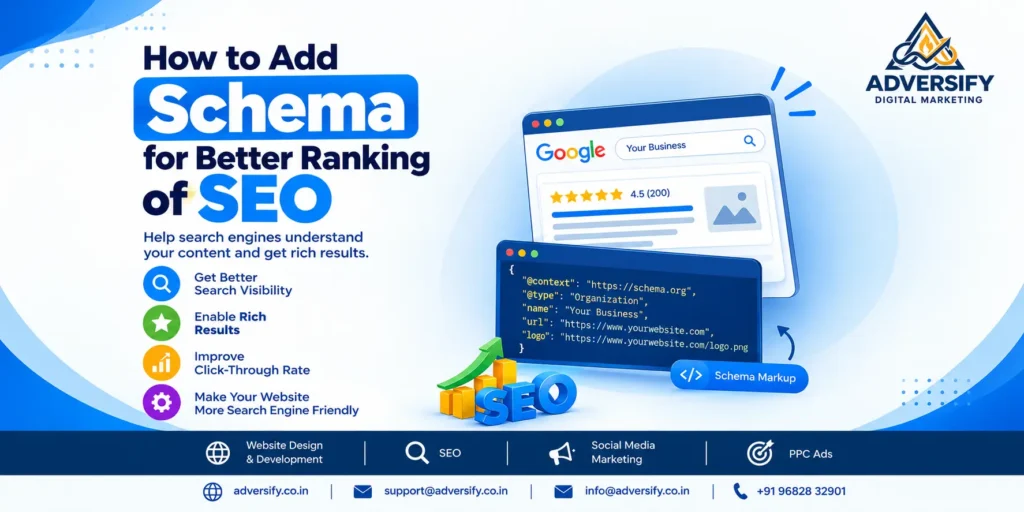
How to Add Schema for Better Ranking of SEO Posted on September 29, 2026 by Adversify Digital Marketing Add Schema How to Add Schema for Better Ranking of SEO Search engine optimization is no longer limited to keywords, backlinks, and technical optimization. Search engines like Google need to understand what your website content is about, and Schema Markup helps provide that additional context. Adding schema to your website can help search engines better understand your pages and may improve how your content appears in search results. If you want to know how to add schema for better ranking of SEO, understanding the right schema type and implementing it correctly is important. What Is Schema Markup? Schema Markup, also known as Structured Data, is a type of code added to a webpage to help search engines understand its content. It provides information about elements such as articles, products, services, organizations, businesses, events, reviews, FAQs, and more. Schema is generally implemented using formats such as JSON-LD. It does not usually change the visible content of your webpage, but it gives search engines additional information about that content. For example, if you have a blog about digital marketing, Article Schema can help search engines understand that the page is an article, along with details such as its headline, author, publication date, and image. Why Is Schema Important for SEO? Schema does not guarantee higher Google rankings by itself. However, correctly implemented structured data can help search engines understand your content and can make your pages eligible for certain enhanced search features. Better understanding can be particularly useful for websites with products, businesses, services, articles, events, recipes, and other clearly structured information. Schema does not guarantee higher Google rankings by itself. However, correctly implemented structured data can help search engines understand your content and can make your pages eligible for certain enhanced search features. Better understanding can be particularly useful for websites with products, businesses, services, articles, events, recipes, and other clearly structured information. Schema can also help search engines identify important entities and relationships on your website. This becomes increasingly valuable as search engines use more advanced systems to understand content rather than simply matching keywords. How to Add Schema for Better Ranking of SEO Adding schema may sound technical, but the basic process is straightforward. 1. Identify the Right Schema Type The first step is choosing schema that accurately represents your webpage. Common examples include: Article Schema – for blog posts and articles Organization Schema – for organizations and companies LocalBusiness Schema – for eligible local businesses Product Schema – for product pages Service Schema – for service-related information where applicable BreadcrumbList Schema – for breadcrumb navigation Event Schema – for eligible events FAQPage Schema – only when the page meets Google’s requirements Do not add schema simply because it is available. The markup should accurately describe the visible content of the page. 2. Create the Schema Markup JSON-LD is one of the most commonly used formats for structured data. A basic Article Schema may contain information such as the article headline, author, image, and publication date. For example, a simplified structure can look like this: { “@context”: “https://schema.org”, “@type”: “Article”, “headline”: “How to Add Schema for Better Ranking of SEO”, “author”: { “@type”: “Person”, “name”: “Author Name” }, “datePublished”: “2026-08-31” } The actual markup should contain accurate information about your webpage. Avoid adding fake reviews, ratings, prices, authors, or other information that users cannot see or verify on the page. 3. Add Schema to Your Website Once the markup is prepared, it can be added to the appropriate webpage, usually within the HTML of the page. If your website runs on WordPress, SEO or schema plugins can simplify the process. Depending on the plugin, you may be able to select a schema type and enter the required information without manually editing code. For larger websites, developers can implement structured data dynamically so that information remains accurate as pages change. 4. Test Your Schema Testing is an important part of schema implementation. A small mistake in the markup can prevent search engines from correctly processing it. You can use Google’s Rich Results Test to check whether your structured data is eligible for supported rich results. You can also use Schema.org’s validator to identify structured-data issues. After making changes, test important templates and individual pages rather than assuming that one successful test means the entire website is correctly implemented. Common Schema Mistakes to Avoid While learning how to add schema for better ranking of SEO, it is equally important to understand what not to do. Avoid using schema that does not match the content of the page. Do not add misleading information simply to make a page eligible for a rich result. Another common mistake is using outdated or incorrect properties. You should also avoid copying the same schema across every page when each page represents different content. For example, an individual product page should contain information relevant to that product rather than generic website information. Most importantly, remember that schema is not a shortcut for poor-quality content. Your website still needs useful, original, relevant, and well-structured content. Does Schema Directly Improve Google Rankings? This is one of the most common questions about structured data. Schema itself is not a direct ranking guarantee. Its primary purpose is to provide structured information that helps search engines understand your content and, when eligible, present it in enhanced search features. Therefore, schema should be considered part of a broader SEO strategy that includes quality content, technical SEO, website performance, internal linking, keyword research, user experience, and authoritative backlinks. Also read: Best Ecommerce SEO Company in India and Which SEO Agency is Best for Small Businesses in India in 2026? Final Thoughts Understanding how to add schema for better ranking of SEO can help you build a more search-engine-friendly website. The key is not simply adding as much schema as possible but using the correct schema type with accurate information that matches the content users can
Types of Backlinks in SEO: A Complete Guide for Better Rankings
Types of Backlinks in SEO Posted on September 27, 2026 by Adversify Digital Marketing Types of Backlinks in SEO: A Complete Guide for Better Rankings Backlinks are one of the most important ranking factors in Search Engine Optimization (SEO). A backlink is a link from one website to another, acting as a vote of trust and authority. Search engines like Google use backlinks to determine the credibility and relevance of a website. However, not all backlinks are created equal. Understanding the different types of backlinks in SEO can help you build a stronger and more effective link-building strategy. Why Professional Website Design Matters Today’s customers expect websites to be fast, mobile-friendly, secure, and easy to navigate. If your website is outdated or slow, visitors are likely to leave within seconds. This can result in lost sales and lower search engine rankings. A professional website designing agency in India understands that a successful website combines attractive design with functionality. Every element—from layout and colors to navigation and page speed—should be optimized to create an excellent user experience. Businesses that invest in high-quality website design often benefit from: Higher search engine rankings Increased customer trust Better conversion rates Improved mobile experience Stronger brand identity Faster website performance What Makes the Best Web Design Company in India? The best website designing company in India doesn’t simply build attractive websites—it creates digital experiences that generate measurable business results. Here are the qualities you should look for before hiring an agency. Website Redesign Can Boost Business Growth If your current website is slow, outdated, or not generating leads, it may be time to work with a professional website redesign company in India. A website redesign isn’t just about changing colors or adding new images. It involves improving user experience, updating content, optimizing page speed, enhancing mobile responsiveness, and implementing modern SEO practices. Common signs your business needs a redesign include: Poor mobile experience Slow loading pages Outdated visual design Low Google rankings High bounce rate Low conversion rates Difficult website management A modern redesign can significantly improve customer engagement while helping your business compete in today’s digital marketplace. Services You Should Expect A leading website designing company in India should provide comprehensive digital solutions under one roof. These typically include: Business Website Design WordPress Website Development Ecommerce Website Development Landing Page Design UI/UX Design Website Responsive Design Website Maintenance Website Speed Optimization SEO Optimization Content Management System (CMS) Integration Website Security Hosting Support Working with a full-service agency ensures consistency across design, development, and digital marketing efforts. Why Businesses Choose Indian Web Design Agencies India has become one of the world’s leading destinations for web design and development services. Companies across the USA, UK, Canada, Australia, and the Middle East regularly partner with Indian agencies because they receive exceptional quality at competitive prices. The best website development agency in India combines experienced designers, skilled developers, SEO specialists, and digital marketing professionals to deliver complete online solutions. Many agencies now use AI-powered tools, modern frameworks, and advanced optimization techniques to build websites that are faster, smarter, and more conversion-focused. How to Choose the Right Website Design Partner Before selecting a website designing agency in India, take time to evaluate their expertise and previous work. Look for: Strong portfolio Verified client reviews Industry experience Responsive support team Transparent pricing SEO knowledge Post-launch maintenance Proven development process Avoid choosing an agency based solely on the lowest price. A professionally built website is a long-term investment that should deliver consistent business value for years. Also read: How to Add Schema for Better Ranking of SEO and Best SEO Companies in India for Small Businesses and Startups Final Thoughts Finding the best web design company in India requires more than comparing prices or browsing portfolios. The right agency understands your business goals and creates a website that attracts visitors, builds trust, and converts them into loyal customers. Whether you need a brand-new business website, a complete redesign, or ongoing maintenance, partnering with an experienced website designing company in India ensures your online presence remains competitive in 2026 and beyond. By combining creative design, responsive development, SEO best practices, and performance optimization, the right agency can help your business achieve long-term digital success and sustainable growth.
Why SEO Services Are Essential for Business Growth in 2026
Why SEO Services Are Essential for Business Growth in 2026 Posted on September 27, 2026 by Adversify Digital Marketing Why SEO Services Are Essential for Business Growth in 2026 In today’s competitive digital landscape, having a website is no longer enough. Millions of businesses are competing for visibility online, making it difficult for potential customers to find your products or services. This is where professional SEO services become essential. Search Engine Optimization (SEO) helps businesses improve their online visibility, attract qualified traffic, and generate long-term growth without relying solely on paid advertising. As search engines continue to evolve and AI-powered search experiences become more common, businesses that invest in SEO gain a significant advantage over competitors who neglect their online presence. What Are SEO Services? SEO services involve optimizing a website to improve its rankings on search engines such as Google. The goal is to help your website appear when potential customers search for products, services, or information related to your business. A comprehensive SEO strategy typically includes: Keyword research and analysis On-page SEO optimization Technical SEO improvements Content creation and optimization Link building Local SEO Performance tracking and reporting When implemented correctly, SEO helps businesses attract visitors who are actively searching for their services, making it one of the most effective digital marketing strategies available today. Key Benefits of Professional SEO Services Consumer behavior has changed dramatically. Most customers begin their buying journey online, whether they are looking for a local service provider, an e-commerce store, or professional consultation. If your website does not appear on the first page of search results, you are likely missing valuable opportunities. Research consistently shows that most users click on results displayed on the first page, while lower-ranking pages receive significantly less traffic. Modern SEO is no longer just about keywords. Search engines now evaluate: Content quality User experience Website speed Mobile responsiveness Expertise and trustworthiness User engagement signals Businesses that focus on these factors are more likely to achieve sustainable rankings and long-term success. Increased Organic Traffic SEO helps drive targeted traffic from users actively searching for your products or services. Unlike paid advertising, organic traffic continues to generate results even after initial optimization efforts. Improved Brand Visibility Appearing consistently in search results increases brand awareness and credibility. Customers are more likely to trust businesses that rank highly on Google. Better User Experience Modern SEO focuses heavily on improving website usability. Faster loading speeds, mobile-friendly design, and clear navigation contribute to a better user experience while supporting higher rankings. Higher Quality Leads SEO attracts users with strong purchase intent. These visitors are already looking for solutions, making them more likely to convert into customers. Long-Term ROI While paid advertising stops generating traffic when the budget ends, SEO continues delivering value over time. A well-optimized website can generate leads and traffic for months or even years. Essential Components of a Successful SEO Strategy Technical SEO Technical SEO ensures that search engines can properly crawl, index, and understand your website. This includes: Website speed optimization XML sitemap implementation Mobile optimization Fixing crawl errors Structured data markup Content Optimization Content remains one of the most important ranking factors. Businesses should focus on creating helpful, informative, and original content that answers user questions and solves real problems. Local SEO For businesses serving specific geographic areas, local SEO is crucial. Optimizing your Google Business Profile, local citations, and location-specific content can help attract nearby customers. Link Building High-quality backlinks from authoritative websites signal trust and credibility to search engines. Ethical link-building strategies remain an important part of successful SEO campaigns. How AI Is Changing SEO Artificial Intelligence is transforming how users search for information. AI-powered search experiences increasingly provide direct answers and recommendations, making content quality more important than ever. Businesses must now focus on: Creating helpful content Answering common customer questions Building topical authority Improving user experience Optimizing for AI-generated search results This shift has led to the growth of concepts such as AEO (Answer Engine Optimization) and AI Visibility Optimization, which complement traditional SEO strategies. Choosing the Right SEO Partner Not all SEO providers deliver the same results. When selecting an SEO agency, look for: Proven experience Transparent reporting Ethical SEO practices Customized strategies Strong communication Focus on measurable outcomes A reliable SEO partner should prioritize sustainable growth rather than promising unrealistic rankings or quick results. Also read: Types of Backlinks in SEO: A Complete Guide for Better Rankings and Best Professional SEO Company in India for Startups With Tight Budgets Final Thoughts SEO continues to be one of the most valuable digital marketing investments businesses can make in 2026. From increasing organic traffic and brand visibility to generating qualified leads and improving user experience, professional SEO services provide long-term benefits that support sustainable business growth. As competition online continues to increase, businesses that invest in strategic SEO today will be better positioned to attract customers, build authority, and achieve lasting success in the digital marketplace. Whether you are a startup, local business, or established company, a well-executed SEO strategy can help you reach your growth goals and strengthen your online presence.