
Patients in Delhi, Noida, Gurugram, Ghaziabad and Faridabad search before they book: “orthopaedic doctor near me”, “paediatric clinic Sector 50 Noida timings”, “dermatologist in Dwarka who accepts walk-ins”. SEO for doctors is about making sure accurate information about you or your clinic appears when people search like this. In healthcare, though, SEO cannot be treated like marketing for a restaurant or a shop. Medical advertising in India is tightly restricted, and the rules were tightened further in October 2026.
This guide explains what doctors and clinics in Delhi NCR can safely do to be found online, what the National Medical Commission (NMC) and Google’s policies say, and a practical checklist for your website, Google Business Profile and content. It is general information, not legal advice. For decisions about your own practice, check with your State Medical Council or a qualified legal adviser.
Key takeaways
- On 6 October 2026 the NMC issued Guidelines on Ethical Advertising and Public Communication for hospitals, medical institutions and Registered Medical Practitioners (RMPs). They treat search-engine, sponsored, social media and AI-generated promotional content as advertising.
- For doctors, these guidelines are read with the Indian Medical Council (Professional Conduct, Etiquette and Ethics) Regulations, 2002, which still restrict self-promotion and soliciting patients.
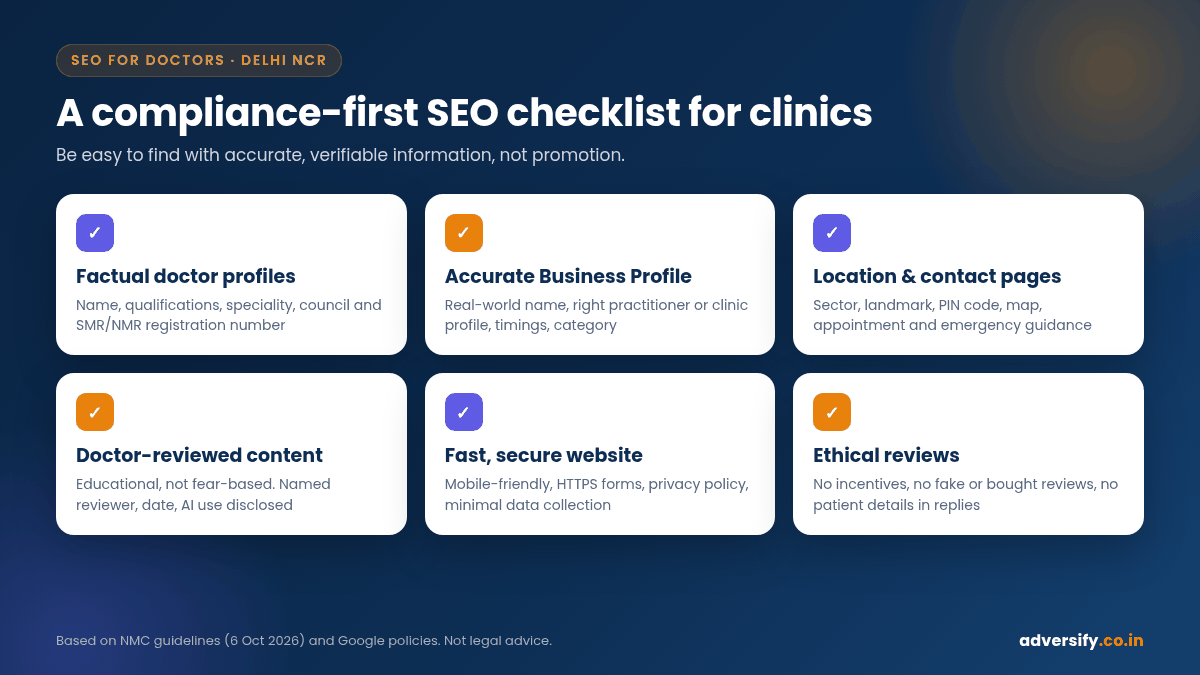
- Safe SEO for doctors focuses on factual, verifiable patient information: who you are, qualifications, registration number, location, timings, services, fees and genuine health education.
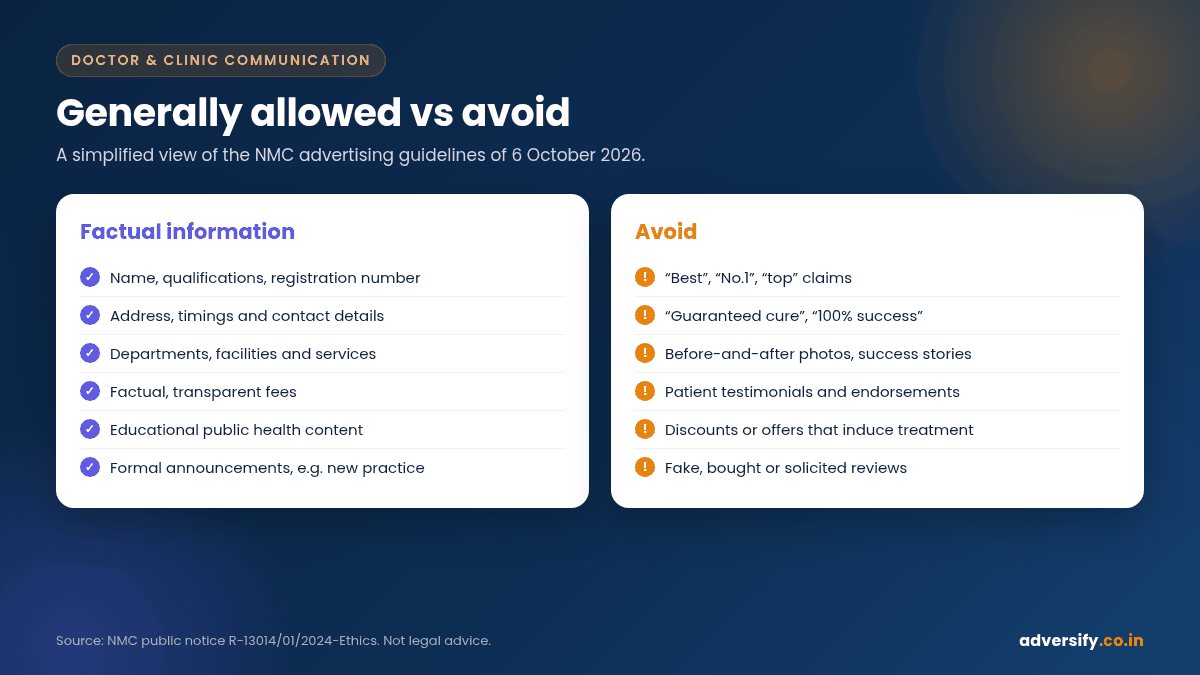
- Avoid “best doctor”, “No.1”, “100% success”, guaranteed outcomes, before-and-after photos, testimonials, discounts that induce treatment, and fake or bought reviews.
- Google Ads restricts healthcare advertising, and health is a sensitive category where advertiser-curated audiences such as remarketing lists cannot be used.
- Google treats health as a “Your Money or Your Life” (YMYL) topic, so trust, accuracy and clear authorship matter even more.
Why SEO for doctors is different
Three things set healthcare apart from almost every other industry we work with:
- Professional ethics rules. Doctors in India are bound by medical ethics regulations that limit advertising and soliciting patients. These rules apply to websites, listings, social media and paid ads.
- Platform policies. Google and other platforms restrict healthcare ads and treat health data as sensitive.
- Higher quality bar in search. Google says its systems give even more weight to content with strong experience, expertise, authoritativeness and trustworthiness (E-E-A-T) for topics that can significantly affect people’s health.
The good news: a clinic website that is factual, transparent and genuinely helpful is both more compliant and better aligned with what search engines reward.
What the NMC rules say about doctor advertising
The rules currently in force
The NMC notified new Registered Medical Practitioner (Professional Conduct) Regulations in August 2023, but held them in abeyance later the same month and adopted the earlier Indian Medical Council (Professional Conduct, Etiquette and Ethics) Regulations, 2002. The 2002 regulations, published on the NMC website as the Code of Medical Ethics Regulations, 2002, say in section 6.1 that soliciting patients directly or indirectly is unethical, and that a physician should not use advertising or publicity that invites attention to their skill, qualifications, achievements or specialities in a self-aggrandising way. They allow formal announcements about starting a practice, changing the type of practice or address, temporary absence, resumption, succeeding to another practice and public declaration of charges.
On 6 October 2026, the NMC’s Ethics and Medical Registration Board issued a public notice with Guidelines on Ethical Advertising and Public Communication by Hospitals/Medical Institutions and Registered Medical Practitioners (No. R-13014/01/2024-Ethics), in force with immediate effect. You can find it in the NMC’s What’s New section. Points that matter most for online visibility:
- Self-promotion, directly or through others, is restricted. Section 8.1(ii) says an RMP shall not solicit patients directly or indirectly, promote their services through self-promotion, engage any third party for marketing medical services, or take part in campaigns that give an impression of commercialisation of medical practice.
- Digital channels count as advertising. The definition covers digital, social media, sponsored, targeted, influencer-led, search-engine, platform-based and AI-generated or AI-assisted promotional communications where the content has a promotional character (section 3.2). Websites and blogs are listed as a medium of advertisement (section 3.5).
- Normal information is not advertising. Information shared in the normal course, without promotional intent or commercial benefit, is exempted, and factual information about equipment, facilities or services is allowed if it avoids superiority claims, guaranteed outcomes and comparisons (section 3.2, Explanations I and II).
- Disclose your registration. RMPs publishing electronic media posts should disclose their name, qualifications, registration status and SMR/NMR registration number. Clinical establishments should disclose the same details for the doctors named in their posts (Explanations III and IV).
- No fake or solicited reviews. No RMP or institution may solicit, buy, manipulate or publish fake, paid or misleading reviews, ratings, testimonials or recommendations, and an RMP should not request or share patient testimonials or reviews for promotion on social media (Explanation V).
- No superiority or success claims. Claims such as “Guaranteed cures”, “Best doctors”, “No.1 Specialist”, “100% success”, “painless treatment” or “Miracle treatment” are prohibited, as are “best”, “top”, “leading” or “most trusted” claims unless objectively verifiable through an independent, transparent method (sections 8.1(iii) and 8.1(ix)).
- No promotional case results. Publishing cases, surgical results, before-and-after photographs, celebrity patients or success stories for promotion is not allowed, except strictly for scientific or educational purposes with anonymised patient consent (section 8.1(v)).
- No inducements. Discounts, limited-period offers, coupons, cashbacks, free procedures or referral benefits that encourage unnecessary consultation or treatment are prohibited. Fees can be disclosed if factual and not misleading (section 8.1(x)).
- Agency payments cannot be per patient. Arrangements with advertising agencies, digital marketing agencies, influencers or platforms must not link payment to the procurement or referral of individual patients (section 8.1(viii)).
- No manipulated engagement or rankings. Procuring fake followers, likes, reviews or engagement, or manipulating search rankings or algorithms to create a misleading impression, is prohibited (section 8.1(xii)).
- AI content needs care. AI-generated promotional campaigns for commercial interest are prohibited, permitted AI-generated content must carry a mark stating that it is AI-generated, and AI must not be used to create synthetic patients, testimonials or outcomes (section 7.2).
- Using a third party is no excuse. Publishing through an agency, platform or influencer does not absolve the doctor or institution of responsibility for content they authorised or permitted (section 4.4).
The guidelines also set out graded action by State Medical Councils for violations, from a warning and ethics training for a first violation up to suspension or removal from the register for serious or repeated violations (section 10.1). Hospitals and medical institutions are dealt with under the applicable Clinical Establishments Act, rules or State Act.
What doctors and clinics can still communicate
The guidelines do not ban an online presence. They explicitly allow hospitals and institutions to share factual, objective, verifiable information such as name, location, contact details, departments, facilities, equipment, services, emergency services, accreditation status and charges (section 8.3). They also say a hospital website with a directory of its doctors, showing names, recognised qualifications, specialities, registration details and availability, serves a patient-information function and is materially distinct from a paid promotional advertisement (section 9.1). Doctors may take part in public health awareness and educational content, provided it does not promote their personal practice or solicit patients (section 5.1).
Note also section 9.2: using an RMP’s photograph is not permitted where it amounts to self-advertisement or promotional publicity. If you plan to use doctor photographs on your website or listings, get specific advice first.
Google’s rules for healthcare: Ads, Business Profile and reviews
Google Ads healthcare policies
Google’s Healthcare and medicines policy says ads and destinations are expected to follow applicable laws and industry standards, that some healthcare content cannot be advertised at all, and that other content needs certification. For India, the policy page states that online pharmacies must be verified by LegitScript and certified with Google, that advertisers cannot promote prescription drugs in ads or landing pages, and that ads for pre-natal gender determination products are not allowed. Speculative and experimental treatments, including most cell and gene therapies outside the specific exceptions Google lists, cannot be promoted.
Health is also one of Google’s sensitive interest categories under its personalised advertising policy. Advertisers promoting in these categories cannot use advertiser-curated audiences such as Customer Match lists, your own data segments (remarketing) or lookalike segments. In practice, a clinic’s search campaign should rely on keywords and location rather than retargeting past patients.
Remember that the NMC guidelines treat sponsored and search-engine promotional communications as advertising, so ad copy must meet both Google’s policies and the NMC rules: no superiority claims, no guarantees, no inducements. If you are considering ads, our Google Ads management team can review what is realistic and compliant for your speciality before you spend anything.
Google Business Profile for doctors and clinics
Google’s guidelines for representing your business include specific rules for individual practitioners such as doctors and dentists:
- A practitioner can have their own profile if they operate in a public-facing role and can be contacted directly at the verified location during stated hours. Support staff should not create profiles.
- A practitioner should not have multiple profiles to cover different specialisations.
- Where several practitioners work at one location, the clinic should have its own profile, separate from each practitioner’s, and a practitioner’s profile name should include only the practitioner’s name.
- A solo practitioner representing a branded organisation should share one profile named in the format “[brand]: [practitioner name]”.
- Your business name should reflect your real-world name as used on your signage, website and stationery; details such as address, category and hours belong in their own fields. Practitioner profiles may include a title or degree such as “Dr.” or “MD”.
- Departments within hospitals may have their own profiles if they operate as distinct public-facing entities.
Fill in accurate categories, address, timings, phone number, appointment link and factual service descriptions. Avoid putting promotional phrases or offers in the description or posts. If a clinic profile is suspended because of naming or address problems, our guide to fixing a suspended Google Business Profile explains the reinstatement process.
Reviews: what is ethical
Reviews are where many clinics get into trouble. Two sets of rules apply at once:
- Google’s Maps content policy prohibits fake engagement, paid reviews and incentives such as discounts or free services in exchange for reviews.
- The NMC guidelines prohibit soliciting, buying or manipulating reviews and say an RMP should not request or share patient testimonials or reviews for promotion on social media.
A cautious approach: do not run review campaigns, do not offer anything for reviews, do not repost reviews as testimonials, and do not ask staff, friends or agencies to write them. Patients will still leave reviews on their own. Respond politely and generally, and never confirm that the reviewer is a patient or mention any clinical details. Patient information must not be used without the consent and safeguards that the law and section 6 of the NMC guidelines require.
YMYL and E-E-A-T: how to build trust in search
Google’s guide to creating helpful, reliable, people-first content explains that for “Your Money or Your Life” topics such as health, its systems give more weight to content showing strong E-E-A-T, and that trust is the most important part. It also encourages clear authorship and warns that fabricated author profiles or false credentials are deceptive. The detailed criteria appear in Google’s Search Quality Rater Guidelines.
For a clinic website, that translates into practical steps:
| Trust signal | How to show it on a clinic website |
|---|---|
| Who is behind the content | Doctor profile pages with full name, recognised qualifications, speciality, registration council and number |
| Medical review | Health articles written or reviewed by a named doctor, with a “reviewed on” date |
| Accuracy | Cite authoritative sources (government health portals, medical bodies), avoid absolute claims, update or remove outdated information |
| Transparency | Clear address, timings, consultation fees if you publish them, emergency guidance and grievance contact |
| Privacy | A privacy policy, secure HTTPS forms, minimal data collection, no patient details on public pages |
A compliance-first SEO plan for clinics in Delhi NCR
Step 1: Audit what is already online
List your website pages, Google Business Profiles (clinic and doctors), directory and health-platform listings, and social media pages. Flag anything with superiority claims, guarantees, before-and-after images, testimonials, offers or missing registration details.
Step 2: Build factual core pages
Create or improve a home page, an About page, individual doctor profile pages, one page per department or service, a location page with map and directions, and a contact and appointment page. Describe services factually: what the consultation or procedure involves, who it is for, preparation, and when to seek emergency care. Avoid promising outcomes.
Step 3: Get local details right
Delhi NCR patients search by area, so use your exact sector, block, landmark and PIN code. Keep name, address and phone identical on your website, Google Business Profile and listings. Our local SEO checklist for Noida businesses covers the basics.
Step 4: Publish genuine health education
Answer the questions patients actually ask: symptoms that need a doctor, how to prepare for a test, what recovery usually involves, how a condition is generally managed. Keep the tone educational, not promotional, and avoid fear-based messaging that could create unnecessary demand for tests or procedures, which section 8.1(i) of the NMC guidelines prohibits.
Step 5: Handle the technical basics
Make sure the site loads quickly, works on small screens, uses HTTPS, has a clean structure with internal links, and uses accurate structured data such as MedicalClinic or Physician that matches what is visible on the page.
Step 6: Protect patient data
Appointment and enquiry forms collect personal and sometimes health information. The NMC guidelines say advertising involving digital personal data must comply with the Information Technology Act, 2000, the Digital Personal Data Protection Act, 2023 and its 2025 rules, to the extent applicable. See the Ministry of Electronics and IT’s data protection framework page and take advice on consent and retention.
Step 7: Measure the right things
Track impressions and clicks in Search Console, calls, direction requests and website clicks from your Business Profile, and appointment enquiries from the website.
How to choose an SEO partner for a medical practice
| Ask this | Good answer | Red flag |
|---|---|---|
| Are you aware of the NMC’s October 2026 advertising guidelines? | Explains how they shape content, listings and ads | “Rules don’t apply to SEO” or no awareness |
| How do you charge? | Fixed monthly or project fee for defined work | Payment per patient, per appointment or per referral |
| How will you get reviews? | No solicitation or incentives; focus on service and profile accuracy | Review packages, staff-written reviews, review gating |
| Who writes health content? | Writers work with your doctors, who review and approve every page | Bulk AI content published without medical review |
| Can you guarantee page-one rankings? | No; explains realistic goals and reporting | Guaranteed rankings or “No.1 doctor” positioning |
Given section 8.1(ii), an individual doctor should be especially careful about what any outside agency is asked to do. Work such as building an accurate website, fixing technical problems, structuring factual doctor and service pages, and correcting listings is very different from a campaign to promote a doctor or attract patients. Agree the scope in writing, keep every page factual, and take advice from your State Medical Council or a lawyer if you are unsure.
Our local SEO services and broader SEO services are delivered on fixed scopes, never priced per patient, and your final quote will confirm any applicable taxes.
Frequently asked questions
Is SEO allowed for doctors in India?
Making accurate, factual information about your practice available online is not prohibited, and the NMC guidelines recognise factual institutional information and patient-information doctor directories. What is restricted is promotional content: soliciting patients, self-promotion (including through third parties engaged to market medical services), superiority claims, testimonials, inducements and manipulated rankings or reviews. Check specific plans with your State Medical Council or legal adviser.
Can I ask my patients for Google reviews?
Be very careful. Google bans incentives and fake reviews, and the NMC guidelines prohibit soliciting reviews and say RMPs should not request or share reviews for promotion on social media. The safest approach is not to run review requests at all and to respond to organic reviews without revealing any patient information.
Can I write “best cardiologist in Delhi” on my website?
No. Section 8.1(iii) of the NMC guidelines names “Best doctors” and “No.1 Specialist” as prohibited examples, and superiority claims such as “best” or “top” are only allowed if objectively verifiable under section 8.1(ix). Describe your qualifications and services factually instead.
Can clinics in Delhi NCR run Google Ads?
Google allows many healthcare services to advertise, subject to its healthcare policies, certification for specific categories and the ban on advertiser-curated audiences for health. The ads must also meet the NMC guidelines, which treat sponsored and search-engine promotion as advertising.
Do these rules apply to dentists and AYUSH practitioners?
The NMC guidelines apply to Registered Medical Practitioners under the NMC Act and to hospitals and medical institutions. Dentists and AYUSH practitioners have their own regulators and codes, so check the rules that apply to your registration.
Want a compliance-first review of your clinic’s online presence?
If you run a clinic or practice in Delhi NCR and want to be found by patients without risking your registration, start with a review of your website, listings and content against Google’s policies and the NMC’s current guidelines. Request a free SEO audit or contact our team. We will tell you honestly what can be improved, what should be removed, and what we would not recommend.