
Every few years search marketing gets a new acronym. Right now it is GEO, short for generative engine optimisation: the work of getting your business mentioned and cited in AI-generated answers from tools such as Google’s AI Overviews and AI Mode, ChatGPT search, Perplexity and Gemini. Some agencies now sell GEO as a replacement for SEO. Others say it is just SEO with a new label.
The truth sits between those two positions, and it matters for how you spend your marketing budget. This article compares GEO vs SEO honestly: where the term came from, what Google and other platforms actually say, what genuinely changes when answers are generated by AI, what stays exactly the same, and how a business in India should adjust its plan without chasing hacks.
Key takeaways
- GEO was formalised in a 2023 research paper (published at KDD 2024) as a way to improve how visible a source is inside AI-generated answers.
- Google says its generative AI features are rooted in its core Search ranking and quality systems, and that from its perspective optimising for generative AI search is still SEO.
- What stays the same: crawlable, indexable pages, helpful original content, clear structure, a good page experience and a trustworthy brand.
- What changes: you’re optimising to be cited inside an answer rather than only to rank in a list, other AI platforms use their own crawlers, and measurement is less straightforward.
- Ignore shortcuts. Google says you don’t need llms.txt files, special markup or “chunked” content for its AI features, and that seeking inauthentic mentions isn’t as helpful as it might seem.
What is GEO?
The term “Generative Engine Optimization” was introduced in a research paper by Pranjal Aggarwal (IIT Delhi) and colleagues from Princeton and elsewhere, first posted in November 2023 and published at the ACM SIGKDD conference in 2024 (arXiv: GEO: Generative Engine Optimization). The authors describe “generative engines” as systems that retrieve sources and use large language models to write an answer with inline citations, and GEO as a framework to help content creators improve their visibility in those answers.
A few findings from that paper are often quoted, so it is worth being precise about them:
- The authors report that methods such as citing sources, adding quotations from relevant sources and adding statistics improved source visibility by up to around 40% in their experiments.
- Keyword stuffing, a classic poor SEO tactic, performed poorly in their tests.
- The benefit varied by subject area, so no single tactic worked everywhere.
- The experiments were run on a benchmark set of queries using a test generative engine and Perplexity, not on Google’s AI Overviews.
In practice, “GEO” is now used much more broadly to mean any work aimed at visibility in AI answers. You will also see AEO (answer engine optimisation), AI SEO and LLM optimisation used for overlapping ideas.
What is SEO, in the same terms?
Search engine optimisation is the work of helping search engines crawl, understand and rank your pages, and helping people choose your result. It includes technical health, content, on-page structure, internal links, earning mentions and links from other sites and, for local businesses, Google Business Profile work. Our SEO services page explains how we approach it.
What Google says about GEO
Google has addressed this directly. In its guide to optimising for generative AI features, Google says the best practices for SEO continue to be relevant because its generative AI features are rooted in its core Search ranking and quality systems. It adds that from Google Search’s perspective, optimising for generative AI search is optimising for the search experience, and thus still SEO (Google Search Central: Optimizing your website for generative AI features).
Google’s AI features documentation makes a similar point: there are no additional requirements to appear in AI Overviews or AI Mode, and to be eligible as a supporting link a page must be indexed and eligible to be shown in Google Search with a snippet (Google Search Central: AI features and your website).
Google also explains two techniques behind these features: retrieval-augmented generation, where its systems retrieve relevant pages from the Search index to ground the answer, and query fan-out, where the model issues several related searches to gather more results. Both start from the same index that classic SEO has always targeted.
That is Google’s view of Google. ChatGPT, Perplexity and other assistants work differently in their details, which is where some genuine differences come in.
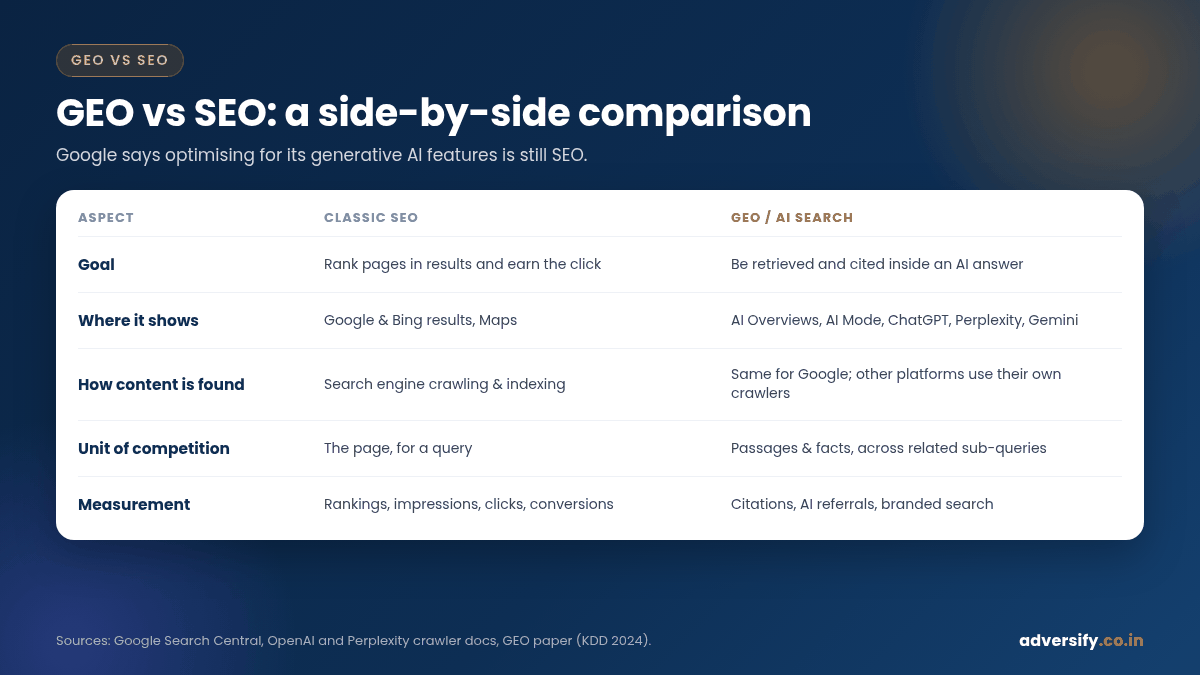
GEO vs SEO: side-by-side comparison
| Aspect | Classic SEO | GEO / AI search visibility |
|---|---|---|
| Goal | Rank pages in a list of results and earn the click | Be retrieved, cited or recommended inside an AI-generated answer |
| Where it shows | Google and Bing results, Maps, image and video results | AI Overviews, AI Mode, ChatGPT search, Perplexity, Gemini, Copilot |
| How content is found | Crawling and indexing by search engine bots | Same for Google; other platforms use their own crawlers and search indexes |
| Unit of competition | The page, for a query | Passages and facts within pages, across many related sub-queries |
| What helps | Helpful content, technical health, relevance, links, page experience | All of that, plus clear answers, verifiable facts and consistent brand information |
| Measurement | Rankings, impressions, clicks, conversions | Citations and mentions, AI referral traffic, branded search, Search Console data for Google features |
| Maturity | Decades of documentation and tools | Fast-changing; fewer reliable tools |
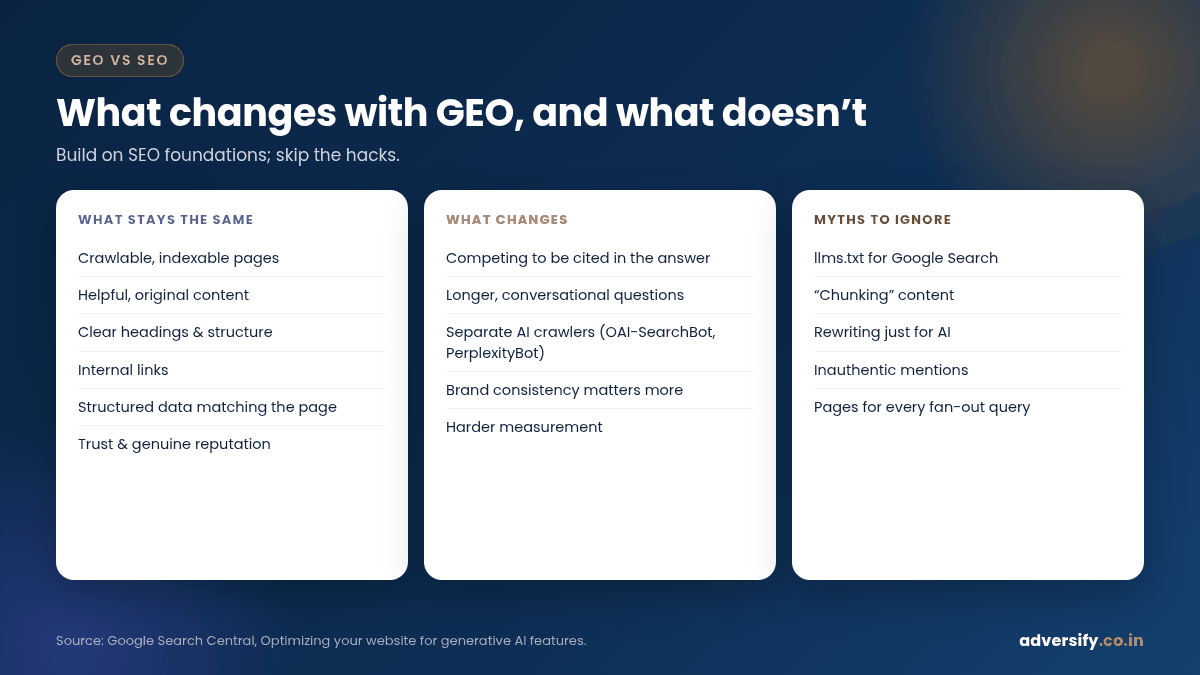
What doesn’t change
1. If you can’t be crawled and indexed, you can’t be cited
Google lists ensuring crawling is allowed in robots.txt and by any CDN or hosting infrastructure as an SEO fundamental that still applies to AI features. In its May 2025 post on succeeding in AI search, Google repeats that pages need to meet the technical requirements, which includes Googlebot not being blocked, pages returning HTTP 200 and having indexable content (Google Search Central Blog: Top ways to ensure your content performs well in Google’s AI experiences).
2. Helpful, original content still wins
Google says that creating unique, non-commodity content will likely influence your presence in generative AI search more than anything else in its guide. It contrasts commodity content, based on common knowledge, with content that offers first-hand experience and a unique point of view. That is the same principle as its long-standing guidance on helpful, reliable, people-first content.
3. Clear structure helps people and machines
Headings, short paragraphs, tables and well-labelled sections make pages easier to read and easier to quote. Google says people appreciate pages organised by paragraphs and sections with headings, while also saying you don’t need to break content into tiny chunks for its AI.
4. Internal links and site architecture
Google lists making content easy to find through internal links as one of the fundamentals that still matter. Our guide to internal linking for WordPress covers how to do this well.
5. Structured data that matches the page
Google says there’s no special schema.org markup needed for its AI features and structured data isn’t required, but that it remains worth using for rich results, as long as it matches the visible content. See our guide on adding schema markup.
6. Trust and reputation
Brands that are well-known, accurately described and positively discussed tend to do better in both classic and AI results. That comes from real customers, real reviews and real coverage, not manufactured signals.
What does change
1. You’re competing to be part of the answer
In classic results, ranking fifth still gets you a visible blue link. In an AI answer, the system may cite only a few sources, and may quote a single sentence from your page. Pages that answer a specific question directly, with clear facts, are easier to use as supporting sources.
2. Queries are longer and more conversational
Google says people use AI Mode for nuanced questions that might previously have taken several searches, and that its systems fan out into related sub-queries. Content that covers a topic thoroughly, including comparisons, costs, steps and common objections, gives those sub-queries something to retrieve.
3. Other AI platforms have their own crawlers and controls
Outside Google, access is controlled separately. OpenAI says OAI-SearchBot is used to surface websites in ChatGPT search, and that sites opted out of it won’t be shown in ChatGPT search answers, while GPTBot is a separate crawler for model training, controlled independently (OpenAI: Overview of OpenAI crawlers). Perplexity documents its own PerplexityBot (Perplexity: Crawlers). For Google, AI features in Search are controlled through Googlebot, while the separate Google-Extended token covers use in some of Google’s other AI systems (Google: common crawlers). Check that your robots.txt and firewall aren’t blocking the crawlers you want.
4. Brand consistency matters more
AI answers often describe businesses in a sentence or two. If your name, services, locations and contact details differ between your website, Google Business Profile, directories and social profiles, the summary can be wrong or vague. Google’s guide also notes that keeping Business Profile and Merchant Center information up to date helps products and services appear in AI responses.
5. Measurement is harder
Google says sites appearing in AI features are included in overall search traffic in Search Console’s Performance report, and its newer guide points to a Generative AI performance report in Search Console. For other platforms, you can track referral traffic in analytics (for example from chatgpt.com or perplexity.ai) and run a fixed set of test prompts each month to see whether and how your brand is mentioned. Results vary between runs, so look at trends rather than single answers.
GEO myths to ignore
Google’s guide lists several things you can ignore for Google Search:
- llms.txt and other special files. Google Search doesn’t use them. Creating one neither helps nor harms your visibility in Google Search, though other services might use it.
- “Chunking” content into tiny pieces. Google says its systems understand multiple topics on a page, and there is no ideal page length.
- Rewriting content just for AI. AI systems understand synonyms and meaning, so you don’t need every keyword variation.
- Inauthentic mentions. Seeding fake forum posts or paid placements isn’t as helpful as it might seem, and spam systems still apply.
- Mass-producing pages for every fan-out query. Google says doing this primarily to manipulate rankings or AI responses violates its scaled content abuse policy.
Google also warns that no third-party tool has access to its internal ranking or AI systems, so be wary of tools that promise AI ranking success.
How to build a combined GEO and SEO plan: step by step
Step 1: Fix access and indexing
Check robots.txt, your CDN or firewall, and the Page indexing report in Search Console. Make sure your key pages are indexed and crawlers you want are allowed.
Step 2: Make your brand facts consistent
Write one clear description of who you are, what you do, where you operate and who you serve. Use it consistently on your About page, service pages, Google Business Profile and directory listings.
Step 3: Answer real customer questions properly
List the questions your sales team hears every week. Answer each one on the most relevant page, directly in the first lines, then add depth: costs or cost factors, steps, comparisons and examples from your own work.
Step 4: Add evidence
Cite sources for facts, use real numbers where you have them, add first-hand detail and show who wrote or reviewed the content. This is good practice for readers and fits what the GEO research found helpful.
Step 5: Strengthen topical depth and internal links
Support each core service page with in-depth guides and connect them with descriptive internal links, so both search engines and AI systems can see the full picture.
Step 6: Earn genuine mentions
Reviews, industry listings, local press, partner pages and expert contributions build the reputation that both classic and AI search reflect.
Step 7: Measure both sides
Track rankings, clicks and conversions as before, and add AI referral traffic, a monthly prompt test and branded search trends. Review quarterly, not daily.
Should you hire a separate GEO agency?
For most businesses, no. Because the foundations overlap so heavily, splitting SEO and GEO between two agencies usually creates duplicated work and conflicting advice. What you need is an SEO team that understands AI search: crawler access, answer-first content, brand consistency and AI-aware measurement. Our AI SEO services are built that way, and our guide to AI SEO services in India lists the questions to ask any provider. If you are in Delhi NCR and specifically comparing providers, our GEO services in Noida page explains what we include.
Frequently asked questions
Is GEO replacing SEO?
No. For Google, AI features rely on the same index and ranking systems, and Google describes optimising for them as SEO. For other platforms, strong SEO foundations are still the starting point. GEO is better seen as an extension of SEO for AI answers.
Is GEO the same as AEO?
They overlap heavily. AEO (answer engine optimisation) is usually used for featured snippets, voice and AI answers; GEO focuses on generative AI answers specifically. Google mentions both terms and treats both as SEO for its own search.
Do I need an llms.txt file?
Not for Google Search, which says it ignores these files. Some other services may read them, so creating one is optional and harmless.
How do I know if ChatGPT or Perplexity mentions my business?
Run a consistent set of prompts each month, such as “best options for [service] in [city]” or “what does [your brand] do”, note whether you are mentioned and which sources are cited, and track referral traffic from those platforms in analytics.
Can anyone guarantee my business will appear in AI Overviews?
No. Google says that even when a page meets all requirements, indexing and serving aren’t guaranteed. Be cautious of anyone who promises placement.
Does GEO work for local businesses?
Yes. Keep your Google Business Profile complete and accurate, make your service and location pages clear, and earn genuine reviews. Google notes that AI responses can include local business information.
Find out how AI search sees your business
If you want to know whether your website is ready for AI answers as well as classic search, start with a clear baseline. Our team in Noida and Hauz Khas, New Delhi will check crawler access, indexing, brand consistency and your most important pages, and run a sample of AI prompts for your category. Request a free SEO audit or book a consultation, and we’ll show you where to focus first.
One Response