
Most car purchases in India now start on a phone. Buyers compare models and variants, check on-road prices, look for “used Creta under 10 lakh in Noida”, read showroom reviews and only then visit. Marketplaces and manufacturer websites take a lot of that attention, but dealers and used-car businesses still have plenty of searches they can win: their own showroom name, “[brand] dealer near me”, service and trade-in queries, and the specific cars sitting in their yard. SEO for car dealers is the work of showing up for those searches with an accurate Google Business Profile, fast inventory pages and genuine reviews.
This guide is for authorised new-car showrooms and used-car businesses in India, with notes for Delhi NCR. It covers Business Profile rules, site structure, vehicle pages, structured data, reviews, used-car dealer compliance, and marketplaces versus your own website.
Key takeaways
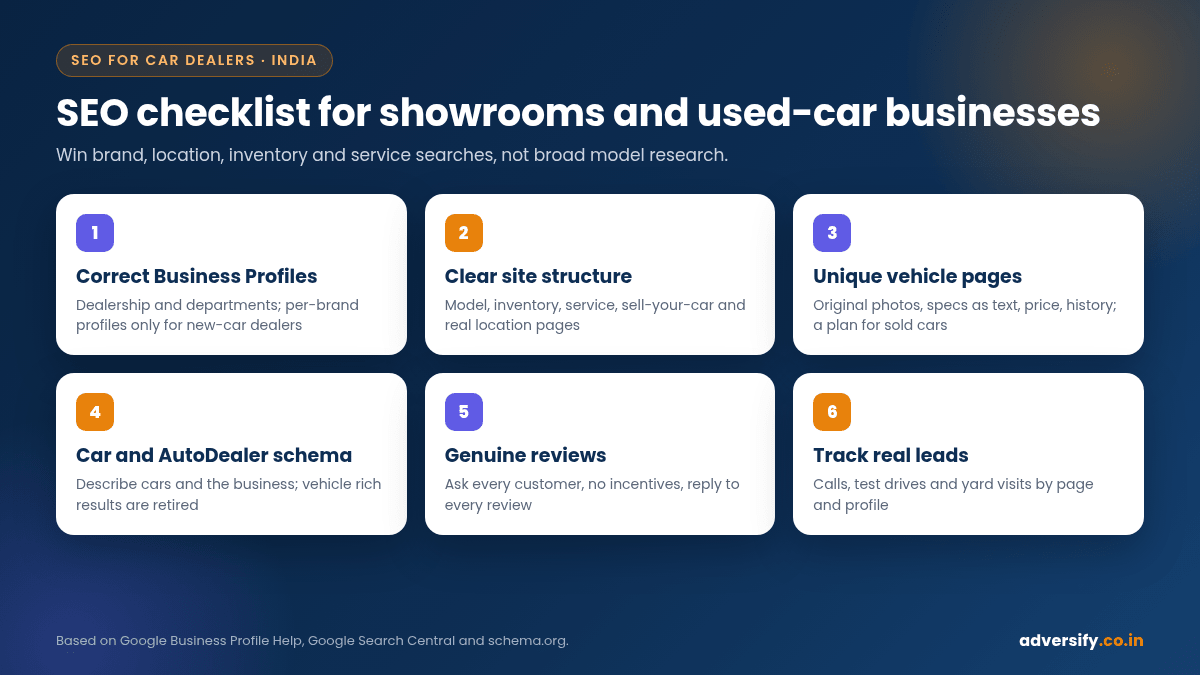
- Google lets every car dealership have a Business Profile for the dealership and its departments; new-car dealerships can also have one per brand sold, but used-car dealerships cannot have profiles per brand.
- Your website’s money pages are vehicle detail pages, model and inventory pages, service pages and location pages. Each needs unique, accurate content, not a copy of the manufacturer brochure.
- Google retired vehicle listing rich results in 2025. Schema.org
Carmarkup is still useful for describing vehicles, but do not expect a special search display from it.- Only ask for genuine reviews, never offer incentives, and reply to every review, including negative ones.
- Since 1 April 2023, dealers of registered (used) vehicles need an authorisation certificate under the Central Motor Vehicles Rules. Showing that you are authorised is also good for trust.
How car buyers search, and which searches a dealer can win
| Search type | Example | Who usually ranks | Realistic for a dealer? |
|---|---|---|---|
| Research on a model | creta vs seltos, nexon ev range | Manufacturers, auto media, marketplaces | Hard; only with genuinely useful local content |
| Brand plus location | tata showroom noida, maruti dealer dwarka | Business Profiles in the map pack, dealer sites | Yes, this is your core local opportunity |
| Used cars by budget and city | used cars under 5 lakh delhi | Marketplaces, large dealers | Possible with a strong inventory section and filters |
| Specific vehicle | 2020 honda city zx petrol used gurgaon | Whoever has a good page for that car | Yes, through well-built vehicle pages |
| Service, parts and trade-in | car service centre sector 63 noida, sell my car ghaziabad | Business Profiles and local pages | Yes, often less competitive than sales terms |
| Your own name | [your showroom name] reviews | You, if your profiles and site are in order | Must win |
Dealers win on local, inventory-specific and service searches, not broad model research. Plan effort accordingly.
New-car showroom vs used-car business: what changes
| Area | Authorised new-car dealer | Used-car / pre-owned business |
|---|---|---|
| Main content | Model, variant, offer and test-drive pages, within manufacturer brand guidelines | Vehicle detail pages for each car in stock, plus budget, make and body-type pages |
| Inventory turnover | Models change yearly; stock pages are fairly stable | Each car may sell within days; pages appear and disappear constantly |
| Google Business Profile | Dealership, departments and one profile per new-car brand sold | Dealership and departments only; no per-brand profiles |
| Trust signals | Manufacturer authorisation, service quality | Inspection reports, ownership history, dealer authorisation certificate, warranty terms |
| Competition | Manufacturer site, other dealers of the same brand | National marketplaces, other local dealers |
Google Business Profile for car dealerships
For local searches, your Business Profile matters as much as your website. Google’s general Business Profile guidelines state that auto dealers have specific and separate guidelines, set out in its help page on signing up for a Business Profile for a car dealership. The key rules:
- Dealership and departments. All car dealerships can have a profile for the dealership itself and more profiles for departments, like sales, parts or service. For a department, use the dealership name with the department name.
- Brands. New-car dealerships can also have a profile for each brand of new cars sold. Used-car dealerships cannot have profiles per brand, because the brands they sell change frequently.
- Categories. Google suggests “Car dealer” for sales, “Car service” for maintenance and “Auto parts business” for parts sales. Choose the most specific category that is accurate.
- Hours. The general guidelines say dealerships should use car sales hours, and if new and pre-owned sales hours differ, use the new sales hours.
- One profile per location. Outside these allowances, do not create more than one profile for the same location, and never create profiles for addresses where you have no staffed premises.
Then keep each profile complete: real photos of the showroom, service bay and stock, accurate phone numbers per department, a website link to the matching page (sales profile to the sales page, service profile to the service page), and regular updates. If a profile ever gets suspended, our guide on what to do when your Google Business Profile is suspended walks through the appeal process.
Reviews: the right way to grow them
Reviews influence both buyers and local visibility, and car buying is a high-trust purchase. Google’s Maps user-contributed content policy is explicit about what is not allowed:
- Offering incentives such as payment, discounts, free goods or services in exchange for a review, or for revising or removing a negative one.
- Reviews that are paid for, posted from multiple accounts by the same person, or posted by people with a conflict of interest such as current or former employees.
- Posting content on a competitor’s profile to damage its reputation.
What is allowed: asking customers to share their genuine experience, without incentives and without trying to influence the rating. A good routine is to send every buyer and service customer the review link after delivery, and to reply to every review. On negative reviews, acknowledge the issue, avoid sharing personal details and take the conversation offline.
One technical note: Google’s local business structured data guide recommends review and aggregateRating properties only for sites that capture reviews about other local businesses. Marking up your own Google reviews on your homepage will not earn star ratings in results.
Website structure for a dealership
| Page type | Target searches | Must include |
|---|---|---|
| Home | Your name, brand plus city | Brands, location, departments, clear contact options |
| New-car model pages (authorised dealers) | [model] price in [city], [model] showroom [area] | Variants, current offers with validity dates, test-drive booking, local delivery details |
| Used-car inventory hub | used cars in [city] | Filters, sorting, fresh stock, inspection and warranty summary |
| Category pages (make, budget, body type, fuel) | used hyundai cars noida, used cars under 5 lakh | A short useful intro and live listings; only index categories that have stock |
| Vehicle detail pages | Specific make, model, year and variant | See the checklist below |
| Service, parts and body shop | car service [area], denting painting [area] | Services, booking, hours, pick-up and drop options |
| Sell or exchange your car | sell my car [city], car exchange offer | How valuation works, documents needed, form |
| Location pages | [brand] dealer [area or city] | Only for real showrooms or workshops, with address, map, photos and staff |
Filters and faceted navigation
Inventory filters can create thousands of URL combinations (make + fuel + colour + budget + sort order). Google’s guide to managing crawling of faceted navigation explains the options. In practice: choose a small set of valuable filter pages (such as make, budget band and body type) with clean, linkable URLs and unique intros; keep other combinations out of the index; and use canonical tags as described in Google’s guide to consolidating duplicate URLs.
Vehicle detail pages: the used-car money pages
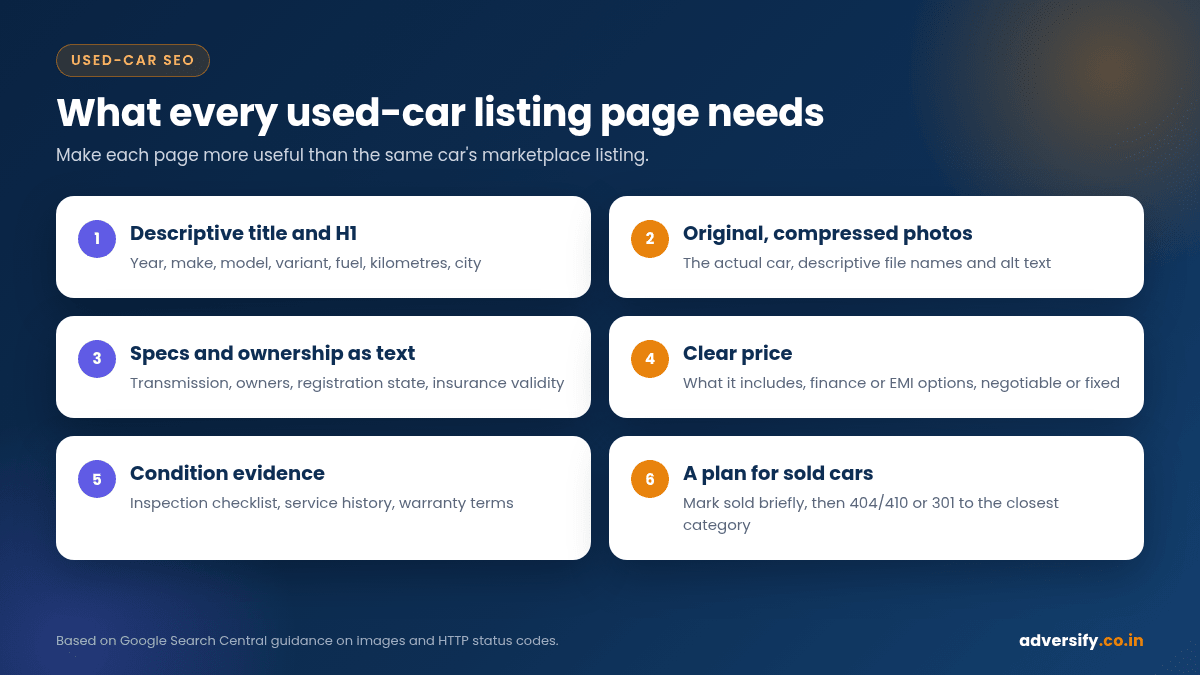
Each car in stock deserves a page that is more useful than its marketplace listing. A strong vehicle detail page includes:
- A descriptive title and H1, for example “2021 Hyundai Creta SX 1.5 Petrol, 32,000 km, Noida”. Year, make, model, variant, fuel, kilometres and city are what buyers type.
- Original photos of the actual car, compressed for mobile, with descriptive file names and alt text. Google’s image SEO best practices apply directly.
- Specifications as text, not only inside images: transmission, fuel, kilometres, number of owners, registration state, insurance validity and colour.
- Price and what it includes, plus finance or EMI options if you offer them. State clearly whether the price is negotiable or fixed.
- Condition evidence: your inspection checklist, service history where available, and warranty terms.
- A short, original description written by your team, mentioning anything a buyer would want to know.
- Clear calls to action: call, WhatsApp, book a test drive and visit the yard, with your location.
Protect privacy: consider masking part of the registration number and never publish the previous owner’s personal details or documents.
What to do when a car is sold
Used-car sites constantly create and remove pages, which can leave Google with thousands of dead or empty URLs. Google’s documentation on HTTP status codes notes that if a page returns 200 but its content looks like an error or an empty page, Search Console reports it as a soft 404. A practical approach:
| Situation | Suggested handling |
|---|---|
| Car just sold, page still gets visits | Mark it clearly as sold for a short period and show similar cars in stock |
| Sold car page with no traffic or links | Remove it and return a 404 or 410 status |
| Sold car page with useful links or traffic | 301 redirect to the closest relevant category (same model or budget), not the homepage |
| Category or filter page with no stock | Keep it with a helpful message if the category is evergreen, or remove it from the index until stock returns |
Also make sure your XML sitemap updates automatically when cars are added or sold.
Structured data for dealers in 2026
Google introduced vehicle listing structured data for car dealerships in 2023, but as part of simplifying the search results page it announced in June 2025 that vehicle listing would be phased out, and its documentation changelog records that the documentation was removed in September 2025 because the feature is no longer shown.
Structured data is still worth adding, for clarity rather than special displays:
- The business: AutoDealer (a type of AutomotiveBusiness) with name, address, phone, opening hours and URL, following Google’s local business guide.
- Each vehicle: schema.org Car with properties such as
brand,model,vehicleModelDate,mileageFromOdometer,fuelType,vehicleTransmission,numberOfPreviousOwnersanditemCondition(for example UsedCondition), plus anoffersblock with price in INR. - Ratings: Google’s product snippet guide notes that
Carisn’t automatically treated as a subtype ofProduct, so you would need both types to attach ratings. Only do this if you have genuine reviews of that item, which is rare for a single used car.
A simplified example for one used car (all values are illustrative):
{
 "@context": "https://schema.org",
 "@type": "Car",
 "name": "2021 Hyundai Creta SX 1.5 Petrol",
 "brand": {"@type": "Brand", "name": "Hyundai"},
 "model": "Creta",
 "vehicleModelDate": "2021",
 "fuelType": "Petrol",
 "vehicleTransmission": "Manual",
 "numberOfPreviousOwners": 1,
 "mileageFromOdometer": {"@type": "QuantitativeValue", "value": 32000, "unitCode": "KMT"},
 "itemCondition": "https://schema.org/UsedCondition",
 "offers": {"@type": "Offer", "price": "650000", "priceCurrency": "INR", "availability": "https://schema.org/InStock"}
}
Generate the markup from your inventory system so it always matches the visible page. Test it with the Schema Markup Validator.
Compliance and trust for used-car dealers
The Ministry of Road Transport and Highways notified G.S.R. 901(E) on 22 December 2022, amending the Central Motor Vehicles Rules for the sale and purchase of registered vehicles through dealers (see the PIB press release). The rules came into force on 1 April 2023. In summary:
- No person may act as a dealer of registered vehicles without a valid authorisation certificate in Form 29B from the registering authority where the business is located; it is valid for five years and must be displayed at the place of business.
- When an owner hands over a vehicle to an authorised dealer, the delivery is intimated to the registering authority electronically in Form 29C.
- Dealers must maintain an electronic trip register for vehicles in their possession, and may not park or store inventory for sale on public roads.
This is a summary, not legal advice; check the current rules with your RTO or legal adviser. From an SEO and conversion point of view, mentioning your authorisation on the website, alongside inspection and documentation processes, answers the trust questions used-car buyers ask before visiting.
Marketplaces vs your own website
| Factor | Marketplaces and classifieds | Your own website |
|---|---|---|
| Reach | Large existing audience | Starts small, grows with SEO and reviews |
| Cost | Listing fees, lead fees or commissions, depending on the platform | Build and maintenance cost; leads carry no per-lead platform fee |
| Competition on the page | Your car sits next to competitors’ cars | Only your stock and your brand |
| Data and remarketing | Limited to what the platform shares | Full analytics, remarketing audiences and CRM data |
| Brand building | Weak | Strong over time |
Most dealers should use both: marketplaces for reach, the website for brand searches, repeat customers, service and lower-cost leads. Write original descriptions for your own site rather than pasting the same text everywhere.
The Delhi NCR angle
- Buyers cross city lines. A buyer in Ghaziabad may buy from a dealer in East Delhi or Noida. Mention the areas you genuinely serve, such as doorstep inspection or delivery, but create location pages only where you have a real showroom or workshop.
- Hyperlocal names matter. People search with sectors, markets and landmarks (Sector 18, Karol Bagh, MG Road). Use them naturally in location pages and your Business Profile description.
- Answer regional questions. Useful content includes how inter-state registration transfer works, documents needed to sell a car, and how vehicle age rules in Delhi NCR affect older diesel and petrol cars, verified against official transport department sources before publishing.
- Use Hindi where customers do. Many NCR buyers search in Hinglish (“second hand car sasta”, “purani gaadi bechni hai”). Reflect those words in FAQs and service descriptions.
Our local SEO services are built around exactly this kind of NCR-wide, location-by-location work.
Paid search alongside SEO
Inventory changes too fast to wait for organic rankings alone. Search campaigns on brand plus location and model plus “used” terms, combined with remarketing to visitors who viewed specific cars, complement SEO well. Use the same landing pages, track which cars and pages generate calls, and feed converting search terms back into your SEO plan. See our Google Ads management service for details.
How to measure SEO for car dealers
| Metric | Where to find it | Why it matters |
|---|---|---|
| Business Profile calls, direction requests and website clicks | Business Profile performance | Shows local visibility turning into actions |
| Impressions and clicks for brand, location and model queries | Google Search Console | Shows which searches you are winning |
| Leads per vehicle page and category | GA4 conversions, call tracking, CRM | Connects pages to enquiries |
| Test drives and yard visits | CRM | The best quality signal before a sale |
| Review count, rating and reply rate | Business Profile | Trust and local visibility |
A practical 90-day plan
- Weeks 1 to 2: audit. Check every Business Profile against Google’s dealer rules, crawl the website for broken, duplicate and empty inventory pages, and review site speed on mobile.
- Weeks 2 to 4: foundations. Fix profile categories, hours and links; set up sold-car handling, sitemaps and filter indexing rules.
- Weeks 4 to 8: money pages. Rebuild the vehicle detail template with the checklist above, add structured data and improve model, service and location pages.
- Weeks 6 to 10: reviews and content. Start a review request routine and publish a few genuinely useful guides for local buyers and sellers.
- Weeks 8 to 12: measure and refine. Use Search Console and CRM data to decide the next quarter’s priorities.
Timelines depend on competition and the site’s history, and nobody can promise page-one rankings within a fixed period.
Common mistakes to avoid
- Copying manufacturer brochure text or marketplace descriptions word for word.
- Leaving sold cars live as empty pages, or redirecting every sold car to the homepage.
- Creating per-brand Business Profiles for a used-car lot, or profiles at addresses without staff.
- Offering discounts or freebies for reviews.
- Indexing thousands of filter combinations with no unique content.
Frequently asked questions
Can a used-car dealer have a Google Business Profile for each car brand it sells?
No. Google’s dealership guidelines allow per-brand profiles only for new-car dealerships. Used-car dealers can have a profile for the dealership and for departments such as service or parts.
Is vehicle schema still worth adding?
Yes, as a way to describe your cars clearly to search engines and other systems, but Google no longer shows vehicle listing rich results, so do not expect a special display from it.
Should I list my cars on marketplaces if I want SEO traffic?
Usually yes for reach. Keep your own website as the home of complete, original listings and your brand, and use marketplaces as an extra channel.
How should I handle pages for cars that are sold?
Briefly mark recently sold cars as sold with similar options, then remove pages with no value (404 or 410) or redirect pages with useful links to the closest relevant category.
How long does SEO take for a car dealership?
Profile and technical fixes can show results within weeks for brand and nearby searches; competitive city-wide terms usually take several months of consistent work. There is no fixed timeline.
Get an SEO review for your showroom or used-car business
If you run a showroom or pre-owned car business in Delhi NCR or elsewhere in India and want more calls, test drives and yard visits from search, start with an honest review of your Business Profiles, inventory pages and site speed. Our SEO services and website design team can help, with transparent monthly reporting and no ranking guarantees. Request a free SEO audit or contact our team.